Tuesday, January 8, 2019

About that "creating" part

As I was getting ready to reshare - I mean curate - my previous post, I happened to glance at the widgets on the leftmost column of this very blog - specifically, the widget that allows you the reader to access the previous posts on this blog.


Uh, I think there's a trend here.

Looks like I have to up the "creating" part in 2019.

Just as a point of reference, for me to equal my 2009 output, I would need to create about two posts a day.

OK, that fails "SMART" goals, since it's not achievable these days. (Although I could potentially get a bonus if I did achieve it.)

But hey, I just increased my 2019 post count by one.

Consuming, curating, and creating (or, I see what @garrytan @krynsky and @empoprises did there)

So there are three posts out there, all with the same theme. Let's start with Garry Tan's post from January 2:

My one professional resolution for the year is to actually write more. The written word is the one way we can leave something behind - it’s a signpost for others, in distilled form.


We'll get to that "distilled" part later, which involves the words edited, reduced, and great.

Tan mentions two things that are keeping him from writing more - vulnerability, and (lack of) novelty. These particular writer's blocks are not universal - some people have no problem stating unpleasant truths, and some people don't worry about saying something that may have already been said. (And yes, I'm pointing at myself, even though I know it's rude to point.) But these possible barriers may need to be addressed by writers, along with others.

Which brings us to Mark Krynsky and his post of January 3, appearing both at krynsky.com and on Medium. Krynsky mentions another possible block.

Perfectionism is something that often stops me cold. I’ll review and edit my posts ad nauseum (I even had to Google this to make sure I used it correctly as WordPress flagged it as wrong. God help me.)

I’ll often do lots of research with links and quote pulls from posts and images and embedded videos…and, and, and. In other words I do lots of things that detract from the words and take me forever to complete a post.


Remember those words distilled, edited, reduced, and great? Obviously you need to perform these activities at some level - Krynsky isn't advocating that we just start typing and hit publish after a text explosion - but the key is to strike a balance. For certain topics, timeliness is also important.

Krynsky touched upon other topics in his post, including one reason why there's a move toward self-publishing in the first place. Hint: many people started "blogging" back when Blogger and Wordpress were new, and Facebook was non-existent.

    (From here - fair use - and I won't throw stones, because it looked better than my site at the time)

One of those people was Jason Koebler. He writes about his first steps in self-publishing, from "Jason's Site" (very 2002, yet also very forward-looking) to Xanga to LiveJournal to MySpace. And then, a few weeks before high school graduation, Koebler received his university email account, which meant one thing - HE COULD SET UP A FACEBOOK PROFILE. (Some of you will recall that Facebook was initially limited to universities.)

But what was the difference between Facebook and all of those other platforms - other than the fact that Facebook solved the monetization issue? The other difference was that it was so EASY to post to Facebook - and, as a consequence, to NOT post to MySpace or LiveJournal or Xanga or your version of "Jason's Site."

But if it's easy to post on Facebook, it's even easier to reshare on Facebook (or on other services - remember FriendFeed?). Resharing even has a newfangled word - curation. And hey, everybody's doing it.

But we all know something that's even easier than resharing/curating. And that, of course, is consuming. Sit back, relax, and let the feed entertain you.

And if you let Facebook's defaults determine how you will be entertained, you'll see things like this.


Now you may see different things, if you're not interested in Amazon and Walmart like I am. That's because Facebook solved the monetization issue by taking money from advertisers and serving up ads to make you click, and non-ad content to make you consume, all based upon algorithms and data mining.

Jason's Site was never like this.

But at least on Jason's Site, you were 100% guaranteed to see Jason's content. On Facebook, the algorithms may bury some of the feeds that interest you. For example, I can't remember when I last saw Mark Krynsky's content in my Facebook feed.


Perhaps that's why Jason Koebler is musing about the GOOD features of Jason's Site, and three people have intentionally written posts about writing more. Garry Tan, Mark Krynsky - and one other person.

(That person needs to update some of his online bios, though - he works for IDEMIA today, not MorphoTrak.)

Thursday, December 13, 2018

Before Blogger is sunsetted, I'd better write this post on Google's customers

I've talked about Google's customers several times in the past, and about Google's need to keep its customers happy.

Google's customers are heavily influenced by the data that Google can provide to them. But lately, there has been less data.

What do Google Search Appliance, Google News & Weather, Reply, Tez, Google Goggles, Save to Google Chrome Extension, Encrypted Search, qpx-express-API, and Google Site Search have in common? All of these were services that Google killed (or will kill) in 2018 alone. The complete list of services that Google has or will kill include several services that I have used, including Google+, Google URL Shortener, Google Now, Picasa, Google Flu Trends, iGoogle, Google Reader, Google SMS, AdSense for Feeds, and Google Buzz. And, of course, a bunch of other services that I haven't used.


By Source (WP:NFCC#4), Fair use, Link

So as the data dries up, Google's customers are looking to places other than Google. And it's not just anecdotal:

In some cases, specific consumer-packaged brands have reportedly shifted half of their search ad budget from Google to Amazon.

Now, to be fair, Lauren Weinstein has noted that Google can't rely on its current customers forever, and is therefore looking for new sources of revenue.

Google knows that as time goes on their traditional advertising revenue model will become decreasingly effective. This is obviously one reason why they’ve been pivoting toward paid service models aimed at businesses and other organizations.

However, with Google's track record of sunsetting services, will corporate customers want to make the investment to switch to some Google service that may not be around a year or two from now?

Friday, December 7, 2018

The gig is up - GrungeBeanie meets FeldGrau Burger

Dave Riley was sitting at his cubicle late one morning, and he was getting hungry.


By Asa Wilson - CubeSpace, CC BY-SA 2.0, Link

Dave was the Chief Enterprise Independent Experiential Innovation Officer at GrungeBeanie. Not to be confused with the clothing style, GrungeBeanie was a Generation BB paradigm-shifting firm using actionable analytics and post-blockchain-based seventh-generation hyper-reality to revolutionize the gig transit market.

Unlike the stodgy Ubers and Lyfts of the world, GrungeBeanie was revolutionizing the transportation ecosystem - or would be doing so, once its beta app was approved by the various app stores.

Well, once the app had actually been coded.

And once the coders had been contracted.

Well, once the first sprint of the overall requirements had been finalized.

But things would be happening Real Soon Now.

Despite having a half billion dollars in venture capital funding, GrungeBeanie only had three full-time employees, although GrungeBeanie's presence would change dramatically once the app was out and people were selected to work with GrungeBeanie.

But all of that paradigm-shifting can work up an appetite, so despite the heavy workload, Dave decided to step outside GrungeBeanie's coworking space and go to the FeldGrau Burger franchise across the street for a quick bite.

Dave stepped into FeldGrau and was immediately greeted by a robot that buzzed up to him.


By Photo by Gnsin - Gnsin, CC BY-SA 3.0, Link

"Are you registered?" the robot asked.

"What?" Dave replied.

The robot immediately went stationary and said, "Please wait for a human."

Seeing no human, Dave wandered around the restaurant and finally found a woman in a uniform sitting at a table. Her badge read "Emily, Independent Experience Consultant."

"Where can I order lunch?" Dave asked.

Emily barely looked at Dave. "What do you want?"

"Just a simple burger," Dave replied.


By Super Rabbit One from UK - MmmmmmmmmUploaded by Fæ, CC BY-SA 2.0, Link

Emily sat there for a moment. "Oh," she said, and then said nothing else.

After a few moments of silence, Dave finally spoke up. "Well?"

Emily looked up. "You don't want a full meal?"

"No, just a burger."

Emily said and did nothing.

Dave was getting impatient. "You do work here, don't you?"

Emily pointed to her Independent Experience Consultant badge. "Duh!"

Dave had finally had it. "Listen, I have a business of my own - I'm the CEIEIO there - and the way that business works is that a customer asks for a product or service, and the business provides it. I have half a mind to contact FeldGrau and let them know that Emily does absolutely nothing!"

Emily did not seem frightened in the least. "I don't work for FeldGrau."

Dave rolled his eyes. "OK, the FRANCHISE, then. I'll contact them, and I can assure you that you won't be an employee of the franchise any more."

Emily started laughing. "I'm not an employee of the franchise. Surely you know that, if you're a CEIEIO. I'm an independent contractor, and my compensation is maximized when people order actual MEALS, not just burgers. I don't have time to bother with burger orderers. Now there's a new contractor who's desperate, and when she shows up later today - if she shows - maybe she'll sell you-"

Emily's watch rang.


By Orangeboxes2 - Own work, CC0, Link

"I have to take this call. It's my parole officer." After a moment, Emily started speaking. "Yes, you got my geolocation right. Yup, I'm gigging at a burger place." After hearing excited comments on the other end of the phone, Emily continued. "No, the owner didn't really care about my embezzlement convictions. We don't interact with the payments anyways. And we don't take cash or plastic, so I couldn't rip off this place if I wanted to. And I don't want to get my third strike."

Dave couldn't help himself. "You're a two-time felon and you're working here? How did they hire you? Didn't they do an employment check?"

Emily walked away from Dave, throwing her "Independent Experience Consultant" badge in the trash as she continued to talk on her watch. "Hey, do you know anyone in computer security who's looking for people?"

Dave watched in silence as the robot followed Emily out the door.

Wednesday, December 5, 2018

The difference between "with" and "for," and why it matters for Uber, Google, and other workers

Precision in written communications is crucial, but sometimes we gloss over the ramifications of the precision.

Case in point - in almost all cases, drivers never work FOR a company such as Uber.


So what's the difference between "with" and "for"? If you work for someone, then you are an employee of the company, and the company is obligated to follow laws regarding employees - minimum wage, health benefits, and the like.

But that magical word "with" makes all the difference:

Uber considers drivers to be independent contractors. Two recent class-action suits challenging this have since been settled, and Uber won both.

But hey, that doesn't affect some of the older tech companies, does it? Google certainly has a whole bunch of employees.

Well...

Google has been increasingly hiring TVCs rather than full-time employees for all types of roles, resulting in a majority TVC workforce. We do essential work, from marketing, to running engineering teams, to feeding you and the rest of the Google staff — all without fair benefits or recognition.

In the quote above, "TVC" stands for "temporary, vendor, and contract" - the second class of people who work for/with Google. Examples:

Google routinely denies TVCs access to information that is relevant to our jobs and our lives. When the tragic shooting occurred at YouTube in April of this year, the company sent real-time security updates to full-time employees only, leaving TVCs defenseless in the line of fire. TVCs were then excluded from a town hall discussion the following day. And when 20,000 full-time and TVC Google employees walked out to demand equal treatment for all workers, TVCs were again excluded from the company-wide discussion held a week later....

Even when we’re doing the same work as full-time employees, these jobs routinely fail to provide living wages and often offer minimal benefits. This affects not only us, but also our families and communities.


So earlier today, the "Google Walkout for Real Change" posted a piece on Medium entitled "Invisible no longer: Google’s shadow workforce speaks up." Their point is that Google workers are Google workers, regardless of employment status, and they should get equal pay and equal access to information.

This is not unique to Google, or to Silicon Valley, or to tech in general. A lot of companies are using contract workers rather than employees. And it's not always a bad deal for the contract workers, either:

For just as there are many who are used by the system, there are just as many who are using it to their advantage. There are a growing number of workers who remain independent because they choose to. For the most in-demand skills, such as data scientists, there can even be bidding wars. Contract workers in these in-demand areas can take their pick of projects, command high rates and then take time off or move on to another project.

"There are six-month CFOs or two-year CEOs who do what they need to do. Then the person goes on and starts new projects," said Chris Dwyer, vice president of research at Ardent Partners, a research and consulting firm.

Ten years ago contractors were often used to fill in for employees on leave. Now it's more likely that companies are hiring temporary workers in very sought-after fields, such as certain "hot" computer-programming languages or data scientists to develop artificial intelligence or machine-learning programs because they have no other choice. "That means for companies to gain access to them, they have to use contractors," said Brian Hoffmeyer, senior vice president at Beeline, a tech company that helps companies manage their contingent workforce.


But knowing that some contractors are doing well is of little comfort to those who are not - especially when they are excluded from the processes at the company "with" which they work.

Monday, November 19, 2018

Unintended consequences - automobile insurance for nonbinary people (and binary people)

This is a prime example of how changes in one system can affect other systems.

Ever since driver's licenses were first created, there was an underlying assumption that the holder of the driver's license was either male or female. Because state driver's licenses are the de facto national ID in the United States (or will be once REAL ID is implemented everywhere), the licenses not only verify your ability to operate a motor vehicle, but are used for a whole slew of other purposes, including determinations of rates for automobile insurance. Since California requires that all drivers have insurance, this is a very big deal.

Enter California's Gender Recognition Act (some other states have similar acts).

The Gender Recognition Act simplifies the process for transgender, nonbinary and intersex Californians to obtain a gender or conforming name change on state-issued identity documents. The Name and Gender Act provides incarcerated individuals the ability to change their gender or name in a California court under existing court processes....

Under the simplified processes created by the new laws, individuals may change their gender markers to nonbinary, in addition to male or female, on state-issued identity documents by petitioning a gender and/or conforming name change through a judicial process or revising their birth records. Starting on Jan. 1, 2019, individuals may change their gender markers on their state driver’s licenses and identification cards.


Now this act has all sorts of ramifications at the state, federal, and international level, but I'm going to concentrate on just one of them - the effect on the automobile insurance industry.

In California, it is legal for automobile insurance companies to base your insurance rate on your sex. So, a male might pay a particular insurance premium based upon relevant data derived from historical records, and a female may pay a different insurance premium based upon other relevant data derived from historical records.

Starting on January 1, the appearance on the nonbinary gender will affect this:

The CDI’s public notice indicates that The Gender Recognition Act which permits California driver license applicants to select “nonbinary” to appear on their driver license instead of “male” or “female” beginning on January 1, 2019, has brought forward the problems with using gender as an optional rating factor since there is no historical experience upon which to establish an actuarially justified nonbinary rate. Given the small population size of nonbinary drivers, it is likely that there will never be sufficiently credible data upon which to base such a rate.

So, what's the proposed solution to this problem? Get rid of insurance rates by sex.

Eliminating gender as a rating factor ensures that nonbinary individuals are treated fairly under Proposition 103’s mandate to avoid unfairly discriminatory rates.

However, this is only in the public hearing stage, with a hearing scheduled for December 3. And it is quite possible that those whose insurance rates will go up because of the change will object to the proposal.

Saturday, November 17, 2018

Bezos is right; every company will fail; why is this news?

So Amazon had an all-hands meeting in Seattle over a week ago, and while my professional interests were concentrated on Amazon's answers to one particular question, there's another answer to a question that has gotten a lot of press.

At an all-hands meeting last Thursday in Seattle, an employee asked Bezos about Amazon's future. Specifically, the questioner wanted to know what lessons Bezos has learned from the recent bankruptcies of Sears and other big retailers.

"Amazon is not too big to fail," Bezos said, in a recording of the meeting that CNBC has heard. "In fact, I predict one day Amazon will fail. Amazon will go bankrupt. If you look at large companies, their lifespans tend to be 30-plus years, not a hundred-plus years."

The key to prolonging that demise, Bezos continued, is for the company to "obsess over customers" and to avoid looking inward, worrying about itself.

"If we start to focus on ourselves, instead of focusing on our customers, that will be the beginning of the end," he said. "We have to try and delay that day for as long as possible."


And now everyone is reporting this like if it's news or something.

It's not.

Sure, it's easy to name companies that have been around for hundreds of years. But most companies haven't.

And in tech, even Bezos' 30 year timeline is somewhat generous. Go back 30 years - incidentally before Amazon, Google, or even Yahoo existed - and look at the Fortune 500. Here are a few of the tech and tech-ish names on that 1988 list.

8 AT&T
25 Eastman Kodak
38 Digital Equipment
61 TRW
62 Motorola
79 Martin Marietta
127 Grumman
208 Polaroid
272 Norton
282 Compaq Computer
318 Tandem Computers
463 Sun Microsystems
483 Atari

I should note that the historical Fortune 500 list is difficult to read because it sometimes uses the companies' current names, rather than the names they were using at the time. (For example, both ExxonMobil and Mobil appear on the list.)

And yes, I intentionally included both AT&T and Motorola on this list. The 1988 AT&T was acquired by a Baby Bell that subsequently renamed itself AT&T, and the 1988 Motorola split in two, with one half going through several subsequent owners.

But these were big companies in 1988. My current employer was around at the time (itself under a different corporate ownership), and it was busily putting systems on Digital Equipment Corporation computers. (A decade later, by the time I joined, we were using more Compaq computers, and we had just bought a company using the Tandem platform.) There were proud workers at Martin Marietta and Grumman, taking on competitors such as Lockheed and Northrop. Come to think of it, the 1988 De La Rue Printrak was taking on North American Morpho Systems, Identix, Digital Biometrics, and other firms. We're all one happy family today, as part of IDEMIA.

(I can't show it to you, but several years ago I created a chart that traced the formation of the company that eventually became MorphoTrust. My chart documented the lawsuit between Identix and Digital Biometrics, and listed an investor's opinions on the merits and demerits of three separate finger and face biometrics companies. All of them became part of MorphoTrust, which de facto merged with MorphoTrak when Oberthur bought Safran Morpho to create IDEMIA. And that, my friends, is why one of my new favorite acronyms is "MVA.")

But enough about the 1988 view of biometrics, or of photography (you only had 36 shots; use them wisely!).

My list of tech companies that are no more may be anecdotal, but the American Enterprise Institute assembled statistical evidence of the transitory nature of companies.

Comparing the Fortune 500 companies in 1955 to the Fortune 500 in 2014, there are only 61 companies that appear in both lists. In other words, only 12.2% of the Fortune 500 companies in 1955 were still on the list 59 years later in 2014, and almost 88% of the companies from 1955 have either gone bankrupt, merged, or still exist but have fallen from the top Fortune 500 companies (ranked by total revenues). Most of the companies on the list in 1955 are unrecognizable, forgotten companies today (e.g. Armstrong Rubber, Cone Mills, Hines Lumber, Pacific Vegetable Oil, and Riegel Textile).

Back in the day, no one could picture a time when Montgomery Ward, Kodak, Polaroid, or Sears would hit financial hard times. And even a few years ago, General Electric was a model corporation.

And those with long memories will realize that there were times when (then-named) Apple Computer's continued existence was in doubt.

So Bezos is right. Someone's going to come along at some point and make Amazon look like a stodgy has-been that hasn't done enough to cut costs.

It's only a matter of time.

Friday, November 16, 2018

This is a test.

IDEMIA Empoprise-BI

When cost-cutting goes awry - no coffee for the NRA

In the United States, the major goal of public companies, most private companies, and even private non-profits is to maximize short-term earnings. And the best way to maximize short-term earnings is to cut costs. The theory is that cutting costs by "capping" expenses and "right-sizing" employee counts may cause temporary pain, but won't hurt the organization in any big way and will lead to a healthier organization in the future.

Well, except when the cost-cutting blows up in your face and scalds you.


By Consumer Reports, CC BY-SA 4.0, Link

Take the National Rifle Association. Ignore the political stance of the organization for the moment, and just look at the NRA as just another non-profit that has encountered a decline in revenue.

(OK, allow me one political aside; the reason that the NRA is getting less revenue is because its supporters are in power. When NRA opponents were in power, the NRA could conduct effective fundraising to get donors to counter the Obama threat. It's harder to scare people into donations when the White House and Congress are friendly to your cause. Similarly, abortion rights groups are presumably seeing an uptick in donations now that pro-lifers are in power.)

So, when you encounter a decline in revenue, you cut costs.

And everyone's talking about the NRA's latest cost cutting move.

The National Rifle Association is doing away with free coffee and water coolers for employees at its Fairfax, Virginia, headquarters — a cost-cutting move that has NRA insiders “freaking out"....

“The whole building was freaking out,” said one former employee who remains in contact with current staffers. Three other sources familiar with the gun group’s operations confirmed the story to The Trace.


So what will happen to the NRA because of this negative publicity? One of two things.

Perhaps this will energize NRA supporters to substantially increase their donations to ensure that the NRA's positions are communicated to politicians and the public, and to ensure that NRA employees don't end up sleeping on the job.

Alternatively, this may de-energize NRA supporters. "If the organization's failing anyway," they might reason, "why should I throw in more money to an organization that might go the way of Sears?"

Now some cost-cutting can be good. If you recall, the Wounded Warrior Project was publicly criticized for lavish over-spending by its former executives. While there was a drop in funding after the exposure, the whole episode was necessary to ensure the long term success of the organization.

But even the biggest anti-gun advocate isn't going to argue that coffee and water are wasteful expenses.

Monday, November 12, 2018

Empoprise-BI 2018 tip for those getting faulty "remove probe" messages on ovens

Because it's Thanksgiving, it's time for the Empoprise-BI business blog to provide its public service, yet again.


By Photo by M. Rehemtulla - https://www.flickr.com/photos/quoimedia/5289972209/in/set-72157625057312514/, CC BY 2.0, Link

This question was posted regarding a Whirlpool Electric Control Board:

The display screen for the oven will not work. It beeps when you touch any function. You can not set a temperature or any of the oven functions. The clock works but the rest of the screen reads enter probe temp or remove probe. We do not have the probe plugged in. ?????

Hey, that sounds like a serious control board problem, and the person who answered the question treated it as such.

Joe, In most cases this issue will be caused by a faulty control board. In some instances it is the harness to the jack causing the problem but will most likely be the control that needs replaced.

But before you replace that faulty control board, consider this similar question that I wrote about in 2016.

Dacor Oven model ECS2275 PRB - probe is flashing and beeping. I was wiping down the oven with a damp (not wet) sponge and PRB started flashing and beeping on the display. How do I turn this off?

The respondent didn't talk about replacing any control boards.

Power the unit off and take and airduster can and blow out the probe port really good and then power the oven back on it should clear.

Blow out the probe port? C'mon, that's silly. How could something like that fix a serious sounding error message?

Well, in some cases (2013), it's not moisture, but...past moisture.

The jacks will tend to corrode and create resistance between terminals after many years causing just the symptoms you are seeing. The correct way to solve the problem would be to replace the probe jack part#8186589 , or you can try and unplug the jack from the harness.

Similar advice was given in 2012:

Our oven had problems right out of the box. The temperature probe messed up the entire cooking selections. Every setting wanted the probe inserted, so we had the repairman fix the probe connection.

And I can go on and on - 2011, earlier in 2011, 2010, and by now you may be wondering how the Empoprise-BI business blog got to be the expert on remove probe messages on ovens.

Well, it wasn't easy. I ran into the same problem myself in 2009.

On Friday morning, something started beeping in the kitchen. Since there are several items in the kitchen with beep capability, it took me a while to isolate the beep. It turned out that our KitchenAid oven was telling us to either enter a temperature, or remove the temperature probe.

Unfortunately, we had not inserted a temperature probe into our oven.

Using my well-honed customer support skills, I proceeded to press every "stop" or "off" button on the oven control panel. This only caused it to beep more. Reluctantly, I realized that I would have to reboot the oven...but since the oven plug was inaccessible, I would have to reboot the house (via the fuse box).

But before I did this, I figured I'd look at the KitchenAid manual to see what help it offered for this situation. It offered none.

As I was waiting for the dishwasher to finish so that I could reboot the house, the problem cleared itself up.


Then I started reading a thread.

We had the repairman out...of course, our oven started working before he made it out. But he said the probe hole can get moisture in it and cause the oven to not work until it evaporates. Which sorta explains why several of us had it start working again. It looks like several people also had it happen Christmas, probably with lots of stuff in the oven for a long time, creating lots of moisture.

In that same thread.

I took my blow dryer and blew air toward the probe for a few minutes then tried the oven again. It turned on but the icon on the front changed to 'push probe in'. I did then re-pushed the start button to 450 and it worked!

So there you have it. Your problem may just be moisture.

See you in 2019 (if Blogger still exists next year).

Wednesday, October 24, 2018

Processed vs. processed

Over two weeks ago, I received the following message (in part):

We're happy to inform you that your [item] has been processed on October 8, 2018. If you selected our standard shipping, your [item] should arrive in a few days. However, delivery via U.S. Mail may take up to 10 days.

So by October 26, after ten days had elapsed and ten business days had elapsed, I contacted the sender of the message and informed them that my item had not arrived.

I received this response:

Our records indicate that we received your request for [item] on 10/08/18. Please note processing of your [item] takes 2-3 weeks. Once your [item] is processed, we ask that you allow an additional 7-10 business days for mailing time.

So apparently my item was processed on October 8, but it will take another two to three weeks for it to be...processed.

I'm confused.

Thursday, October 18, 2018

Who determines the purpose of a company? (Or, can an anonymous Amazon employee define corporate evil?)

I could limit myself to the recent Medium post by an anonymous Amazon employee regarding Amazon's provision of facial recognition software to government agencies (DISCLOSURE: my employer provides competing facial recognition software to government agencies), but I'd rather talk about the general case first before delving into the specifics.

In the United States, a corporation may consist of a single shareholder, a few shareholders, or a bunch of shareholders. Amazon, for example, probably has thousands if not millions of shareholders; the company has 487.74 million shares outstanding. At the same time, a company has some number of employees - Amazon has approximately 566,000.

Who determines what a company (Amazon, or any other company) is supposed to do? The shareholders? The employees? Someone else?

One possible answer to this question is "the government" - not necessarily the specifics of what any company does, but how the company will do it. Take this quote from then-Senator Al Franken at a 2010 event:

[I]t is literally malfeasance for a corporation not to do everything it legally can to maximize its profits...

Later in 2010, Max Kennerly, Esq. published a post on this topic, looking at Franken's statement, other views on the truth of Franken's statement, and a Delaware court case that touched on this. The court case (PDF) was eBay vs. Newmark, and concerned the company Craigslist. Unlike Amazon, Craigslist had a limited number of shareholders: a guy named Craig, a guy named Jim, and a company named eBay. As Kennerly quoted from the case:

Jim and Craig did prove that they personally believe craigslist should not be about the business of stockholder wealth maximization, now or in the future. As an abstract matter, there is nothing inappropriate about an organization seeking to aid local, national, and global communities by providing a website for online classifieds that is largely devoid of monetized elements. Indeed, I personally appreciate and admire Jim’s and Craig’s desire to be of service to communities.

But:

The corporate form in which craigslist operates, however, is not an appropriate vehicle for purely philanthropic ends, at least not when there are other stockholders interested in realizing a return on their investment. Jim and Craig opted to form craigslist, Inc. as a for-profit Delaware corporation and voluntarily accepted millions of dollars from eBay as part of a transaction whereby eBay became a stockholder. Having chosen a for-profit corporate form, the craigslist directors are bound by the fiduciary duties and standards that accompany that form. Those standards include acting to promote the value of the corporation for the benefit of its stockholders.

Well, that's what the court said, in essence saying that the shareholder eBay was entitled to assume that Craigslist was in the business of making a profit. But Kennerly himself added a caveat to what the court said:

Unlike Chancellor Chandler, I don’t think Jim and Craig did anything wrong by trying to protect the frugal, community-centered corporate culture at craigslist. Although it is certainly reasonable to presume that, in general, a shareholder invests in a for-profit Corporation for the purpose of maximizing their returns, it’s not like eBay bought shares of Halliburton and then watched as Halliburton forsake war in favor of soup kitchens and music programs for kids. It’s not Dodge v. Ford.

Instead, eBay knowingly and voluntarily bought a piece of Jim and Craig’s frugal, community-centered company. As such, the fiduciary duty owed by Jim and Craig to eBay has to be viewed in the context of the company itself – a company renowned for its tiny size, community service mindset, and its refusal to adopt typical principles of short-term profit-maximization.


But Kennerly then notes that he isn't the one making the rules; the court is.

But what I think should be the law — and what a couple politically-biased professors claim is the law — isn’t necessarily the law. Under eBay v. Newman, the law is as Franken said: “it is literally malfeasance for a corporation not to do everything it legally can to maximize its profits.” Just ask Jim and Craig; no one disputes it’s their company, but they’re legally prohibited from taking steps to preserve the profit-alongside-community-service mission that’s served them well. Maximize profits, or else.

So, let's return to my initial question: who determines what a company (Amazon, or any other company) is supposed to do? The shareholders? The employees? Someone else? Some people say that the government requires maximization of profits, while others say that shareholders (or maybe just a majority of them) can determine how the company stays in business.


What about the employees? Well, now we're ready to get to the Medium article about Amazon. By way of introduction (DISCLOSURE: my employer provides competing facial recognition software to government agencies), Amazon provides a product called Rekognition that can be used for facial recognition. Washington County, Oregon has purchased the software, and as I write this Orlando, Florida is testing it. For a variety of reasons that I won't get into here, over 450 Amazon employees do not think that Amazon should be selling this software to government customers. An anonymous Amazon employee, writing about this view, says the following:

Amazon talks a lot about values of leadership. If we want to lead, we need to make a choice between people and profits.

On the surface, this strikes me as an extremely naive statement. I don't know how happy the Amazon employee would be if Amazon turned around and said, "OK, we're not going to do business with governments, despite the reduction in revenue. By the way, here's your pay cut." (Incidentally, I'm assuming that the anonymous Amazon employee is NOT one of the Amazon employees who is receiving government food stamps. Not THERE'S a people and profits issue.

But in reality the Amazon employee may not be that naive after all.

While the company's requirements for warehouse workers aren't necessarily all that stringent, a higher skill level is needed for all of those Amazon employees who do the tech stuff to build the platforms. And when Amazon seeks new employees, it has to compete against other tech companies such as Google, Microsoft, Apple, and Craigslist. When the companies are in the driver's seat, this isn't too hard - Amazon can pick the employees it wants, and the employees will swallow whatever job requirements Amazon imposes.

But what if the potential employees are calling the shots? It could get a little tough.

INTERVIEWER: Congratulations, Cindy. Amazon is prepared to offer you a salary of $150,000 a year, a bonus incentive plan, company paid health insurance, $100 in Uber vouchers every month, and pre-paid Amazon Prime. Just sign here...

CINDY: Wait a minute. I have a few questions.

INTERVIEWER: The Amazon Prime is prepaid.

CINDY: Before I sign, I need assurances that Amazon is fully committed to the Me Too movement.

INTERVIEWER: Amazon takes allegations of harassment very seriously, and strives to maintain a workplace that is inclusive for all.

CINDY: OK, what about Black Lives Matter?

INTERVIEWER: They do.

CINDY: But wait. Based upon an MIT study that examined three specific facial recognition algorithms - none of them from Amazon - I have personally concluded that every single facial recognition algorithm is racist and sexist and should not be provided to any government agency that could deprive people of color of their freedom. Does Amazon agree with this, or do I need to offer my technical services to Craigslist?


So who determines what a company is supposed to do?

The government, which (via the court system) seems to argue that companies MUST put profits before people?

The majority of shareholders, who (at least in theory) decide the direction that the company should take in the short-term and the long-term?

The company's management, which often wrests de facto control of the company from the shareholders and does what it wants to do?

The company's employees, who (since they're doing the work) are entitled to have a major say in what the company does, and does not do?

There's one category that we didn't cover - the company's customers. If the customers quit buying Amazon products (or Nike products, or whatever), then it doesn't matter what the government, shareholders, management, and employees think. If people (and government agencies) refuse to buy Amazon products, Amazon may join Sears in bankruptcy court.

Thursday, October 11, 2018

The latest in #iamnottrendy - I joined Tumblr this week.

Those of you on Google+ know that everyone is stressing out over which service they're going to join when Google+ shuts down. (Let's go to Sporeplus! Let's go to WeeWee! Let's go to BigAnimal!)

Well, as of now I haven't done any of these things, even though at least one of these options probably meets my criteria for a Google+ replacement. First, the replacement needs to support multiple types of posts (text, links, pictures, whatever) like Google+ does. Second, the replacement has to have a mobile app.

I have found a replacement that meets both of my criteria, and it's not Pluspora or MeWe or Mastodon or any of the other things that the cool kids are looking at this week. And it offers another benefit: both Mitch Wagner and Steven Perez are on this service.

The name of the service?

Tumblr.

Perhaps you've heard of it. After all, it's been around for over a decade. I just never got around to joining it until this week.

There is, of course, one big drawback to Tumblr - namely, that it's owned by Oath, the company that was once Yahoo! and the company that makes Google appear to be stable and consistent. So we'll see how long Tumblr lasts.

Anyway, my Tumblr name is Empoprises, I'm at https://empoprises.tumblr.com/, and I'm trying to duplicate my Google+ categories as Tumblr hashtags (yes, I've already used #guvmint). Not implying that I know what I'm doing in Tumblr, but I'm slowly figuring it out.

Maybe.

Monday, October 8, 2018

Google Plus to Shut Down. Both Remaining Users Pissed.

To understand this post, you need to know a bit of history.

Remember FriendFeed? A very stable service that was bought by Facebook in 2009 - not for the service, but for the people and the technology?

Well, by 2010 FriendFeed had an unusual bit of instablity, which prompted a TechCrunch article by MG Siegler entitled "FriendFeed Goes Down Hard. Both Remaining Users Pissed." This elicited a reaction from the FrindFeed faithful (see my blog post at the time), but people still thought of FriendFeed as a "ghost town."


And by 2015, FriendFeed was pining for the fjords.

Which brings us to Monday, October 8, 2018, the day that the Wall Street Journal ran an article,

That's behind a paywall.

But TechCrunch (again) stepped in to report what was going on.

Google is about to have its Cambridge Analytica moment. A security bug allowed third-party developers to access Google+ user profile data since 2015 until Google discovered and patched it in March, but decided not to inform the world. When a user gave permission to an app to access their public profile data, the bug also let those developers pull their and their friends’ non-public profile fields. Indeed, 496,951 users’ full names, email addresses, birth dates, gender, profile photos, places lived, occupation and relationship status were potentially exposed, though Google says it has no evidence the data was misused by the 438 apps that could have had access.

Because the word "ghost town"...


...has attached itself to Google+, the news later in the article was not surprising. It seems that this security issue was the final straw.

Google+ will cease all its consumer services while winding down over the next 10 months with an opportunity for users to export their data while Google refocuses on making G+ an enterprise product.

Google confirmed this in a blog post about Project Strobe, which apparently has to do with blinding people so they can't see Google advertisements. Or sumfin.

The [security] review did highlight the significant challenges in creating and maintaining a successful Google+ that meets consumers’ expectations. Given these challenges and the very low usage of the consumer version of Google+, we decided to sunset the consumer version of Google+.

To give people a full opportunity to transition, we will implement this wind-down over a 10-month period, slated for completion by the end of next August. Over the coming months, we will provide consumers with additional information, including ways they can download and migrate their data.

At the same time, we have many enterprise customers who are finding great value in using Google+ within their companies. Our review showed that Google+ is better suited as an enterprise product where co-workers can engage in internal discussions on a secure corporate social network. Enterprise customers can set common access rules, and use central controls, for their entire organization. We’ve decided to focus on our enterprise efforts and will be launching new features purpose-built for businesses. We will share more information in the coming days.


If this sounds familiar, it's because Google has shut down a lot of services over the years. While many are talking about Google Reader, Google Wave, and Orkut, there have been others - iGoogle, Google Talk, Google Health, Google Buzz, Jaiku, Google Answers, and many more. Personally, the one that hit me was the cessation of Neven Vision's police offerings after Google acquire it.

And so I'm writing about all of this...on Blogger. Perhaps I should repurpose it as a tymshft post.

Saturday, July 7, 2018

When The Onion is beaten by reality - the REAL imitation of Yellowstone National Park

Several years ago, well-known satirical website The Onion ran an article entitled Yellowstone National Park Concerned About Competing 'Yello-Stone Natural Park' Built Right Across Street. The article described the opening of a competing, similarly named park right next to the well-known national park. Well, perhaps not so well-known, according to one park visitor quoted in The Onion's piece:

"At least it was great to finally see Old Reliable in person," Danaher added. "I had no idea that it spouted every hour on the hour and erupted in sync with classic rock hits each night at 7:30."

Of course, The Onion (unlike some of its detractors) often writes pieces that make you think. And while that probably wasn't the intent of this article - it was written during Barack Obama's first term, back when Ryan Zinke was an obscure Montana state senator. But it did get me thinking about something.

Basically, the Onion's story about an imitator to Yellowstone National Park happened for real.

And it happened decades before the 2011 Onion article.

Let's go back to the summer of 1968. While some people were protesting the Vietnam War, Doug Haag was driving around Wisconsin.

As he whizzed past numerous cars packed with families and pulling pop-ups and trailers, the concept struck him. All these campers needed a place to stay and might want something better than a campground along a busy highway. What if there was a “destination” campground, where families could spend their vacations swimming, playing, and enjoying nature?

Having bought the land for his destination campground, Haag had to name it.

From his advertising experience Haag knew, “In order to draw campers, we needed a clever and recognized name for our campground. My partner and I and our families had many discussions about names. Paul Bunyan, Lewis & Clark, Hiawatha, Pocahontas, Robin Hood, sports stars, and historical figures. We went through them all, but nothing seemed to fit.”

But then one day Haag happened to hear his kids listening to a cartoon on a TV set, and he had his name. He went to the producers of that particular TV show, Screen Gems, and got the license that he needed. Now there are Jellystone Parks everywhere.


The TV show that inspired Haag, of course, was the Yogi Bear show. It was the story of two bears with a love for pic-a-nic baskets, but who had to beware of the watchful eye of the Ranger. The bears and Ranger were at a park called Jellystone Park, a name that was obviously similar to that of Yellowstone Park. That wasn't the only thing that the cartoon borrowed - the star bear's name was remarkably similar to that of a then-famous baseball player, and the bear's mannerisms were remarkably similar to the Honeymooners' Ed Norton. (Another Hanna-Barbera cartoon, The Flintstones, had characters similar to Ed Norton AND Ralph Kramden.)


Yogi Bear originally appeared in 1958, as a secondary character to Huckleberry Hound. But even before Yogi Bear got his own TV series in 1961, he had attracted the attention of the real Yellowstone National Park - in a good way:

Yellowstone Superintendent Garrison first wrote to Yogi Bear in December of 1960. In his letter to Yogi, Garrison complemented the bear on his success, and invited him to think of Yellowstone as a second home considering its similarities to Jellystone. Superintendent Garrison also wrote to Yogi about some of the troubling behavior of the bears in the park at that time. He extended to both Yogi and Boo-Boo a permanent pass to the park as well as a certificate thanking them for their efforts to educate the public about bears. This letter began a relationship between Yellowstone and Superintendent Garrison and Hanna-Barbera and Yogi Bear....

Hanna-Barbera agreed to produce bear education pamphlets and signs for park non-commercial use. The park set about writing and creating handouts to give to park visitors detailing bear safety measures. The pamphlets reminded people to not leave food in their cars, keep their windows rolled up, and properly store their food when camping. Hanna-Barbera and [Kellogg's] agreed to produce standing signs as well. These cut-outs of Yogi Bear were placed at the entrances to the park. Visitors in the sixties were greeted by Yogi Bear himself, holding signs reminding visitors to be safe in the park.


But sometimes the fictional Yogi Bear, like the fictional Onion, would confuse people:

The public’s love of Yogi Bear led to great public involvement when the park began to alter its bear management policies. When the Park began installing bear safe trash cans and dumpsters in the park, many people were concerned that the bears would starve. “What will Yogi eat?” was a common theme in these arguments.

Tuesday, July 3, 2018

The song of business

OK, I goofed.

I just wrote a wonderful piece for the Empoprise-BI business blog...and accidentally posted it to the Empoprise-MU music blog instead.

I'll just leave it right there.

Which means I need to say something musical, so I will. Instagram's new feature that lets you share Spotify tracks on Instagram stories is addicting.

Monday, April 23, 2018

Those who can, do. Those who can't...there's always motivational speaking

My company's annual Users Conference is next month, and we always feature several keynote speakers at our conference. Over the years we have featured people who have done extraordinary things, and people who have found themselves in extraordinary situations.

But over the weekend I encountered a motivational speaker who has never crossed our radar. Perhaps you've heard of him.

You know you’re capable of more if only you could…

Tell your story in such a powerful way you touch people’s hearts and move them to action
Stand in front of a group of dozens…hundreds…or even thousands with confidence
Create financial freedom for yourself and your family by sharing your message
Sounds fantastic…But it’s scary, isn’t it?

You risk rejection and the pain of being told “no.”

So you’re torn between taking a chance and going for it or playing safe and small while your heart aches with disappointment that you’re not going after your dream.

And you’re just a little jealous when you see someone else make it and you know you have a bigger message and could make an even bigger impact.

If only…


Yes, this speaker has taken a risk and faced rejection. His story continues.

Hi, this is William Hung. That’s right, the person who’s failed audition on American Idol has been viewed more than 5 million times on YouTube.

But what looked like a humiliating failure, actually turned out to be my greatest opportunity.

I was in the media. I got a recording contract. I had a part in a movie and on the popular show, Arrested Development.

That all happened ONLY because I took a chance and failed.


Here's his speaker demo reel.


I was unable to find his speaker's fee, but it's safe to say that he doesn't command Richard Branson rates.

Tuesday, March 27, 2018

Update - ISC West takes action on booth babes

Last year, I posted some observations about the clothing (or lack thereof) at one of the booths at the ISC West trade show in Las Vegas, Nevada.

For some people, the use of scantily clad people in that one booth detracted from the professionalism that one would expect at a business show.

For other people, the criticism was ridiculous - "You guys clucking at this should take your skirts off" was one reaction.

Well, I learned a couple of new things this week.

First, the attire of the one company's "staff" at the 2017 show was against show regulations. 2016 guidelines prohibited "[a]ttire of an overly revealing, suggestive nature" such as "[t]ops displaying excessive cleavage."

Second, the people running ISC West have stated that they WILL enforce the 2016 prohibition in 2018. This was communicated to the Institute for Professional Video Management, along with the comment "It’s very important to us that our attendees feel comfortable during their experience at the show."

While this doesn't take care of the entire issue - it's best if booths are staffed by people that know the products - it at least takes care of the most offensive part of the 2017 display.

Incidentally, this change is not restricted to the computer technology world. Booth babes are also disappearing from the Geneva Motor Show, and #MeToo is cited as a possible reason.

However, it appears that there are still booth babes at the SHOT show.

Sunday, March 18, 2018

(empo-utoobd) My long-term Plan C to reverse the @YouTube TOU #4 Section H permanent disabling of my account

For the background of this, see the posts from 2009, 2009, 2013, early today, and a little later today.

Briefly: one day in 2009 I discovered that my YouTube account had been permanently disabled. I was told at the time that the account "has been found to have violated our Community Guidelines" and that "[w]e are unable to provide specific detail regarding your account suspension or your video's removal." (In essence, you read our Community Guidelines and figure out what rule you broke.)

Four years later I learned additional information: namely, that I allegedly violated TOU #4 Section H. From what I could make out, it sounds like I had constructed automated scripts or something.

As I stated in 2013 (and again less than 24 hours ago) the only problem is that to my knowledge I never did violate TOU #4 Section H. I don't even know how to construct automated scripts or whatever it was that I allegedly did.

Basically, I hadn't addressed this with Google since 2013. But I figured that after five years, it was time to launch a second appeal of the permanent disabling of my account.


Impressively, Google moved quickly to review the entire situation, including the circumstances surrounding my permanent disabling nearly a decade ago. This is remarkable, since Google had to review a ton of information, including information that I don't even have about my alleged violation.

So, less than six hours after I launched my appeal, I heard back from Google.

Hello,

Thank you for your account suspension appeal. We have decided to keep your account suspended based on our Community Guidelines and Terms of Service. Please visit http://www.youtube.com/t/community_guidelines for more information.

Please do not respond to this email. Replies to this email will not be processed. Please refer to our Help Center for more information.

Sincerely,
The YouTube Team


Oddly enough, I actually received LESS information in 2018 than I did in 2013. At least in 2013 I was told what part of the terms I had alleged violated. This time around, I was merely told that Google had "decided to keep your account suspended based on our Community Guidelines and Terms of Service."

I still don't know what I allegedly did.

And it's not worth Google's time to even discuss the specifics to me. After all, there were over 500 million YouTube channels in 2012. Why spend time worrying about one relatively unknown person who is unhappy? I guess I should feel thankful that Google even spent six hours reviewing the case.

I have to say I'm not especially shocked that my appeal was dismissed. In fact, even before my appeal was rejected, I began wondering what I should do if it WAS rejected.

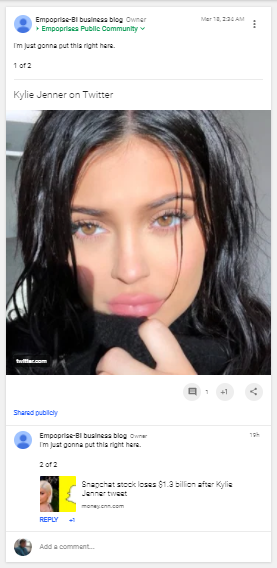
Hence, this thread, which consisted of links to two items.


The first was a tweet from a woman named Kylie Jenner. If you haven't heard of Kylie Jenner, let's just note that she has a sister named Kim Kardashian. And she has two mommies, but that's a whole other story.

So what did Kylie Jenner tweet on February 21?

sooo does anyone else not open Snapchat anymore? Or is it just me... ugh this is so sad.

Now if I were going to tweet something like this (which I wouldn't; I don't use Snapchat), I'm not sure that it would cause much of a ripple. But that tweet from Ms. Jenner has resulted in over 75,000 retweets, and over 370,000 likes.

And what else? Well, that brings me to my second link.

Snap (SNAP) stock closed down 6% on Thursday after the reality TV star said she is no longer using the app. The plunge wiped about $1.3 billion off the company's market value.

While Jenner's effect on Snapchat's stock price was subsequently questioned, you can bet that Snapchat internally paid very close attention to Ms. Jenner's issues. And I'm sure that someone discussed it with Evan Spiegel.

I don't think that Sundar Pichai spent any appreciable time examining the ramifications of the suspension of my YouTube account.

And if I decide to launch yet another appeal of my suspension in 2023, I don't think that Pichai or his successor will spend a lot of time on it either.

Or will he?

Because, you see, if I begin to execute a long-term plan now, I can GUARANTEE that my YouTube permanent disabling will FINALLY be reversed.

I'll admit that my idea is not original with me. I stole it from Steve Martin.

You.. can be a millionaire.. and never pay taxes! You can be a millionaire.. and never pay taxes! You say.. "Steve.. how can I be a millionaire.. and never pay taxes?" First.. get a million dollars. Now.. you say, "Steve.. what do I say to the tax man when he comes to my door and says, 'You.. have never paid taxes'?" Two simple words. Two simple words in the English language: "I forgot!"

Martin's technique works...just as long as you get past the "get a million dollars" part.

My long-term plan to reverse the permanent disabling of my YouTube account also has two steps.

The first step?

Become more famous than the Kardashian/Jenner family and the Trump family COMBINED.

Once I achieve that first step, and get to that rarefied plane where people hang on my every word, and a single word from me can make or break empires...well, at that stage, the rest is easy.


Because, you see, when I reach that level of fame, and I decide that I want to talk at the World Trade Center (not too far away from Wall Street) at 9:15 on a weekday morning (right before the U.S. stock markets open), and I would like Oprah Winfrey, Kim Kardashian, and Donald Trump to ask me questions...they WILL come. (And Putin will be so sad that I didn't invite him...but he won't be able to do anything about it.)

CC BY-SA 3.0, Link

And Donald Trump will be groveling before me, telling me that I'm the greatest genius of all time.

I'll just smile.

And because the world wants to know everything about me, Oprah Winfrey will ask me what TV shows I watch.

I'll respond, "Well, to tell you the truth, I don't watch much TV."

(At that time, future stock prices on the companies owning the major television networks will plummet.)

I'll quietly continue. "Since I live in the West Coast, just about everything is on tape delay except for sports, and I don't really like to watch things that happened three hours ago."

(And just like that, NBC will immediately start broadcasting "Saturday Night Live" at 8:30pm in Los Angeles.)

But I'm not done yet. "I love sports. I'd watch the Dodgers if they were on TV, but of course most people in Los Angeles can't see the games."

(Within five minutes, the Dodgers would sign a deal allowing every over-the-air TV station in Southern California to carry every Dodgers home and away game live, without commercial interruption.)

Having satisfactorily answered Oprah's question, I can turn my attention to Kim Kardashian's question.

"So, what online services do you like?"

"Well, Kim," I'll respond, "I love online services. Perhaps I don't use Twitter as much as Donnie-boy here..."

(Twitter immediately files for bankruptcy.)

I continue. "...but there are other social services that I love. One of the services that I loved the most was FriendFeed. Too bad Facebook shut it down."

(As I continue speaking, Mark Zuckerberg will place an urgent Messenger message to Benjamin Golub. "Do what you can to get the FriendFeed servers running again. NOW!" orders Zuckerberg.)

I continue talking. Billions of people are hanging on my every word. The slightest comment, positive or negative, about any online service will make or break careers and reputations.

Finally, after a couple of minutes of this, Kim will ask the question that I previously ordered her to ask.

"But you haven't mentioned YouTube," she'll say.

And I'll smile.

"YouTube doesn't want me to use its service," I'll say quietly, in my best aw shucks voice. "I guess I'm not all that important to YouTube."

During the next minute, as Donald, Oprah, and Kim pour adulation on me and my wisdom, Google's Tiger Team will pour through its warehouse of data, looking up the super-secret private number on my mobile phone.

And as the interview concludes, and the U.S. stock markets prepare to open for the day, my phone will ring.

And the CEO of Google will be on the other end of the line, preparing his or her abject apologies for the years that I was unable to use the YouTube service.

Problem solved!


Yes, the scenario above is entirely possible, once I get past that first "fame" step.

In the meantime, if you want me to like or comment on your videos...it ain't happening. Sundar doesn't want me to.

(empo-utoobd) Well, they got the appeal

This was an auto-generated message that I received a half hour before my post went live, but I might as well document it.

Hello,

We have received your account appeal and will get back to you as soon as possible.

Sincerely,
The YouTube Team