Monday, February 13, 2017

On those who refer to #SmartCommunity instead of #SmartCity when developing #IoT strategy

So anyways, over the weekend I was doing some reading on smart cities, because smart cities are like trendy and stuff. Actually, they're mainstream rather than trendy - even I attended a Smart Cities conference late in 2014. (Some day I'll tell the story of how I got there.)

One of the articles I saw was one that Gordon Feller tweeted about - an article on Meeting of the Minds entitled What, Exactly, is a Smart City?.

But before I talk about that article, let me mention who wrote it, Peter Williams, Ph.D.

INTRAPRENEUR AND STRATEGY CONSULTANT.
IBM Distinguished Engineer

KNOWN FOR: Creating new businesses in established companies; identifying new uses of data and technologies (especially Internet of Things - IOT - and analytics) that enable new or improved business models; advising start-ups and established companies; innovation and lateral thinking; expertise as a change agent.

THEMES:- Resilience and sustainability; IOT; artificial intelligence; analytics; business implications of emerging technologies; all for both public (city/state) and private sectors.

SKILLS: - Innovation; Strategy; Planning; Business Model Design; Process and Organization Design; Business Metrics; Demand Generation; Sales Enablement; Partner Ecosystem Development and Channel Management; Communications; Change Agent.

SECTORS: - Government; Utilities; Cleantech; High Technology; Manufacturing; Defense; Consumer Goods.


In addition to his work for IBM, Dr. Williams is also a visiting lecturer at Stanford University.

Teaching a 3-unit class on Smarter Cities - how ICT enables smarter cities, and the advantages and pitfalls that arise. My first iteration of the class had 11 students. In 2015 and 2016 it maxed out at 50+.

As he notes in the article, Dr. Williams' 50+ students who are taking the class obviously want to know what a smart city is. If you break the phrase down into two words, you can attack each word one at a time. For Dr. Williams, "smart" is fairly straightforward.

Smart cities are a leading manifestation of the internet of things (IOT): they involve the use of sensors – either standalone or added to physical devices – to generate data that can be communicated, integrated and analyzed to enable some aspect of city life to function better in some way. Data flows may be used singly or in combination with other flows, or in combination with historical (ie accumulated) data from the past. At this level, IBM (my employer) has a snappy definition of “smart” – “Instrumented, Interconnected, Intelligent”. The Smart Cities Council is in much the same place, with its “collecting, communicating and ‘crunching’” [of information].

So we have a working definition of "smart." But isn't "city" straightforward also?

Not really.

To people in the United States, we usually define cities in terms of size (and sometimes incorporation). New York, New York is a city. Guasti, California is not.

But things are a little different in other parts of the world.

Yet in the UK, a city historically was defined by the presence of a cathedral: while some of these places are very large, the city of St Davids, in Wales, has a population of just 1,600 people, who are significantly outnumbered by the sheep in the area. Meanwhile Reading, England is “just” a town, but with a population of nearly 233,000....

St Davids, with its cathedral, is undoubtedly a religious center, but with its tiny population, not really an economic or social one. Yet the mere town of Reading has a university, several top-flight sports teams and a strong economy adding value to a significant stretch of SE England; it is clearly a center of several things, and of some significance.


To address these and other concerns, Dr. Williams proposes an alternative nomenclature:

This leads me to suggest that we should use a more neutral term such as “community” in preference to city. Communities can be large or small, and they may or may not be a center of some noteworthy aspect of human activity; they may be separated from other communities or they may be aggregated into a conurbation of some kind. But any community of any size or significance can be “smart”. Communities should also define the services of interest to them, within their territorial boundary or outside it, as required.

Perhaps the community is Reading, England. Perhaps the community is the entire state of Andra Pradesh in India. Or perhaps the community is the non-governmental Waze community, a worldwide subset of people who are using information from smartphones and other sources to calculate optimum driving routes.

This terminology debate piqued my interest, so I started to wonder if there were others that talked about "smart communities" rather than "smart cities." And I found a few examples. ESRI uses the term. Yokogawa uses the term. And, as Geoff Arnold points out, Verizon uses the term.


This is all really a semantic issue, but perhaps an important one when you are targeting your Internet of Things strategy. If you just focus on the cities, you're missing a lot of the market.

I can't hear you...and that's a good thing for Facebook Video

Our movement from the desktop to the laptop to the mobile device has required us to rethink a bunch of things.

Take video. I've been experimenting with Facebook Video a little bit myself, and others are definitely using it in a variety of ways. But before you take the video plunge, consider this bit of wisdom from AdAge:

Facebook users are voting with their ears; more than 85% of videos are now played without turning the sound on.

Why? Because, as AdAge notes, people viewing video on mobile devices find sound to be intrusive. If you thought sound was intrusive back in the 1990s when your desktop computer would surf to auto-play MIDI files, consider the situation today. You might be sitting in an airport, or in a coffee shop, or in your cubicle, and the last thing that you want to happen is to have sound blaring out of your phone.

But you can caption your videos; in fact, for some customers Facebook can do this automatically. I've tested this feature; here is the video with unedited captions.


And yes, I've already broken AdAge's tip 2, "work with a vertical screen."

Let's fix that. And let's actually add captions after the fact to a Facebook Live video.

Friday, February 10, 2017

Update to The Porch, it is a'changing

I done said a few things about the Porch a little while ago - November 14 if you're into dates and stuff.

I can go out and stand on our porch and take a look over yonder and see the stuff across the road - the metal shop, the chapel, and the little old bank by the corner. I can grab me a cup of tea or coffee from the Flavia machine and just gaze out on the world.

And then I done said,

Now this would be the ideal time to post a picture of The Porch - perhaps a selfie with me, a cup, and the metal shop et al in the background. Except that The Porch is kinda sorta boarded up at the moment....

And then I talked about MARKETING PEOPLE, but I'll spare you that for now. (Peek if you're made of stern stuff.)

Well, The Porch construction (and related construction) has proceeded along to the point where I can take a picture. The building kinda sorta visible through the windows is "the metal shop," a/k/a Micrometals.


Obviously the modernistic layout is delightful to those there marketing people, of which I am one.

Now I just need a rocking chair.

Thursday, February 9, 2017

#outpacing The secret to getting mentioned? Not avoiding the radar.

Entrepreneur Magazine recently ran an article about using competitive insights to outpace rivals. The article began with an example of a company that responded to competitive pressure.

When United Airlines announced that early this year it would start offering a "basic economy" class (Delta and American have made similar announcements), the option was an obvious attempt to tap into a different market: budget airline passengers.

The author, Jim Fowler, didn't discuss the wisdom of that particular move, but confined himself to looking at this as an example of innovating (rather than reacting - see my post from 20 minutes ago).

But he didn't stop there.

See if you notice a common theme in the headings Fowler (or perhaps his editor) used in the article.

1. Keep the skies friendly.

2. Follow other flight patterns.

3. Stay open to alternate routes.


I assume you see what he did there.

But actually, I'd like to make a point regarding this "not avoiding the radar" phrase that I mentioned in the post title. While noted business thinker Dusty Street was famous for saying fly low and avoid the radar, the truth is that businesses very much want to be on the radar. Certainly Street's former employer, the "Roq of the 80s," understood that principle well. Perhaps you want to briefly avoid the radar as you're planning, but once you launch your radio format, new fare structure, or Entrepreneur Magazine article, you want to be on everyone's radar.

(Of course, I still have to work on my #DontDoThatAgain series for tymshft.)

#outpacing The secret to getting mentioned? References.

Entrepreneur Magazine recently ran an article about using competitive insights to outpace rivals. At one point, the article talks about ways to monitor the competition.

Next, once you have the information and the data you need, trying to glean insights from it can be intimidating. Many companies take quarterly deep dives, but that’s three months of information to sift through. Wouldn’t a better solution be to keep your finger on the pulse with daily tidbits of competitive intelligence?

In the original article, the words "competitive intelligence" are a hyperlink - to Owler.

Guess how I learned about the Entrepreneur Magazine article? That's right - through one of my daily Owler reports. (It's probably in both of them, come to think of it.)

And I guess it's also kinda sorta relevant to note that the author of the piece, Jim Fowler, is the founder and CEO of Owler. I guess when he named his company, he didn't want to give it an F.

Of course, as I previously noted in a post on my Empoprise-BI Facebook page, this is not the first time that Owler has self-promoted.

Good for them.

More later.

#outpacing The secret to getting mentioned? A pithy quote.

Entrepreneur Magazine recently ran an article about using competitive insights to outpace rivals. When reading such articles, it helps to look for the words "in short."

In short, using the competition's moves to drive your own innovation is a lot different from reacting to what the opposition does.

More later.

Monday, February 6, 2017

(take two) Hard to #BoycottThe97 tech companies that united against the Presidential Executive Order

[THIS VERSION IS FOR THE PEOPLE WHO AREN'T SPOTIFY USERS. YES, I POSTED THIS IN THE WRONG BLOG AT FIRST.]

As USA Today reported early this morning, 97 companies filed a "MOTION FOR LEAVE TO FILE BRIEF OF TECHNOLOGY COMPANIES AND OTHER BUSINESSES AS AMICUS CURIAE IN SUPPORT OF APPELLEES." In essence, the companies objected to some of the immigration aspects of the executive order "PROTECTING THE NATION FROM FOREIGN TERRORIST ENTRY INTO THE UNITED STATES."

(DISCLOSURE: My employer has an interest in a separate portion of the executive order that is NOT cited in this particular court case, the "biometric exit" portion in section 7. I've briefly mentioned this section before.)

Those who support President Trump's position may choose to boycott these 97 companies, in the same way that companies such as Starbucks and 84 Lumber are being boycotted.

But 97 companies is a lot of companies.

If you're boycott-happy, here they are (Scribd link):

APPENDIX A
LIST OF AMICI CURIAE

1. AdRoll, Inc.
2. Aeris Communications, Inc.
3. Airbnb, Inc.
4. AltSchool, PBC
5. Ancestry.com, LLC
6. Appboy, Inc.
7. Apple Inc.
8. AppNexus Inc.
9. Asana, Inc.
10. Atlassian Corp Plc
11. Autodesk, Inc.
12. Automattic Inc.
13. Box, Inc.
14. Brightcove Inc.
15. Brit + Co
16. CareZone Inc.
17. Castlight Health
18. Checkr, Inc.
19. Chobani, LLC
20. Citrix Systems, Inc.
21. Cloudera, Inc.
22. Cloudflare, Inc.
23. Copia Institute
24. DocuSign, Inc.
25. DoorDash, Inc.
26. Dropbox, Inc.
27. Dynatrace LLC
28. eBay Inc.
29. Engine Advocacy
30. Etsy Inc.
31. Facebook, Inc.
32. Fastly, Inc.
33. Flipboard, Inc.
34. Foursquare Labs, Inc.
35. Fuze, Inc.
36. General Assembly
37. GitHub
38. Glassdoor, Inc.
39. Google Inc.
40. GoPro, Inc.
41. Harmonic Inc.
42. Hipmunk, Inc.
43. Indiegogo, Inc.
44. Intel Corporation
45. JAND, Inc. d/b/a Warby Parker
46. Kargo Global, Inc.
47. Kickstarter, PBC
48. KIND, LLC
49. Knotel
50. Levi Strauss & Co.
51. LinkedIn Corporation
52. Lithium Technologies, Inc.
53. Lyft, Inc.
54. Mapbox, Inc.
55. Maplebear Inc. d/b/a Instacart
56. Marin Software Incorporated
57. Medallia, Inc.
58. A Medium Corporation
59. Meetup, Inc.
60. Microsoft Corporation
61. Motivate International Inc.
62. Mozilla Corporation
63. Netflix, Inc.
64. NETGEAR, Inc.
65. NewsCred, Inc.
66. Patreon, Inc.
67. PayPal Holdings, Inc.
68. Pinterest, Inc.
69. Quora, Inc.
70. Reddit, Inc.
71. Rocket Fuel Inc.
72. SaaStr Inc.
73. Salesforce.com, Inc.
74. Scopely, Inc.
75. Shutterstock, Inc.
76. Snap Inc.
77. Spokeo, Inc.
78. Spotify USA Inc.
79. Square, Inc.
80. Squarespace, Inc.
81. Strava, Inc.
82. Stripe, Inc.
83. SurveyMonkey Inc.
84. TaskRabbit, Inc
85. Tech:NYC
86. Thumbtack, Inc.
87. Turn Inc.
88. Twilio Inc.
89. Twitter Inc.
90. Turn Inc.
91. Uber Technologies, Inc.
92. Via
93. Wikimedia Foundation, Inc.
94. Workday
95. Y Combinator Management, LLC
96. Yelp Inc.
97. Zynga Inc.


How many of these companies have provided products or services that YOU used in the last few days? I can count Apple, Automattic, Facebook, Foursquare, GitHub, Glassdoor, Google, Levi Strauss, LinkedIn, Microsoft, Spotify, SurveyMonkey, Twitter, Wikimedia, and probably a dozen others that I missed.

So why Levi Strauss? Its Bay Area location? Its place in Silicon Valley corporate attire?

Actually, something different.

Inventions and discoveries by immigrants have profoundly changed our Nation. Some, like alternating current (Nikola Tesla), power our world. Others, like nuclear magnetic resonance (Isidore Rabi) and flame-retardant fiber (Giuliana Tesoro), save lives. And yet others, like basketball (James Naismith), blue jeans (Levi Strauss), and the hot dog (Charles Feltman), are integral to our national identity.

And the brief doesn't even mention Albert Einstein or Wernher von Braun.


This blog has been verified by Rise: R83321a0396f06faf125136041fec3176

Passion pages from @Jesse Stay - and yes, they're safe for work

While thinking about a Monday post idea, I went through the things that I recently shared on my Empoprise-BI Facebook page and ran across this item that features Jesse Stay. I've mentioned Stay in my blogs multiple times, most recently in July. And I'm sure that he's touched that he has been referenced in such a prestigious blog as this one.

But even I must admit that while a mention in Empoprise-BI is phenomenal, an article about you in ADWEEK is perhaps a bit more prestigious.

The article is actually from 2014 (which is why Stay is wearing Google Glass in the accompanying pictures), but the tips equally apply today.

When a business creates a social media presence on a platform such as Facebook, the business can proceed in one of two ways. One is to create a page devoted to the business. Another is to create a separate Facebook page for each of the business' products.

For one client, Stay recommended a variant of the second method, but instead of focusing on products, he focuses on benefits.

Or, in his words, passion.

So he created "passion pages" for his customer, familyshare.com.

Instead of creating and promoting one main-brand Facebook page, we figured out who our audience is and what areas we want to target, what areas we want to move into, and we built Facebook pages around each of those, focused on the passions of those audiences for each page — passion pages.

We used “I love” in our page names, a lot. The goal was to build up a large audience and spend as little as we could to grow the audience. Then we could post links back to our web sites at zero cost and drive traffic. Within six months, we doubled our referral traffic from Facebook. I hear they have doubled that seven times since then.


So now it's a year and a half after the ADWEEK article was published, and I went to visit one of the pages - I Love My Family. The page continues to publish content, and is liked by over 9.8 million people (including at least one of my Facebook friends who doesn't know Jesse Stay from Jesse James).

So I've been thinking about Stay's benefits ideas, and how I could apply them in the incubator that is Empoprises (with its Facebook, Google, and Twitter presence). If I were to do this, I'd have to flip from my branding strategy to a benefits strategy. Facebook/Google content related to tymshft, for example, could be renamed to something else. However, my existing tymshft statements ("There is nothing new under the sun...turn, turn, turn" and "It's about time") are not truly motivating benefit statements. Maybe "don't do THAT again"....

Another issue is that at present, the only Empoprises "products" are the blogs themselves - this one (the Empoprise-BI business blog), the aforementioned tymshft, my Empoprise-IE Inland Empire blog, and my Empoprise-MU music blog. (I haven't updated my Empoprise-NTN NTN/Buzztime blog in over a year, and the last three updates were about Ziosk.)

Perhaps I should get back to my fiction(ish) book.

Monday, January 30, 2017

It's different on the other side of the barricades

This promised to be a momentous day at the City Hall at University City. This was the first day of work for two new city employees. And despite their surface differences, they were very similar.

Juanita Mandela X had been a lifelong resident of University City, and was well acquainted with the pulse of the town. Despite its reputation as a bastion of progressivism, Juanita had engaged in numerous battles with the city's power structure. While a student at the university itself, Juanita founded the Coalition for True Progress, which not only took on the university administration, but also the administration of the city itself. Juanita became well-known for her activism, and even acquired the nickname "Android Queen" for her use of her cellular phone to document and expose corruption in high places. Finally, at the urging of her coworkers at the Huey Newton Food Collective, Juanita ran for the City Council itself, handily defeating an incumbent with over 20 years of tenure on the council.

But Juanita was not the only outsider who gained access to the City Council's membership. Wayne "Bud" Wallace had not grown up in University City like Juanita had, but in his ten years in residence he had also established a name for himself. One would think that a Tea Party man in a "MAGA" hat would be completely shunned in University City, but many felt that Bud was a breath of fresh air in the town. Bud was also in food service, as owner of the city's only McDonald's franchise, and had successfully waged a war against the city to allow his franchise to be built. His message of freedom resonated throughout many sectors of the city, aided by his daily YouTube videos. The next logical step in his quest to "expose seedy government" was to penetrate government itself. Despite police harrassment, including attempts to compel Google to reveal personal information about his YouTube account, Bud prevailed against the city and wound up on the City Council itself.

Given their past tendencies, it was no surprise when both Juanita and Bud used Facebook Live to document their arrival at City Hall to formally assume their City Council duties. They even engaged in some good-natured banter as they approached the front door, with Juanita proclaiming "Make University City great again!" on Bud's Facebook Live stream, and Bud returning the favor by shouting "University City lives matter!" on Juanita's stream.

Holding their mobile phones aloft, they marched to the front door...

...where they were met by the City Attorney.

"Are you here on government business?" she asked.

"Yes," they both replied.

"Then you will need to conduct your business with government issued phones," the attorney replied. "Private phones do not conform to our city's security policy, nor do they conform to the city's public disclosure policy."

"Public disclosure? I'm publicly disclosing this entire conversation on Facebook Live!" Juanita responded.

"That's not the public disclosure that I'm talking about. Due to the Transparency Ordinance - an ordinance that both of you championed last year, by the way - all communications by government officials are part of the public record, and subject to public records requests. Therefore when conducting government business, you need to use a device with the appropriate software to facilitate the required disclosures."

"Required disclosures? I have a right to privacy!" exclaimed Bud.

"Not when you're conducting public business. I seem to recall that you were the one who insisted that all Planning Commission emails regarding your business application be publicly revealed. Well, now that you're a member of the Planning Commission, that applies to you too."

Juanita and Bud lowered their phones, shutting them off.

"Oh, and by the way," the lawyer continued, "Bud, I'm still waiting for you to file your ethics report documenting your restaurant's in-kind contributions to the University City Little League. There are obviously huge conflicts of interest here."

Saturday, January 28, 2017

Unintended consequences - will @SamaritansPurse be zipped up in Iraq?

Unintended consequences. When people do unto you as you have done unto them, business can suffer.

As I previously noted, U.S. companies such as McDonalds, Walmart, Coca-Cola, and Starbucks aren't that popular in Mexico right now.

Because of a new executive order (which I'll get to in a minute), Google and Netflix are having some issues around the world.

But I'm not going to talk about those companies, because they have been very, very mean to our President.

But what about someone who has been very supportive of our President - Franklin Graham - and his organization - Samaritan's Purse?

If you haven't heard of it, Samaritan's Purse is a well-known Christian relief organization that provides services throughout the world, including in Mosul, Iraq.


In addition to monetary donations, Samaritan's Purse needs people.

Christian medical personnel, especially lab technicians, are urgently needed to staff the hospital for deployments of three weeks or longer. Particular needs include trauma/general surgeons, anesthesiologists, emergency medicine physicians, operating room nurses, intensive care unit nurses, surgical technicians, and operating room sterilization staff.

So, for example, if you are a Christian doctor and a U.S. citizen who wants to help the people in Iraq, you can apply to serve. Presumably Samaritan's Purse will help with the necessary paperwork, including passport and visa issues.

Unfortunately for Samaritan's Purse, their job just got a little tougher:

...pursuant to section 212(f) of the INA, 8 U.S.C. 1182(f), I hereby proclaim that the immigrant and nonimmigrant entry into the United States of aliens from countries referred to in section 217(a)(12) of the INA, 8 U.S.C. 1187(a)(12), would be detrimental to the interests of the United States, and I hereby suspend entry into the United States, as immigrants and nonimmigrants, of such persons for 90 days from the date of this order (excluding those foreign nationals traveling on diplomatic visas, North Atlantic Treaty Organization visas, C-2 visas for travel to the United Nations, and G-1, G-2, G-3, and G-4 visas).

This is an excerpt from Friday's executive order, and while other portions of the executive order (most notably section 7, biometric exit) have more applicability to me personally, the section above matters to a lot of people.

Specifically, those associated with countries referenced in 8 U.S.C. 1187(a)(12). While the law refers to a separate list of countries maintained by the Government, two countries are specifically called out - Syria, and Iraq.

"But that doesn't matter," you may say, "since it refers to people from those countries who want to enter the United States. It doesn't have anything to do with people from the United States who want to go to those countries. Samaritan's Purse can still send people to Iraq - right?"

Sure - as long as Iraq allows it. But what if Iraq follows the lead of one of the other affected countries, Iran?

Iran says it will ban all US citizens from entering the country in response to President Donald Trump's executive order limiting immigration from seven Muslim-majority countries, according to an Iranian Foreign Ministry statement published on state media Saturday.

Iran is among seven countries whose nationals are barred from entering the United States for 90 days under Trump's order.


But Iran is Iran, and Iraq is Iraq, right? Iraq loves us, right?

Well, let's see how much Iraq loves us now:

Lawyers for two Iraqis with ties to the US military who had been granted visas to enter the United States have filed a lawsuit against President Donald Trump and the US government after they were detained when they arrived in New York Friday....

The two Iraqi men named as plaintiffs in the suit are Hameed Khalid Darweesh, who worked as an interpreter for the US during the Iraq War, and Haider Sameer Abdulkaleq Alshawi. The suit said Darweesh held a special immigrant visa, which he was granted the day of Trump’s inauguration on January 20, due to his work for the US government from 2003 to 2013.

The lawsuit said the US granted Alshawi a visa earlier this month to meet with his wife and son, whom the US already granted refugee status for their association with the US military.


So follow this. These two men actively worked with the United States during the war in Iraq - one of them for ten years. Needless to say, these men were not popular with some segments of Iraq's population - both the secularists who supported Saddam Hussein and the religious people who now support ISIS. Presumably the one place where they WOULD be accepted would be the United States - and upon their arrival in the U.S., they were detained.

How do you think the Iraq government, responding to domestic political pressure, will respond to this?


How will Samaritan's Purse respond to this? And is it possible that the past statements of the leader of Samaritan's Purse have ended up causing problems for his workers in Iraq?

P.S. Before you say that this action of President Donald Trump has never ever happened before, remember the plight of the Vietnamese boat people. Of course, back in those days, it was the Republicans who wanted to bring the South Vietnamese into the country, and the Democrats who wanted to keep them out.

By Christmas of 1975, an estimated 130,000 Vietnamese refugees had been sponsored by churches and families who provided them with new homes in the United States. According to an article in Vietnam magazine, an American publication, the only state that initially resisted the influx of boat people was California, where Jerry Brown was then in his first term as governor. Brown’s administration reportedly attempted to prevent planes loaded with refugees from landing at Travis Air Force Base.

Brown received a stinging rebuke from White House photographer David Hume Kennerly, who had photographed the evacuation. According to the article, Kennerly said Brown had “no compassion for your fellow human beings.”

Friday, January 27, 2017

Starbucks getting roasted in Mexico...and in the United States


Starbucks has been a topic in the Empoprise-BI business blog since its beginnings in 2009. And now it's back in the news due to the spat between Mexico and the United States regarding the wall. There have been generalized calls for boycotts of U.S. companies.


TIME notes that some specific companies have been targeted.

Others messages call for specific boycotts of U.S. companies in Mexico, including McDonalds, Walmart and Coca-Cola. One of the most heavily trending hashtags is #AdiosStarbucks, or “Goodbye Starbucks,” referring to the Seattle company which has opened hundreds of coffee houses here.

However, in any type of boycott, there are innocent bystanders who are affected by unintended consequences.

A shift manager at a Starbucks in the middle-class Roma neighborhood of Mexico City said Thursday he had already seen a slump of about 10 percent in customers at that particular outlet. “It’s bad because this is a franchise and it affects the jobs of Mexican workers,” said the manager, who asked his name not be used as he was not an authorized spokesman.

And if anyone things that Trump will come to the defense of this Washington state-based company, think again.

Starbucks has not voiced any political support for Trump, and was itself the subject of a protest by Trump supporters in December.

Tuesday, January 24, 2017

Speaking of Apple and Donald Trump...is Donald Trump actually Steve Jobs 2.0?

What do Buddy Holly, Marilyn Monroe, John Kennedy, and Steve Jobs have in common?

They all died before their time, and have been somewhat immortalized as a result.

Despite the fact that we know negative things about each of these people, they are on the whole regarded in a positive manner.

Because of this, any comparison of a living person against one of these people can get complicated, because the living schmuck cannot in any way compare to the dead revered one.

Which is part of what was going on in this Kara Swisher article that asked what would have happened if Steve Jobs had been around to witness the political triumph of Donald Trump. In essence, while Jeff Bezos and others are strangely silent as President Trump attacks their beliefs, Swisher argues that Jobs wouldn't have stood for Trumpism. Her opening to advance this occurs when an insider at a Washington eatery notes that the era of pirates is over.

Pirates - as in the people who hoisted a pirate flag over a small building at Apple's headquarters.

Where has that once-celebrated sentiment gone? Pirates. Break things. Disrupt. Resist. Win by being smarter and better. Believe in and embrace the future. Gone, it seems, with the election of one loud-mouthed politician, which makes me worry about what will inspire the next generation of innovators.

I'll get back to Swisher's question in a minute. But first, let's see what she said next.

It also makes me wonder how Jobs would react now to this Trump situation and what he would say in the face of an administration hostile to much of what Silicon Valley has stood for for so long.

Then, an admission that Jobs wasn't perfect - but he was no Trump:

I was lucky enough to interview Jobs many times over the course of my career, and it was entirely true he was deft at throwing up an epic reality distortion field, which was still in no way like the “alternative facts” that the Trump administration’s most deft Pinocchio, Kellyanne Conway, spews with an enthusiasm last seen in public when Joe Isuzu ruled the airwaves in the 1980s.

Then she provides an example of Jobs himself stating an alternative fact:

Look, Jobs did some sometimes dissemble, as do many in tech. He committed an epic whopper, for example, when he told me and Walt Mossberg onstage in 2005 that he was not likely to make a phone, even though he was working hard on the breakthrough iPhone he introduced in 2007.

Reality distortion, dissembling, an "epic whopper" - but no, Steve Jobs never uttered an alternative fact. As a beloved comedian used to say in a routine about Noah, "RIIIIIGHT."

But at this point the offended fanbois' necks are getting visibly red around their turtlenecks. "How can you compare Saint Steve to Trump?" they ask. "Look at the evidence! Trump, for all his bravado, is a complete failure at business! Steve Jobs was an unqualified business success!"

Um, not so fast. He was doing well at the beginning, and was doing well at the end, but there were some lean years during which he ended up leaving (or being forced out of) his own company, and then had to find a buyer for his new company that failed. That buyer, of course, was Apple, which was also infused by Microsoft money - a little tidbit that the fanbois sometimes don't get around to mentioning.

Oh, and one more thing...

Remember the question that Swisher asked about the pirate sentiment? Break things, disrupt, resist and all that?

While Swisher is bemoaning the fact that the pirate mentality is gone in the tech industry, you don't have to go far to find a remarkable example of a pirate in action.

Someone who was certainly disruptive, who did all sorts of things that you weren't supposed to do, who resisted (and continues to this day to resist) any attempt to conform to conventions. Someone who, despite being a pirate, triumphed in an industry where he wasn't supposed to triumph, over a competitor who was seemingly much, much smarter than he was.

If you haven't figured it out already, I'm talking about the "loud-mouthed politician" that Swisher hates - and frankly, who I don't really like myself.

But when you look at results, Donald Trump's electoral triumph is a "pirate" achievement comparable to the Macintosh, and the iPhone that Steve Jobs lied - yes, lied - about. Heck, Sean Spicer or Kellyanne Conway would be perfect flacks for Jobs - except that Jobs' huge ego wouldn't allow him to share the stage with anyone.

And before we talk about Trump's lapses in morality, what was the name of the product that came out before the Macintosh? And how much contact did daddy have with daughter during her first years?

We try to make pirates into beloved cuddly creatures, but pirates can be cut-throat and not nice at all. There are a bunch of victims of Donald Trump, just as there are a bunch of victims of Steve Jobs. The talent, or curse, of pirates is that they have the vision and temperament to look at a society and its rules and decide to do something better while breaking a number of rules along the way. For each pirate, we have to decide if piracy is worth it.

Business must change: is Apple moving from AuthenTec to another biometric modality? Maybe, maybe not.

(DISCLOSURE: I am employed in the biometric industry.)

At the time, it seemed like a weird purchase to most people. It was 2012, and Apple paid $356 million for a company called AuthenTec. Most of you had never heard of this company, and were wondering what in the heck Apple was thinking. Yes, AuthenTec manufactured fingerprint readers, but who was going to want a fingerprint reader on a phone? Yes, my former employer Motorola had released a mobile device with a fingerprint reader (the MC-75), but that was targeted for a vertical market. Apple was a consumer company. What were the chances that consumers would actually use a fingerprint reader?

Well...higher than we thought.

[Apple tasked] AuthenTec engineers with rethinking fingerprint scanning on mobile. The results were nothing short of amazing: Apple has managed to take competition by surprise by seamlessly integrating the sophisticated Touch ID sensor into the iconic Home button, a far cry from the unreliable solutions that require you to swipe the sensor.

The benefits went all the way back to my industry, biometrics. As people accepted the idea of using fingerprints on their iPhones, and eventually on other mobile phones, they became more accepting of using all types of biometrics in all types of consumer situations.

But by 2016, there had been more and more stories about how the fingerprint security had been defeated. No system is 100% secure, and even when you start incorporating technologies such as "liveness detection" into fingerprint readers, talented computer scientists can find ways to defeat the security.

Or, in one case, a six year old:

A 6-year-old girl from Arkansas may have just shown how vulnerable the supposedly secure Touch ID system really is after she was able to use her unwitting mother's smartphone to make several purchases online.

Ashlynd Howell from Little Rock surprised her parents when she was able to place $250 worth of purchases on Amazon earlier this month without their knowledge. The shopping spree was only discovered after the Howells received 13 order confirmations for Pokémon items.

At first, Ashlynd's mother Bethany thought her Amazon account had been hacked, leading to the illegal purchases. However, the mother soon found out that her daughter had scanned her fingerprint while the mother was taking a nap to bypass the Touch ID system on her phone.


Liveness detection would do no good here. Mom was obviously alive, and the finger had not been cut away from her body. And I guess all of us in the industry will start subjecting our technology to six year old kid hackers.

But is it necessarily valid to jump to the conclusion that fingerprints are so insecure that they should be scrapped for something else? One TechCrunch writer may be on to that path.

Will the Touch ID security feature of the iPhone be replaced soon?

A well-known analyst and forecaster of Apple's business moves has raised the possibility of Cupertino revamping its existing biometric and security features in 2017 iPhones.

KGI Securities analyst Ming-Chi Kuo says Apple might explore various new technologies such as better sensors and even a facial recognition system that it can incorporate into the latest installations of the iPhone.


The article goes on to cite the Arkansas story as a possible reason for the switch.

Well, if that's the reason, then you'd better sit down - or lie down. Facial recognition won't pass the six year old hacking test unless sleeping mom covers her head so her face can't be seen.

Now perhaps there may be valid reasons for Apple to release a phone without the AuthenTec technology and with a camera-based technology - cost, user acceptance, use cases, and the like. Or alternatively, Apple could implement my personal preference - multimodal biometrics, in which the device is capable of using a variety of biometric authentication methods, either singly or in conjunction. Let's say you wanted to hack Donald Trump's Twitter account, and you had gone through the trouble of duplicating Trump's fingerprints. What if you ALSO had to duplicate his face, his iris features, and his voice to be able to hack into his account? Again, not completely impossible, but much much harder than just hacking based upon a single biometric.

Or a password.

Wednesday, January 18, 2017

Police body cameras and the swing of the pendulum

Not too long ago, there were people that were demanding all police body cameras, all the time. I have previously noted some flaws in that model, most recently here.

Now people have apparently discovered that body cameras expose more than police brutality - and the previous "cameras always on" mantra is being modified just a bit. Examples:

For example recent legislation in some states strictly regulates when police should turn the cameras off. In the District of Columbia, officers are not allowed to record at a school if they are engaged in “noncritical contact.”

Connecticut prohibits officers from recording in a hospital, mental health or other medical facility unless they are engaged in recording a crime suspect.


More here.

Tuesday, January 17, 2017

How Britain's Alternative Meat Distribution System Benefits The Pharmaceutical Industry

National economies are complex things, and a new entrepreneur needs to figure out a lot of things to be successful. What goods will she sell? How will she obtain the finished goods? What is her distribution channel?

But before figuring out all of that, a new entrepreneur needs to figure out her business mission and goals. So let's start there.

The mission of Jane's Distributing is to net £50 to £100 daily to support Jane's heroin and crack habit.

Once you figure out your corporate mission, you can then answer the other questions about the goods to sell, the distribution network, and the like. A Vice article details the specifics of people who finance their heroin and crack habits by stealing meat.

Why meat?

Shoplifting is on the rise, and considering a slab of pork belly in your coat pocket is a little less conspicuous than, say, a boxed and tagged digital camera, it's no surprise the most recent Global Retail Theft Barometer study identified meat as one of the most commonly stolen items from supermarkets....

"People can see the price and the sell by date. I get half the sale price for it, which is good—a lot of other things you have to sell on for less," says Scott.


Once an entrepreneur decides that she's going to steal meat, the mechanics of getting the meat out of the supermarket (without the necessity of a financial transaction) dictates the type of meat that will be stolen. Expensive is good, bulky is bad. Scott even provided the Vice reporter with a list of the five most desirable meats to steal.

Then, an entrepreneur has to find customers. Sometimes it's a bit difficult.

"I have a few regular pubs I sell meat in; most of the pubs where I sell meat are estate pubs. In some of them the landlord will ask for first refusal before he lets me offer it to his customers. Sometimes I have to sneak in and sell it without the manager knowing."

And sometimes it's all too easy.

"Once I was in Co-op and I'd stuffed a load of posh hams costing £6 [$9] down my coat, but they had fallen out the bottom onto the floor right in front of this old lady. I swear she was not a day younger than 70. She picked them up, gave them back to me and said, 'If you're selling them, I'll meet you outside,' and she bought the lot."

But WHY do heroin addicts have to steal? I always thought that in the UK, methadone was just a shot away, just a kiss away. Well, Vice covered that also:

I’ve chosen not to take methadone, a synthetic opioid prescribed to substitute the use of heroin. Because, aside from the taboos associated with queuing to pick up that mug of green liquid every day, long-term methadone use has been linked to a variety of health problems, some of which aren’t related to heroin abuse, such as bone damage and tooth decay.

There are many other alternative treatments, of course, but methadone remains the one most commonly prescribed by drug services. Personally, I prefer buprenorphine derivatives like Subutex or Suboxone....However, Subutex and Suboxone cost the government or treatment service considerably more than methadone – perhaps why they're not offered as regularly – and, with an average price of £3,000, implants and Naltrexone-aided detox will never be an option for most people.


From the perspective of an opiate consumer, there are other downsides to switching from an addiction to heroin to an addiction to methadone:

This second addiction allows services to keep track of and control those in treatment. Although presumably unintentional, this involves degrading many of those people on a daily basis, forcing them to publicly consume a less desirable but free supply of drugs.

So the invisible hand continues its work, legalities or no.

Monday, January 16, 2017

Why business social media account responses are important

Last week, I shared a Tourism Currents post entitled "'They never answered me' – do visitors say this about you?"

Let's say you manage a local tourism bureau, and as part of your work you set up a website with all sorts of information explaining why tourists should spend millions of dollars in Rockwall, Texas or wherever. While the information may be wonderful, there may be times when a potential tourist has additional questions. I bet that Rockwall is responsive to questions posted via its contact form, but this commitment is not universal. Tourism Currents:

[W]e spoke with a travel blogger recently who wrote a blog post....On Facebook, he tagged every single restaurant featured in the post, and he also tagged every single DMO [destination marketing organization] where the restaurants were located.

Result?

Of the six eateries tagged, only two responded by Liking his Facebook post and leaving a comment. Only one of the two shared it over to their own Page followers.

Of the six DMOs tagged, plus the state tourism board, only three Liked it, and of those, one left a comment and one shared it with their Page followers....

Finally, NONE of them left a comment on the actual brunch blog post itself, to maybe say “glad you enjoyed our brunch” or “thanks for visiting our town.”


Now I can't pretend that this problem only afflicts the tourism industry. Some people, when seeing a contact form on a web page, give up in frustration, figuring that the question would end up in the void.

But there are exceptions. While people can point to bad examples of social media responses, there are also good examples. Here's one, culled from this list of 14 outstanding responses:

While attending the #PSEWEB conference in Vancouver, Mike McCready tweeted that, while he liked his room at the Delta, the view wasn’t so nice. He didn’t tag the hotel, and he wasn’t asking for anything.

Within an hour, Delta responded – offering a room with a better view. And when Mike returned to his room after the conference, he found a dish of sweets and a handwritten card from the staff at his hotel. It made such an impact that he wrote a post about it – the very same day.


Consistency is important. Back in 2011, I reflected (negatively) on a company that had this to say:

You don’t have to engage with your followers all the time, but every so often. This will remind your followers that you are aware of their voice and you value it.

Or, as I put it,

And even those who concentrate more on the monologue than the dialogue realize that you have to at least pretend to listen.

Well, I just revisited this company - specifically, its Twitter account. Its Twitter biography says all the right things:

#DigitalMarketing Specialists | #ContentMarketing #Copywriting #AdWords #SEO #SocialMedia #InboundMarketing

Since they know all this stuff, perhaps I should use them to build up my Twitter account, specifically my number of followers and my Klout score. And I can learn the reasons why personal engagement is important but corporate engagement is not.

Bot, I don't care if your name is Siri or Alexa or HAL

I've talked about the concept of frictionless interaction before, and while I'm reluctant to use the term for fingerprint actions, there's no problem in using the term for voice actions.

Theoretically, I could go up to my local barista and simply say, "Tall coffee." Yet in polite society, such actions would be frowned upon. Even in American urban society, the actual conversation with a barista has more than two words. The barista may say, "Good morning, may I help you?" and I might reply, "Good morning, I'd like a tall coffee, please." 14 words instead of 2; terribly inefficient, but it's necessary to keep society running.

But what if we're talking to a bot? Bots are scary, and to make them less scary, it would help to personalize them.

Or so Elizabeth McGuane (lead content designer at Intercom) thought:

From a design perspective, bots are aligned with the whole concept of messaging-as-a-platform — we could build a bot right into our own messenger using the same simple elements we’d already designed for human-to-human conversation.

So when we experimented with building a bot, we wanted to use those simple elements to communicate. We gave our test bot a name and let it introduce itself like a real person would: “Hi, I’m Bot, Intercom’s digital assistant.”

What we found was surprising. People hated this bot — found it off-putting and annoying. It was interrupting them, getting in the way of what they wanted (to talk to a real person), even though its interactions were very lightweight.

We tried different things: alternate voices, so that the bot was sometimes friendly and sometimes reserved and functional. But we didn’t see much change.

It was only when we removed the name and took away the first person pronoun and the introduction that things started to improve.


McGuane concluded:

The name, more than any other factor, caused friction.

McGuane's solution - rather than humanizing the technology, she minimized its presence. In her use case, her customers already knew that they weren't speaking to a human, and that they were speaking to something more akin to a robot or machine. So why try to hide that fact? And since the customers knew that they were speaking to a robot, it was perfectly permissible to make the interaction as quick - and frictionless - as possible.

Or as frictionless as we want the experience to be. Some of us crave a little friction. For example, I usually say "thank you" to Siri, and Siri responds.

But there are also practical reasons to say "thank you" to Siri - at least if you are single:

“Pay attention to how your prospective beau treats the women in his life. If he doesn’t treat them with respect, sooner or later he’ll be doing the same to you.”...

Last month, I went on a Tinder date with a guy who seemed perfect. He was a successful oncologist with a great sense of humor and a face so symmetrical, it made my knees buckle.After dinner, we had a little time to kill before the opera he was going to take me to, so we decided to walk by the animal shelter he helps out at. He pulls out his phone and barks into it, “Siri, is it going to rain?”

That’s it. No “please.” No “thank you.” No small talk about Siri’s day to make her feel like she mattered as an individual. Nothing. You better believe I dumped his doctor ass before he could even finish offering to give me his jacket.

Tuesday, January 10, 2017

One case in which the "you will die" headline may be legitimate

Years ago, the medical and legal professions did not allow their practitioners to advertise.

Boy, has that changed - although they're careful about how they advertise.

Sort of.

Consider the many medical advertisements that sound something like this:

I had suffered from my myopia and deviated septum for years. Finally, when I turned to Super Duper Hospital, the trained physicians were able to assist me. Because of Super Duper Hospital's commitment to research, I was treated with new technologies that are not available anywhere else.

Well, that's what the actor portraying the patient literally said in the commercial. But the underlying message that the hospital is conveying is somewhat different. Imagine this message delivered by Arnold Schwarzenegger or the late Don LaFontaine:

If you go to any other hospital, you will DIE.

So when I first saw the headline for this article, my first reaction was to roll my eyes.

Secure IoT before it kills us

But then, when you start thinking about the things that are controlled by IoT devices, you realize that this is not an exaggeration.

2010: Stuxnet (believed to have been created by Israeli intelligence) vibrates centrifuges in Iran nuclear plant.
2011: Hacker takes wireless control of insulin pumps.
2014: Hackers commandeer hundreds of webcams and baby monitors.
2015: Researchers remotely take over and crash Cherokee jeep.
2015: Plane flight controls hacked via in-flight entertainment system.
2016: Smart thermostats hacked to host ransomware.


But there is a danger of overreaction on either side of the spectrum.

On the one hand, you could ignore the threat altogether and not really pay heed to the possibility that a device may be hacked. This opens you to a hacking incident and/or a lawsuit.

On the other hand, you could overreact and demand that no IoT device be deployed unless it is 100.000% secure. And as any security expert knows, 100.000% security is impossible.

But it certainly is possible to provide some level of security for IoT devices. After all, we do it all the time for the non-trendy computers.

As Microsoft’s [National Security Officer Stuart] Aston points out: “With each generation of smart things, we seem to have to relearn the lessons of the past.

“A lot of IoT security best practice is no different from the best practice we’ve learned through securing PCs and mobile devices over the years. We just need to ensure it’s rigorously applied.”

Monday, January 9, 2017

Who's on first - employees, or customers? (Or, why Uber is no Virgin)

Conventional wisdom dictates that the customer always comes first. However, Richard Branson of Virgin famously challenges that notion, stating that his highest priority is pleasing his employees.

"It should go without saying, if the person who works at your company is 100 percent proud of the brand and you give them the tools to do a good job and they are treated well, they're going to be happy."

And if Branson's employees are happy, then he believes that they will make his customers happy, which will make his shareholders happy.

Uber has a different view. Consider how it treats its employees - uh, wait a minute. Uber's actual employees are fairly limited in number, since Uber drivers themselves are not employees of the company. (Notice how ridesharing companies always say you can "work WITH Uber" or "work WITH Lyft" - not FOR.)

Uber's emphasis, and the emphasis of all companies in the gig economy, is on the service. It's not in building a dedicated group of employees, but in building a service that can use interchangeable parts - eventually, for example, there won't be drivers working with Uber any more, as Uber moves to driverless cars.

This emphasis leads to a customer comes first mentality, in which drivers (non-employees) are a distant second.

Although ‘being your own boss’ might sound like a good thing on the surface, there are lots of times when drivers are going to need help from the guys in charge. And even though Uber is constantly refreshing their help section, adding new options for drivers and testing new help features, their customer support reps still struggle mightily to address drivers’ most basic problems....

I think the ratings system is great for passengers since it holds drivers accountable for their actions but there are a lot of ways it can work against drivers too. One of my biggest complaints about the ratings system is that it is a one-sided marketplace. Drivers have to maintain a 4.6 rating in order to stay active, but passengers have no such requirement....

What a lot of these pain points really boil down to is a customer-centric approach to building a business. It’s hard to fault Uber for doing things this way....But it’s clear with a lot of these policies that the real customer is the passenger and not the driver.


Uber makes the retention of customers a high priority, as many companies do. But Uber does not prioritize the retention of drivers - something that leads to all sorts of issues for the company. (DISCLOSURE: I am employed in the biometric industry.

On fake friends (also known as business spokespeople who do not exist in reality)

Before I launch into the main topic of this post, let me provide you with an update on "The Porch" that I mentioned last November.

The update is that there is no update.

Here's what I said in November about the construction in the public area of my office building:

Now this would be the ideal time to post a picture of The Porch - perhaps a selfie with me, a cup, and the metal shop et al in the background. Except that The Porch is kinda sorta boarded up at the moment....

You see, my company does not own the building, and only leases a portion of the building. The rest of the building is empty, which is perhaps what is motivating the building owner to renovate the lobby area, including The Porch....

There's all sorts of construction now, and my formerly peaceful oasis has all sorts of scaffolding, temporary barriers to keep you from falling off The Porch, and construction workers scurrying around doing important stuff.

I'm not sure how much longer the construction will take, but we'll see what things look like when it's all finished.


Nearly two months later, the construction is still going on, and my formerly peaceful oasis has all sorts of scaffolding, temporary barriers to keep you from falling off The Porch, and...well, you get the idea.

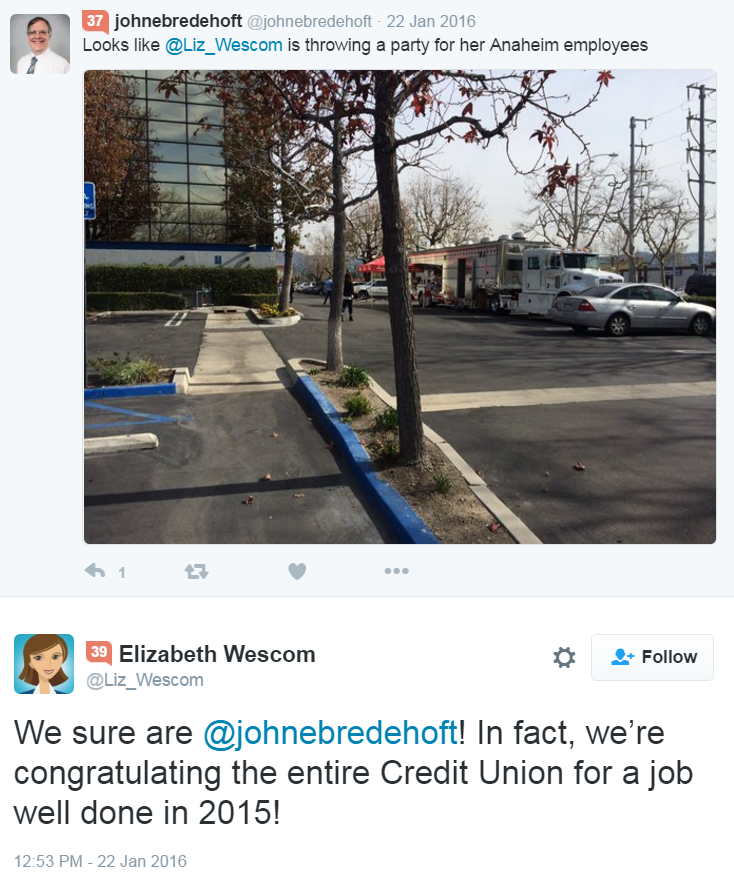
In that same post, I mentioned my friend Liz. Her formal name is Elizabeth, but she lets you call her Liz. That's the name she uses on Twitter and Instagram. Now Liz works right across the road from The Porch, at the Wescom Building in Anaheim.

Actually, she works at the Wescom Building in Pasadena.

Actually, she doesn't work at either place.

Because - and I hope you're sitting down for this - Liz Wescom doesn't exist.

Oh, sure, we chat at times.


But that does not negate the fact that Liz Wescom is a fictional entity, created by Wescom's marketing department, or perhaps by an outside advertising agency. All that I know is that before she was on Twitter and Instagram, she was inside Wescom automated teller machines (see page 5 of PDF).

But Wescom isn't the only entity that creates non-existent spokespeople. As a child, I was scared of Mr. Clean, but was not all that scared of Mr. Whipple. And on a more geopolitical front, the United Nations tried (and failed) to enlist Wonder Woman as a spokesperson.

Let's face it, we like to associate with people, even when dealing with corporations. And if the corporation doesn't have a real live person like Lee Iacocca or Steve Jobs, then the corporation has to use a fake one. In some cases, a real spokesperson eventually becomes a fake one - Colonel Sanders being a notable example.

But do these fake spokespeople work? In some documented instances, they work really well. One example: the American Family Life Assurance Company of Columbus, Georgia had a barrier when getting business, because someone asking for insurance isn't going to necessarily remember "American Family Life Assurance Company." Even the acronym - AFLAC - isn't something that you intuitively remember.

Unless a duck says it.

To solve this problem, they decided to experiment using a duck as a mascot since the brand name sounds like the “quack quack” sound a duck makes. Upon investing in advertising to promote the duck and the business, the result has been phenomenal with name recognition and profits soaring. In fact, name recognition has been at 91% – higher than big insurance companies MetLife or Cigna and in the same ballpark as behemoths McDonald’s and Coca Cola.

Now that recognition helps bring the revenue in to a life insurance company - or to a chicken fast food joint, a toilet paper manufacturer, or a credit union.

Wednesday, January 4, 2017

#empoplaaybizz My most popular Empoprise-BI post of 2016 isn't popular any more (remember PokeStops?)

I just checked my analytics to see what my most popular post in the Empoprise-BI business blog was in 2016. To no one's surprise, it was a summer post about a really trendy topic - #empoplaaybizz PokeSTOP! Or, James Kim is NOT a marketing genius.

What - the name James Kim doesn't ring a bell?

He's the "marketing genius" who everyone was talking about in late July, because he had the great idea to open a chain of cafes and call then Pokestops.

Because, you see, if you call them Pokestops, then smartphone-wielding people will flock to them.

Or, that's what Kim thought in late July.

I was slightly more pessimistic.

So assume that Nintendo et al are extremely happy with the idea of giving Kim a cut of the money, and that the trademarks are approved, and that locations are selected. In a best-case scenario, we'll start seeing these "Pokestops" in...

...well, in 2017 if everything goes perfectly. If things get bogged down with litigation and zoning restrictions (imagine your average city council approving a restaurant that is designed to have a bunch of people milling around), the process could take years.

By which time the Pokémon Go fanaticism may have faded just a little bit.


Faded? Ya think?


Of course, my solution about deploying incense at restaurants wasn't that valuable either, since incense can only be used by the person who deploys it. But at least my other suggestion - the use of lures - would work (provided your establishment is already an official Pokestop, or is very close to one).

Meanwhile, everything has seemingly gone quiet on the James Kim front since August, when there was a "non-final action" on his trademark application.

Kim's probably busy on his Rogue One Restaurant concept.

A McDonald's on Vatican-owned property - what's the problem?

As many of you know, Vatican City is not only the center of the Roman Catholic Church, but is also an independent country in its own right. Vatican City itself occupies specific boundaries, but some Vatican-owned buildings spill over into the neighboring country of Italy. And the first floor tenant of one of these buildings is stirring controversy:

A new McDonald’s site opened last Friday in the Pio Borgo district of Rome, and the Vatican isn’t exactly “lovin’ it,” as it were. That’s because the new McDonald’s location, just around the corner from St. Peter’s Square, sits about 100 yards away from the walls of the Vatican State and within a Vatican-owned building....

While McDonald’s has another location some 200 yards from the Vatican (and there’s also a Burger King), the controversy comes more from the fact that the newest addition to the burger chain resides directly within Vatican-owned property. The building also just happens to be home to Vatican officials, including several senior cardinals. McDonald’s reportedly pays the Administration of the Patrimony of the Apostolic See more than $30,000 a month for the building’s bottom floor.


And?

I fail to see the problem here. Unless the Cardinals are engaged in a perpetual fast, I don't see anything in a McDonald's that contradicts Roman Catholic doctrine. If McDonald's were anathema, we wouldn't see stories like this one out of Oklahoma.

Members of the St. Philip Neri Catholic School alumni class of 2016 delivered more than 30,000 pop can tops collected by the middle school to the Ronald McDonald House.

I suspect that the true controversy here is the fact that McDonald's is an American-owned company. I suspect a nice Italian restaurant would cause no controversy whatsoever.

Friday, December 16, 2016

Why the Federal Government isn't agile

From NextGov:

A new Homeland Security Department program promoting agile software development has hit a stumbling block.

The $1.54 billion Flexible Agile Support for the Homeland contract vehicle—a group of 13 vendors pre-approved to sell agile services to the department—has been halted by protests from at least eight companies not included on that list....

INTEGRITYOne Partners, Harmonia Holdings Group, Cybermedia Technologies, Brillient Corp., Citizant, Ventera Corp., Incentive Technology Group and BC Digital Services filed protests with the Government Accountability Office.


More here, including details on a previous agile effort by the Department of Homeland Security (DHS). And according to the article, it is anticipated that the demands of the incoming Trump Administration will spur further efforts in this vein.

(DISCLOSURE: My employer has contracts with DHS, but not under this particular vehicle.)

Verizon is building a wall - regarding the Yahoo deal

Since walls are really cool these days, especially if someone else pays for them, I figured that I'd talk about them.

But I'm going to talk about a different type of wall - a logical wall that can be erected between two companies, or even between two parts of the same company.

Let me jump back to 2008, and to a personal example. In late 2008, I was working for Motorola's Biometric Business Unit when I learned that Motorola wanted to sell this unit to a company called Safran - pending government approvals.

Now some would expect that once the announcement was made, all of the Motorola employees and all of the Safran employees would all get together and start talking about how things would work once the deal went through.

As Donald Trump would say, "WRONG!"

All of us Motorola employees were strictly cautioned that the deal might go through, or it might not. Until the deal actually went through, we were to consider Safran employees as competitors, just like we always had.

I had no idea what the Safran employees were told - again, I wasn't talking to them - but presumably they were told the same thing.

In fact, during the next few months, Motorola and Safran actually submitted competing bids for several opportunities, continuing the fierce competition month after month after month.

Several months passed, and the deal wasn't finalized yet. It was probably February 2009 when I went to a conference at the National Institute of Standards and Technology - a conference that was also attended by a Safran employee.

During a break in the proceedings, the Safran employee and I had a conversation. It went something like this.

Have you heard anything?

I heard that the deal may get done this month.

That's what I heard too.

Of course, I previously heard that the deal might get done LAST month.

Yeah, that's what I heard too.


As it turned out, the deal didn't get done in February. Or in March. Finally, on a day in early April, we at Motorola officially heard that we no longer worked for Motorola any more (and could you kindly give us our batwings back please?). Only after that could all of us work on the reorganization.

Fast-forward to the Verizon-Yahoo deal - which like all deals of this type, may or may not happen. With the most recent revelations about a billion Yahoo accounts being hacked, the chance of the deal not happening is increasing.

So Verizon has to plan for the possibility of acquiring Yahoo, and thus getting confidential information about how Yahoo operates. At the same time, Verizon has to plan for the possibility of not acquiring Yahoo, and needs to consider the ramifications of the purchase WITHOUT access to that confidential information.

So how is Verizon doing this? By creating two separate teams and walling them off from each other.

While a Verizon group led by AOL Chief Executive Officer Tim Armstrong is still focused on integration planning to get Yahoo up and running, another team, walled off from the rest, is reviewing the breach disclosures and the company’s options, said the person, who asked not to be identified discussing private information.

This is different from the wall that was enforced between Motorola and Safran between 2008 and 2009. In the earlier case, we were talking about two separate companies. In the Verizon case, we're talking about walling off two different groups WITHIN THE SAME COMPANY.

As it turns out, I've actually had experience with walls within a company.

But that's a Motorola trade secret.

One that I'm not allowed to disclose to Safran.

Monday, December 12, 2016

Ten narcissists in U.S. Presidential history who outdo @realdonaldtrump

There are many, many disagreements between businessman-turned-President Donald Trump and his opponents. But there is one thing upon which both of them agree.

Both agree that he is an extreme narcissist - or, as Trump himself would put it, the most amazing narcissist ever.

As President-elect Trump keeps himself busy with Cabinet appointments, thank you tours, television executive producing duties, and Twitter, his opponents are apoplectic, preparing for the end of the world.

I said above that Trump would also declare HIMSELF to be an extreme narcissist. I don't know if any journalist has ever directly asked him the question, but think about it. Would he respond to the "Are you a narcissist" question by saying that he's humble? I think not.

Jeffrey Kluger, co-author of Apollo 13 (a/k/a Lost Moon) and author of the more recent book The Narcissist Next Door, addressed this very question in a listicle of facts about narcissists.

4. One of the best ways to determine if a person is a narcissist is to ask them if they are a narcissist. They will often say yes.

"In the case of a narcissist, it's often because what they're saying is 'Well yeah, if you mean do I have a high opinion of myself, I do, but that's because gosh I'm the best person I know. I deserve to have a high opinion of myself,'" Kluger said.


But is Trump truly the most amazing narcissist ever? The jobs of President and Chief Executive Officer tend to attract narcissists, and if you look at some of Trump's predecessors in the Oval Office, you'll find many have been tagged as malignant narcissists - usually by their enemies. Here are things that have been written about three living politicians:

The most shocking thing about the [event] ... was [politician's] complete obsession about [self]....[Politician's] performance is a case-study in malignant narcissism with all the attendant paranoia and disturbing inability to consider other ... human beings at the center of the [event].

Psychologically speaking, [politician] is what is called a “malignant narcissist.” ... A “malignant” narcissist ... is a narcissist who reacts sadistically to others who don’t support and enable their narcissism. For example, instead of self-reflecting and taking in critical feedback, the [politician's staff] reacts with ruthless contempt for anyone who disagrees with them. Like a mean and cruel-spirited malignant narcissist, [the politician's staff] deny the accusation and try to destroy the messenger. Ultimately, a malignant narcissist wants to annihilate anyone who in any way threatens their illusory self-image and self-serving agenda.

I feel that my role as a former president is probably superior to that of other presidents. Primarily because of the activism and the – and the injection of working at the [major organization] and in [a list of issues]. We’re right in the midst of the – of the constant daily debate.

These quotes respectively refer to Trump's opponent Hillary Clinton, and to Presidents George W. Bush and Jimmy Carter.

But narcissists have their admirers. At the same time that Tammy Bruce and others criticize Clinton for self-absorption, others are awed by her:

Maybe she is more than a president. Maybe she is an idea, a world-historical heroine, light itself. The presidency is too small for her. She belongs to a much more elite class of Americans....Hillary Clinton did everything right in this campaign, and she won more votes than her opponent did. She won. She cannot be faulted, criticized, or analyzed for even one more second. Instead, she will be decorated as an epochal heroine far too extraordinary to be contained by the mere White House.

Narcissists, by their very force, can be captivating, and while Clinton, Bush 43, Carter, and Trump all have their enemies, they also have admirers.

But none of these hold a candle to the REAL narcissists who have resided in the White House. The Pew Research Center rated the narcissism of all of the Presidents from Washington to George W. Bush - and while the methodology of any such study can be questioned, it's probably fair to say that the people at the top of the list were/are more narcissistic than the people at the bottom of the list.

So, who topped the list?


Compared to the people at the top of this list, Trump is a nobody. Imagine Trump trying to say "You're fired" to Lyndon Johnson, Theodore Roosevelt, or Andrew Jackson. Lyndon would crush Trump's anatomy, Teddy would batter him with a big stick, and General Andy would shoot him faster than Indiana Jones.

But how is someone supposed to act when he or she ends up on the staff of Donald Trump - or of Steve Jobs? Jane Brody quoted Joseph Burgo:

“The best defense for employees who choose to stay is to protect the bosses’ egos and avoid challenging them,” Dr. Burgo said in an interview. His general advice to those running up against extreme narcissists is to “remain sane and reasonable” rather than engaging them in “battles they’ll always win.”

It also helps to praise narcissists for being so wonderful - something that Vladimir Putin apparently knows very well.

Thursday, December 1, 2016

Uh, @daily_express - @predsci and @Gizmodo told us about the possible 2020 solar storm in 2012

There is a chance that Donald Trump may become President of the United States!

Does this sound like old news?

Well, how about this piece, dated November 30 (yesterday), from Sean Martin of the Daily Express?

Researchers have warned that there is roughly a 12 per cent chance that a solar storm could smash into Earth by the end of the decade....

This means that satellite signals will struggle to penetrate the swollen atmosphere, leading to a lack of Internet service, GPS navigation, satellite TV such as Sky and mobile phone signal.


Obviously this would have huge implications for our modern world - and we have less than four years to prepare!

According to Martin, this prediction was made by Pete Riley of Predictive Science. And you know he's a scientist because of his URL - http://www.predsci.com/~pete/ is your typical UNIX-like user name. We're not dealing with a DOS guy here.

And like a good scientist, Riley realizes that his calculations are approximations. According to Martin, Riley stated:

He said: “Even if it’s off by a factor of two, that’s a much larger number than I thought.”

So I went to the Predictive Science website and searched for a recent report detailing Riley's prediction - and couldn't find one.

This seemed odd, so I kept on poking around until I found this article - FROM 2012.

Pete Riley, a senior scientist at Predictive Science in San Diego, told Gizmodo that there is roughly a 12% chance that the Earth will experience an enormous megaflare within the next ten years. "Even if it's off by a factor of two, that's a much larger number than I thought," said Riley.

Riley published his prediction in Space Weather: The International Journal of Research and Applications.


So Martin basically resurrected a four year old story. And how is the respected press covering it?

According to Express, senior scientist, Pete Riley of Predictive Science in San Diego, California said that the chance of huge solar storm by 2020 is high.

Modern-daay researchers have warned that there is a 12 percent chance that a solar storm will smash Earth in the end of this decade. This powerful event will be as big as the Carrington event which occurred in 1859, according to Express UK.

As reported by the UK’s Express , experts believe there is a one in eight chance that earth will be hit by a major solar storm before 2020, which would wipe out nearly all technology that is not hardened against EMP events – so, pretty much every piece of technology that is not owned and operated by governments.

Great scoop, Express. But what will you do when someone scoops you in 2018 and doesn't reference your "work"?

And as for Predictive Science itself, it only offered this comment.


Obviously Predictive Science doesn't put a lot of stock in Twitter. After all, USENET is just fine for scientific discussion.

#empogmgmu Part Six: Ryerson University, Pluralism, Diversity, and the Holocaust

See all the #empogmgmu posts

Actually, not all of them. Part five is here

Nothing new on the Oleg Atbashian front, and perhaps nothing new there until February. But the country of Canada, which doesn't claim George Mason as a Founding Father, is having its own issues with the Students for Justice in Palestine.

Let's start with a piece from the independent newspaper for Ryerson University. The paper is called The Eyeopener.

More than 200 students filled the Library Building’s lecture hall for the Ryerson Students’ Union (RSU) Semi-Annual General Meeting (SAGM) on Nov. 29.

After many amendments to the order of the agenda, three motions were voted on (not including the RSU’s financial audit report for the 2015-2016 year, the agenda and meeting minutes).

Quorum was lost just under four hours into the SAGM and the meeting was adjourned. The remaining 16 motions were pushed to the RSU’s next board meeting. RSU president Obaid Ullah said the meeting will take place before the winter break.


Well, four hours is a long time, so it's understandable that students lost interest. Maybe that Bullard comedian has a new show on Canadian TV or something, and they walked out to watch it.

Actually, The Eyeopener targets the exact moment when the quorum was lost.

A motion was brought forward detailing plans for the RSU to have a Holocaust Education Week. An amendment was proposed to make the education week include education about all genocides and not just the Holocaust specifically. However, quorum was lost before a vote could be made.

Hmm, that's kind of odd. You'd think that people would stick around to talk about something like that, Israel and Palestine being in the news and all.

At least one publication thinks that the timing of the loss of the quorum was no accident:

Local members of Students for Justice in Palestine and the Muslim Students Association reportedly staged the walkout Tuesday night during the semiannual general meeting of the Ryerson Student Union.

Unlike George Mason, the resolution was sponsored by some mainstream Jewish organizations, including Hillel and B'nai Brith. And it even had politically correct wording:

The resolution, which was submitted by a member of the Ryerson Hillel Jewish students’ group, called on the Student Union to offer annual Holocaust education programs to emphasize “the value of pluralism and the acceptance of diversity.” There was no mention of Israel.

The unfortunate outcome for SJP and MSA is that Ryerson can now be painted as an anti-pluralistic, anti-diverse, Holocaust-loving university.

Oops.

See all the #empogmgmu posts