Monday, March 31, 2014

Who has the...um...clout in the #BaconClubhouse promotion from .@klout and .@mcdonalds ?

Business promotions are best when they are win-win situations. Back in 2008, I talked about an Izea promotion which married Izea, Kmart, and influential bloggers such as Loren Feldman and Julia Roy. Today, the online promotional model has progressed to the state where less influential bloggers such as myself can get involved. No, I'm not getting $500 gift cards, but I did receive a $5 McDonalds Arch Card from Klout.

[DISCLOSURE: I RECEIVED A $5 MCDONALDS ARCH CARD FROM KLOUT.]

I've earned several Klout perks, but this is the first one that I was actually able to use.


As you can see from the receipt, I applied the $5 from the Arch Card to a $7.44 meal. If I had literally chosen to just try the Bacon Clubhouse Burger, the $5 Arch Card would have covered the cost.

McDonalds' goal in the promotion was to get people to try - and ideally to talk about - its new Bacon Clubhouse Burger.

Thick-cut Applewood smoked bacon, caramelized grilled onions, white cheddar*, crisp leaf lettuce and fresh tomato, all lovingly layered on a quarter pound** of 100% pure beef, then topped with Big Mac special sauce. Served on our artisan roll.

(Note: the burger is also available in grilled and crispy chicken configurations.)

Unfortunately, much of the discussion of the Bacon Clubhouse Burger is canned. You'll see a lot of tweets like this:

Getting an unbeatable taste of the new #BaconClubhouse burger thanks to mcdonalds my klout perk!

You'll notice that I refrained from using the word "unbeatable" in my post title (which is also tweeted). I figure that if I'm going to shill something, I might as well put a bit of original effort into it. (A lesson that I learned from the aforementioned influential bloggers.)

In this case, it's fair to say that this promotion is a win-win-win situation. McDonalds gets some online discussion about its new offering from people who presumably have the ear of others. The Klout perk recipients, of course, get free food. And Klout, which was just acquired by Lithium Technologies, gets some free publicity.

Oh, and my review of the burger. I rarely get the high end burgers from fast food places (these days, I'm more likely to get the plain burger when I go to McDonalds), but this one clearly falls into the premium category - a cut above the Big Macs and Quarter Pounders which were McDonalds' mainstays until a few years ago. If you like bacon, this is definitely recommended.

One more disclosure is in order - when I went to the McDonalds to get the meal, my receipt had a "buy one get one free" offer. However, I'm not going to use it - since even one of these sandwiches is filling, I'm certainly not going to order two.

Friday, March 28, 2014

When protectionism gets too protective - a story

Diana was getting irritated at her teenage son's pronouncements at the dinner table.

"And the laws that ban Tesla sales in all those states are totally bogus!" declared Jim. "And mom, what you and the other car dealers are doing is completely unfair!"

Diana finally exploded. "I've had enough of your mouth!" she yelled back. "You think that Tesla is all cool, but what would you think if your precious Tesla broke down and there wasn't a network of independent dealers to support it? The dealer model has worked for years - if it ain't broke, don't fix it."

Jim grumbled and returned to his green beans.

Diana's scowl disappeared when her husband walked in through the front door.

As Mark sat at the table, Diana asked an important question.

"Honey," she asked, "did you have a chance to order those books from Amazon today?"

Mark was not smiling. "Actually, I didn't. During lunch I went to Amazon's web site, and I was greeted with a message from Amazon."

MESSAGE TO AMAZON CUSTOMERS IN NEW JERSEY

As a result of legislation recently enacted in your state, Amazon is no longer able to sell items directly to customers with New Jersey addresses. We are working to rectify this situation as soon as possible. Rather than fighting the will of New Jersey voters, we are striving to establish a network of independent dealers to sell goods to our New Jersey customers.


"So what does this mean?" asked Diana.

"According to the New Jersey Booksellers' Association," said Mark,

Amazon's approach is not innovative, but rather, by cutting out the dealer hurts the consumer.

The independent system of retailers that operates in New Jersey promotes price competition because a manufacturer doesn't control distribution and prices. It also promotes greater access to warranty claims, which is something direct online booksellers hate.


"And the governor agreed," Mark noted.

"Since Amazon first began operating in New Jersey, it was made clear that the company would need to engage the Legislature on a bill to establish their new direct-sales operations under New Jersey law," said spokesman Kevin Roberts. "This administration does not find it appropriate to unilaterally change the way products are sold in New Jersey without legislation and Amazon has been aware of this position since the beginning."

"But we'll still get free next day delivery under Amazon Prime, right?" asked Diana.

"I doubt it," said Mark. "The delivery schedule would be up to the individual book dealer."

"Well, we'll still get Amazon's pricing, won't we?" asked Diana.

"Maybe, maybe not," said Mark. "The dealer will need to show some profit, so it's possible that the prices may actually go up, despite the competition."

Diana's son Jim was smirking, and even Diana's glare couldn't dampen the smirk on Jim's face.

Thursday, March 20, 2014

Mike Michalowicz on disqualifying your client

In an American Express piece, Mike Michalowicz talked about the effective use of reverse psychology in sales - when a potential client is expecting a particular bit of sales-speak, bring something else instead.

One of his examples was classic.

Years ago, my wife and I were bed shopping; the salesperson saw us—a young couple—and walked us past the pricey Tempur-Pedic beds to the ones she thought we could afford. When I asked about the ones we’d passed by, she told me that we couldn’t afford those and she was prepared to show me ones in my price range. Of course, I had to prove her wrong, and we walked out...

Oh, and one more thing.

...only after having bought the Tempur-Pedic bed.

You know that salesperson could sleep well at night.

Read Michalowicz's other five points here.

Wednesday, March 19, 2014

Forget the article from .@marcwayshak - just look at this one sentence that he wrote

Recently, Marc Wayshak wrote an article entitled "5 simple ways to outsell your competition." It's an outstanding article with tips on focusing on customer needs.

But I'm not going to talk about the article.

Instead, I'm going to highlight a single sentence from the article that says more about business - and psychology - than most things that have been written today.

Here's the sentence:

We are all more comfortable selling to nondecision-makers.

Think about it.

It could have been worse. The criminal could have filed a fake tax return for Richie Incognito

The FBI emphasizes that tax return fraud can affect almost anyone.

From November 2012 through April 2013, [Yafait] Tadesse and co-defendant Eyaso Abebe carried out a scheme to obtain the names and Social Security numbers of unsuspecting victims from various websites and use this information on false tax returns that claimed fraudulent refunds. The tax returns falsely claimed that the victims earned similar wage and withholding amounts and worked at Wal-Mart. The returns all claimed fraudulent refunds that were to be loaded onto pre-paid debit cards. These pre-paid debit cards listed Tadesse’s apartment complex in Carrollton, Georgia as the mailing address.

While the IRS stopped several of the false returns from being fully processed, several fraudulent refunds were directed onto prepaid debit cards. Surveillance videos showed that Tadesse used one of these prepaid cards at stores in Carrollton, Georgia.


OK, so it's a tax fraud story, and some false tax returns were filed claiming that some people earned Walmart wages. But this is where it gets interesting.

One of the tax returns filed by Tadesse and Abebe used the name, Social Security number, and date of birth of U.S. Attorney General Eric H. Holder, Jr.

Yup, the Attorney General. In other words, the person that's directly responsible for sending you to prison if you're convicted of a Federal crime...like tax fraud.

There is no indication that the attorney general was specifically targeted as a result of his position.

Obviously not.

In another story, the FBI detailed ways to reduce the chance that you will become a victim of identity fraud.

While identity theft may be difficult to completely guard against, there are steps you can take to make it harder for thieves to steal your personally identifiable information:

- Check your credit report on a regular basis.

- Don’t carry around your Social Security card or any document containing your Social Security number.

- Properly dispose of documents that contain sensitive information; shred them instead of throwing in the trash.

- Only give out your personal information when absolutely necessary—especially on websites and social media sites—and keep track of who you give it to (this could be helpful in determining the source of a breach of personally identifiable information if you become a victim).

- Protect your personal computers by using firewalls and the latest anti-virus software.

- File your taxes as early as possible during tax season, since criminals using stolen identities tend to file their fraudulent returns early to obtain refunds before the legitimate filer submits a return.

- And if you’re someone who isn’t required to file a tax return, consider filing anyway to prevent someone else from filing a false return in your name and to be alerted in case someone has already filed a false return in your name.


The IRS has published its own tips, including the following:

Don’t give a business your SSN or ITIN just because they ask. Give it only when required.

Consider tenant applications:

A Social Security number is used for personal identification, and is necessary to do a credit check on a potential tenant. With the rise in identity theft, people have become reluctant to share this information with strangers, especially before they've signed a lease or entered a formal contractual agreement with a landlord. You can refuse to give out the digits, but don't be surprised if the landlord, in return, refuses to rent to you.

But be sure you know who the landlord is:

Sadly, there are scammers aplenty in the real estate world. Fake landlords will show an apartment, collect completed applications from several prospective tenants, then sell the information on the black market. In addition, free listing sites such as Craigslist are infamous for fake rental listings that request a Social Security number for a preliminary credit check.

Monday, March 17, 2014

It is now 2014. Chris Schauble is now Kent Schocknek. Safety first, kids.

This little piece of news doesn't really...um, register with most southern Californians. An earthquake occurs during the morning news, and two anchors react.

Early morning TV viewers saw anchors Megan Henderson and Chris Schauble sense something is amiss. Schauble interrupts Henderson, points up and says, "Earthquake! We're having an earthquake!"

They then hide under the news desk like two students during a Cold War nuclear missile drill while the shaky camera focuses on a suddenly abandoned studio.


Ho hum...but wait a minute. Was one of those anchors Chris Schauble, formerly of KNBC? He reacted differently a few years ago:

The earthquake begins, and the newscasters remain at their desks. Bjorklund gazes up toward the ceiling, with a complete lack of concern on her face. The newscasters note that someone off-camera (Ana Garcia) ran into the newsroom, barefoot, then ran back out again.

And here's the kicker:

Schauble then notes that "it could have been handled differently, shall we say" - a direct slap at Shocknek's well-known coverage from twenty years earlier.

Now I have been a staunch defender of Kent Shocknek and (in this particular instance) Christopher Nance for decades. When an earthquake takes place, you are SUPPOSED to duck and cover - something that Shocknek and Nance demonstrated way back when, and something that Schauble belatedly demonstrated today.

As the Yahoo writer puts it:

Looking cool is overrated. Safety first, kids.

Now I'm wondering what happened to the barefoot Ana Garcia. Did she leave KNBC like Shocknek and Schauble did?

Updating my 2012 post about .@VZWSupport and my Samsung Stratosphere OS upgrade

For those who have forgotten the details:

Back on September 18, 2012, an Android operating system upgrade was pushed out to my first-generation Samsung Stratosphere phone. After the upgrade was complete, I began having problems connecting my phone to my netbook via USB, and was receiving errors such as

Sorry…Process com.android.settings stopped unexpectedly. Try again

The "solution" for these problems was to perform a factory reset of the phone, which even Verizon Wireless (my cellular provider) acknowledged was painful:

Often times after a software update is completed a factory reset becomes necessary. I know completing this step can be a bit painful, but it resolves so many minor problems that pop up after the update.

I chose not to perform the factory reset at the time, and am still not pleased that a factory reset is recommended after an OS upgrade. (Imagine if Windows, Linux, or the MacOS required such a step.)

Eventually, my initial workaround to connect my phone and netbook ceased to work, so I developed another workaround - using a popular free cloud-based service to store files for transfer between the two devices. But I'd still get the nasty error message when I plugged my phone into my netbook to charge the phone.

And, as the months went by, other little things would crop up occasionally. Whether they were related to the OS upgrade is unclear, but they were petty little things that I could live with.

Until 11:30 pm yesterday (Sunday).

I was sent to the store to get something, but I would have to make a phone call from the store to get the right thing.

Now, even under the best of circumstances, making a voice call on my phone is a complex undertaking, because I have both Skype and Google Voice installed on my phone. So if I want to make a call, first I have to say "no" to the dialog box that asks if I want to use Skype, then I have to say "no" to the dialog box that asks if I want to use Google Voice, then I have to say "no" to the second dialog box that asked if I want to use Skype. (I don't know why I'm asked this a second time; this is one of those petty little things that's cropped up over the last few months.)

Sometimes, however, I don't encounter the best of circumstances. I'll choose the person that I want to call, then after a couple of minutes I get the first dialog box, then after a few more minutes I get the second dialog box, and then I eventually get the third.

Last night I wasn't that lucky - I never could make the voice call from the store.

So I resorted to texting - and even the text message took 10 minutes to be sent.

Oh, and I was unable to get a connection when I tried to uninstall Skype, and sometimes my settings said that my voice phone number was unknown.

Now some or all of these things may have had nothing to do with the OS upgrade. They might not have had to do with my phone; perhaps I was just in a bad coverage area. But as I sat in a chair in the store, staring at my phone, waiting for something to happen, I made a resolution - "I think I'll do that factory reset when I get home."

Eventually I got home (despite the communication issues, I did buy the correct item), and got ready to perform a post-midnight factory reset. I found these instructions at the Verizon Wireless website; they described a "preferred method" and an "alternate method." The preferred method would complete the process in 2 1/2 minutes or less, so I chose that method.

Eight minutes later, I switched to the alternate method. Luckily, that worked, and I was able to proceed with phone activation and setup, which was going fine...until my phone shut off due to lack of power (despite being connected to the charger). Luckily, the phone turned out fine - I think.

As of today, the phone is working. Due to the late night activity, I've only installed a few applications so far - Spotify, of course, was a necessity. But I haven't rushed to install Skype or Google Voice.

And I never did check to see if I was now able to transfer files between my phone and netbook.

Friday, March 14, 2014

Small companies are not big companies - on performance reviews

I have adopted a personal crusade to remind many wide-eyed startup proponents that things are a little different in the Fortune 500 world.

But I have to remind myself that the reverse of this is also true.

I was reading a print publication that summarized this study and noticed something in one of the tables (reproduced in slide 16 of the online presentation). Only 70% of the surveyed firms perform employee performance reviews.

I've gotten so used to performance reviews that they're almost a subconscious activity now, like breathing. Despite changes in corporate structure, and changes in the performance review itself, I've probably been reviewed on an annual basis for two decades now. So to me, the idea of NOT having a performance review is foreign.

But then I began thinking...

Brad's manager told him that he had to attend an important meeting on Friday. This was confusing to Brad, because the QwikShop Zippy Store was not the place to have important meetings. He entered the store, caught his manager's eye, and joined him in the small closet at the back of the store.

"Now, Brad," the manager, "I realize that you've only been here three weeks, but this is the time for performance reviews, and you need to participate also."

Brad was only seventeen years old, so he didn't know what his manager was talking about. "Performance reviews? What's that?"

"Oh, that comes down from corporate."

"You mean Manny?" Manny was the 74 year old man who, with his wife, owned the QwikShop Zippy Store and the adjacent gas station.

"Yeah, Manny. He got a hold of some business book and decided that the QwikShop Zippy Store needed to be professional."

Brad still looked a little confused, but his manager continued.

"Now, Brad," said the manager, "I've evaluated your performance based upon our corporate mission statement. If you leafed through the papers that you were given on your hire date, you remember that the corporate mission statement of the QwikShop Zippy Store is to be one of the world's leading producers and providers of entertainment and information, using its portfolio of brands to differentiate its content, services and consumer products. The company's primary financial goals are to maximize earnings and cash flow, and to allocate capital toward growth initiatives that will drive long-term shareholder value."

"What does that have to do with the QwikShop Zippy Store?" asked Brad.

"I don't know. Manny took the mission statement from Disney. He figured that if it's good enough for Walt Disney, it's good enough for him."

The manager paused for a moment. "So, Brad," he asked, "how have you driven long-term shareholder value?"

Brad mumbled incoherently.

"Let me help you with this," offered the manager. "When you walked here this morning, I saw you picking up a cigarette butt in the parking lot and throwing it away. That contributed to the intangible valuation of the firm, didn't it?"

Brad began to wonder if community college were such a good idea after all. If this was what they taught you in community college, it wasn't worth it.

Thursday, March 13, 2014

Amazon Prime price increase - trust the anecdotal evidence, or the surveys?

It's happened. The rumored price increase for Amazon Prime has been announced, and a $20 increase in the standard annual price (from $79 to $99) will take effect on the customer's next renewal.

As Alexis Kleinman notes, this is the first price increase in nine years - and while a 25% increase may seem steep, if you've been a long-term member and annualize the increase, it isn't so bad. (Which raises the question of whether Amazon should have increased prices every year, rather than doing it in one fell swoop, but that's a topic for another time.)

So what will happen? First I looked at the anecdotal evidence, as seen in Alex Scoble's Facebook thread. The majority of commenters there felt that Amazon Prime was still a good deal. However, Scoble's Facebook friends are probably atypical, since we are more likely to be cord-cutters, and thus are more likely to use the streaming capabilities of Amazon Prime.

But what about a more broad-based survey? Back in February, Reuters reported the results of a survey:

In a survey of more than 6,400 current Prime customers, Prosper Insights & Analytics found that 63 percent of consumers would pay only the current $79 fee for Prime - and no more. An additional 29 percent would pay $89-$99, and only 8 percent would pay $109 or more, a $30 minimum increase.

At the time that the survey was conducted, all sorts of price increase figures were being rumored, while the actual price increase was lower than some estimates. (In fact, I wonder if Amazon intentionally leaked a high price increase value, so that consumers would be pleased when the actual price was lower. Again, a topic for another time.)

So now that Amazon will be priced above $79, will over half of Amazon's customers drop the service at the next renewal period? The Proper Insights people think so:

"It's not going to work - if Prime members get this blanket email that rates are going up $20, Amazon is going to see a push back for this," says Pam Goodfellow, Prosper's consumer insights director. "The few consumers willing to pay $109 for Prime are younger, predominantly male, have a lot more money to spend and spend heavily on the electronics category."

Yes, this could potentially be a disaster along the lines of the Netflix disaster when it initially split up its mail delivery and streaming services. (Of course, things are fine several years later.) But my personal suspicion is that this is much ado about nothing, and most Amazon Prime users will happily renew at the higher rate.

Then again, I've been wrong before.

Tuesday, February 25, 2014

The importance of good management - a new DMV manager uncovers $50,000 in fraudulent activity

The FBI has released the story of fraudulent activity in the El Cajon, California office of the California Division of Motor Vehicles. A driving school owner, in cooperation with a few DMV employees, was able to get anyone a California driver's license - for a price.

“One guy flew in from Dallas, took a cab to the DMV office, paid for his license, and flew back to Dallas a few hours later,” said Special Agent Mike Peters, who investigated the case with Special Agent Kim George out of our San Diego Division. “It was so blatant,” Peters said, “that our surveillance showed the driving school operator brokering multiple deals in the DMV parking lot.”

This went on for three years, resulted in the fraudulent issuance of more than 100 driver's licenses, and netted over $50,000 for the ring.

So how did it stop?

When a new manager arrived at the El Cajon DMV office, however, “she instantly realized that something wasn’t right,” Peters said. The new manager alerted the DMV’s investigative arm, who in turn called the FBI.

This raises a question - why didn't the old manager catch this? Was the old manager clueless, or was the old manager in on the scam? The FBI summary doesn't say.

According to the FBI, the case is ongoing.

The Retail Equation and its Return Rewards program - when a return becomes a sale

I've found that my three posts on The Retail Equation are among the most popular posts on the Empoprise-BI business blog. If The Retail Equation ever provided services for KitchenAid, I auspect that my blog views would eclipse those of Arianna's little website.

It turns out that the big data generated by The Retail Equation's clients' servers isn't just used to prevent fraud. It can also be used for positive things, such as generating sales from the return exchange:

Once considered a cost of doing business, many retailers today are rethinking the return counter to make the shopping experience better for customers, which can have big benefits to the bottom line....[R]etailers can drive incremental sales through our product called Return Rewards®, which uses information about a consumer’s return transaction to instantly customize an offer for that particular person at the point of return. This provides an immediate incentive for the consumer to continue shopping at the store and for a specific product.

Additional information on Return Rewards can be found here.

Monday, February 24, 2014

When Jim Bakker's website is more easily accessed via U-Verse (or, why cable/satellite services may survive after all)

If you had asked me about the broadcast industry a few short weeks ago, I would have summed it up as follows:

The cable and satellite companies continue to use a dinosaur model that requires you to subscribe to a specific cable/satellite provider to get content from companies such as HBO. In the long term, however, this model will die because it is competing with the Internet, where everyone has access to the same content.

I have strongly believed this, and I've continuously talked about it over the years. For example, in 2010 I asked the question Will the cable/satellite model have to change?, and provided the following answer:

If enough people decide that cable/satellite service isn't worth it, the industry will be forced to adopt a more economical model that better serves the customer.

And I continued to make similar statements:

[O]bviously people won't pay for these cable/satellite services any more. And at the same time, the content providers won't get all of that guaranteed revenue that has made them greedy.

Then both the cable/satellite providers and the content providers will really have to fight for my business. Instead of holding these fake crisis wars every few years, they'll have to come up with a new business model - oen that will make it worthwhile for me to watch your shows.


It's only a matter of time before this cable/satellite model keels over, right?

Perhaps not.

In the history of my Jim Bakker-ish "I was wrong" moments, this has probably been the biggest "I was wrong" moment yet - and it only took me a couple of days to figure out how wrong I was.

For those of you who missed it, two big stories emerged over the past few days. Timothy B. Lee summarized both of them - the ongoing negotiations between Cogent and Verizon, and the completed deal with Netflix and Comcast.

In brief, Netflix (a customer of Cogent) accounts for a huge percentage of Internet traffic. For various reasons that Lee explains, this means that broadband companies such as Verizon and Comcast can try to demand money from Netflix (or Cogent) to carry Netflix's traffic. As of now, Verizon has not succeeded in getting money from Cogent - but Comcast has succeeded in getting money from Netflix.

There are, of course, a number of ramifications of this. One of those, however, bears mentioning:

As this proceeds, there will be no effective difference between the current cable/satellite entertainment industry and the online broadband industry.

For example, this month's current brouhaha in the former industry is DirecTV's refusal to carry The Weather Channel. Perhaps your response is to ignore DirecTV altogether and just go directly to weather.com. But what if weather.com has paid a fee to Verizon, and hasn't paid a fee to AT&T? If that is the result, then videos on weather.com may be degraded if you try to access the website from AT&T. And, of course, Jim Bakker's own website may be affected.

Of course, it's possible that the fees would only be demanded - and paid - by companies such as Netflix with extreme broadband requirements, and that it wouldn't be economically feasible for the broadband providers to demand similar fee payments from weather.com, or jimbakkershow.com, or blogger.com, or wordpress.com...

Hmm. This is suddenly getting somewhat personal.

This waste solution is in the bag - Cass Sunstein on loss aversion #apmp

Last week, Dr. Tom Sant of Hyde Park Partners gave a presentation to the California chapter of the Association of Proposal Management Professionals. In his presentation ("The Art and Science of Compelling Value"), Dr. Sant briefly mentioned Dr. Daniel Kahneman, a Nobel Prize winner for economics who doesn't happen to be an economist.

One of Dr. Kahneman's concepts is that of "loss aversion." I was searching for some easy-to-understand examples of loss aversion, and I ran across three of them in a Cass Sunstein article that I found on LinkedIn.


[taberandrew, some rights reserved]

In his article, Sunstein's second example concerned efforts by the District of Columbia to reduce the use of plastic bags in grocery stores. First, the District tried an incentive:

One approach was to offer a five-cent bonus to customers who brought reusable bags.

It turns out that the incentive didn't work. So the District moved to the penalty phase:

More recently the District tried another approach, which is to impose a five-cent tax on those who ask for a grocery bag.

This was very effective. As Sunstein comments, "Five cents is not a lot of money, but many people do not want to pay it." Carol Rucker notes that the fee resulted in a 50% reduction in disposable bag use in Washington, DC grocery stores.

See Sunstein's other two examples here.

Friday, February 21, 2014

All politics is local, the homeland security education edition

If our people are not sufficiently educated to fight threats to homeland security, then the terrorists (and hurricanes) have already won. This is apparently what New York Governor Andrew Cuomo believes:

Governor Andrew Cuomo last month earmarked $15 million in his state budget proposal for what he called “the nation’s first college dedicated solely to emergency preparedness and homeland security.” Cuomo announced plan during a presentation for Vice President Joe Biden in January, saying there would be “a need” for it.

This proposal certainly has support:

A spokesman for the state’s university system, SUNY, said Chancellor Nancy Zimpher supports Cuomo’s proposal.

But at the same time, there are those who are opposed to it:

Assemblywoman Linda B. Rosenthal, chair of the Assembly’s Commission on Science and Technology, wrote a letter to Assembly Speaker Sheldon Silver advising Silver to reject Cuomo’s plan. “I cannot support this initiative until I have a better understanding of the proposal, its long-term cost and impact on existing programs,” she wrote.

Rosenthal...noted in her letter that she was worried that the college would be competing with John Jay College of Criminal Justice, a school in her district. “I am concerned about how this college will be integrated with existing related programs at campuses around the State,” she wrote.

“For example, John Jay College of Criminal Justice … in my district offers a range of courses in Emergency Preparedness, Homeland Security.”


So what does the John Jay College of Criminal Justice have to say about itself?

A senior college of The City University of New York, John Jay College of Criminal Justice is the preeminent national and international leader in educating for justice. Whether it is in the pages of The Lancet, across from opposing counsel, or behind a podium, John Jay students, graduates and faculty make their mark on the world.

Set in the heart of New York City, John Jay offers students a liberal arts and criminal justice curriculum that balances the sciences, humanities and the arts with professional studies. Offering both undergraduate and graduate degrees, the College is unique in its mission....


Well, it won't be unique in its mission of the Governor and the State University of New York have their way.

So we have the City University fighting with the State University - and that is how homeland security decisions are made.

Thursday, February 20, 2014

LinkedIn Publish

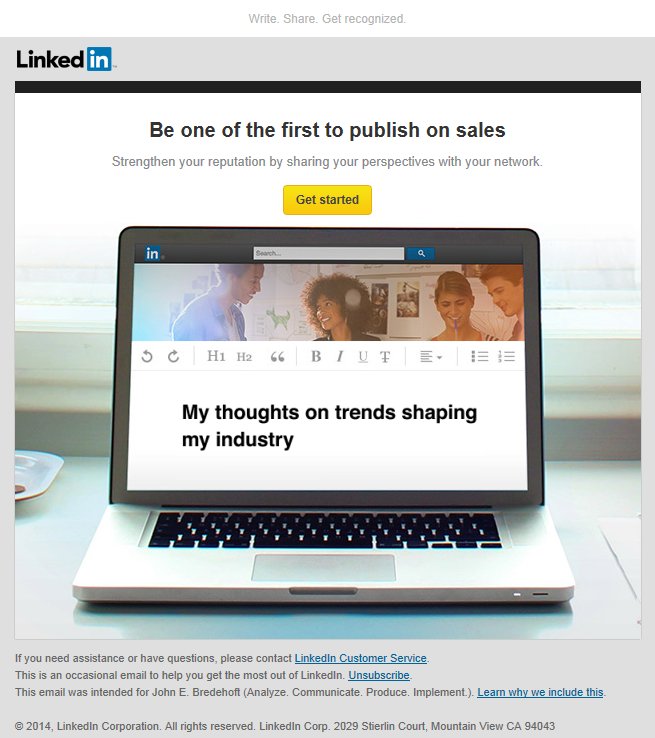
So anyways, I was reading my personal email and ran across this:


It seemed easy enough, but before I clicked that "Get Started" button, I figured that I'd better figure out what this Publish feature was. So I ended up reading John Hall's explanation.

The initial reaction of some members may be to compare this feature to sharing a post with only their connections, as they’d been able to do in the past. However, there’s a huge difference between a friendly post and an actual article in terms of quality.

LinkedIn is creating specific channels that will support targeted content for a variety of industries. As you build your platform, this will be a key way to stand out as an industry leader. If your features don’t get enough traction, this could prevent your platform from being as useful as it could be.


I am fairly select in what I choose to share via LinkedIn's existing capabilities, confining myself to brief discussions specific to biometrics or proposals. While my...um, broader interests are certainly available on the web, I figure that people who are reading on LinkedIn don't particularly care about my thoughts on Bob Casale.

At the appropriate time, I'll give this a spin and see what happens.

P.S. This is what LinkedIn said:

The company's press release, written by Ryan Roslansky, Director of Product Management:

We believe in giving our members access to the business knowledge they need to be great at what they do. To put that simply, we are making a commitment to our members: the time you spend on LinkedIn will make you better at your job today.

The valuable Influencer posts and the wide range of professional content from millions of publishers that we currently aggregate on LinkedIn are powerful, but only the tip of the iceberg. Combined, our members have extremely valuable and varied experiences; however, their knowledge and expertise has not yet been captured and shared.

Starting today, LinkedIn is opening up our publishing platform to our members, giving them a powerful new way to build their professional brand. When a member publishes a post on LinkedIn, their original content becomes part of their professional profile, is shared with their trusted network and has the ability to reach the largest group of professionals ever assembled. Now members have the ability to follow other members that are not in their network and build their own group of followers. Members can continue to share their expertise by posting photos, images, videos and their original presentations on SlideShare.

Every professional has valuable experience to share. Trying to grow your business by reducing customer attrition? Read the post from Monica Adractas, head of customer retention at Box, on churning out churn. Just starting a career in sales? Read the post from Brent Beshore, the founder/CEO at adventur.es, on how to sell anything. Need a science-based planning tool for river restoration? Read the post from Glen Leverich, senior geomorphologist at Stillwater Sciences, on A Science-based Planning Approach for Riparian Restoration.

LinkedIn Influencer started in fall of 2012 and features top voices in business like Richard Branson, Martha Stewart and Bill Gates. The expertise they have shared through their Influencer posts has resonated in a meaningful way with LinkedIn members and is fueling business conversations. The average Influencer post drives more than 31,000 views and receives more than 250 likes and 80 comments. By any measure, this is a remarkably high level of engagement for digital content.

We are adding new Influencers who are excited to share their insights and experiences directly with LinkedIn members. They include Nissan CEO Carlos Ghosn, CEO of AOL Brand Group Susan Lyne, and Financial Expert and CNBC host Suze Orman. We will regularly evaluate who we have as Influencers to include only the most engaged, prolific and thoughtful contributors and to ensure that their expertise matches up with our members’ interests.

Starting today, 25,000 members will have the ability to publish content on LinkedIn. We’ll be steadily expanding the capability to all members in multiple languages over the next few weeks and months to come. Check out our member help center for more information.


P.P.S. I would have linked to LinkedIn's original press release, rather than Yahoo's version of it, but I couldn't find press releases on LinkedIn's page. Maybe you have to be a Premium member to find them.

P.P.P.S. If you're interested in LinkedIn, be sure to read Jason Alba's blog. I've written about it before.

Foreign banks and ex-American tax cheats - additional unintended consequences from .@pattonroberta

Robert Patton is an indefatigible sharer of valuable information, and his share of a National Public Radio item caught my eye as yet another example of unintended consequences. (For my previous discussions of unintended consequences, look at what happened with Chinese birth control, friendly relations toward Afghan farmers, and James Ulvog's favorite topic of green energy.)

For my non-U.S. readers, I should point out that National Public Radio serves the people of the United States. (Although I'm sure that if Slovenia has its own "National Public Radio," it's probably a quality organization.) And this story deals with American citizens abroad - or, more accurately, FORMER American citizens abroad.

It all started with Americans hiding money in Swiss bank accounts and not telling the Internal Revenue Service about it. Needless to say, this did not make Congress happy, because both Republicans and Democrats agree that it's essential to collect government revenue from people who would never vote for you anyway - and tax cheats fall into that category. So Congress took action:

During the economic recession, lawmakers saw a chance to bring in massive sums of money and stop tax cheats at the same time.

"They just found UBS in a terrible scheme to encourage tax evasion," Barney Frank, the Democratic congressman from Massachusetts, told NPR in 2009. "I think there are clearly tens of billions that can be recovered there."

The next year, in 2010, Congress passed the Foreign Accounts Tax Compliance Act. The law affects every foreign bank that does business with the U.S. And not just banks: It also applies to retirement accounts, mutual funds, and more.


NPR's Ari Shapiro points out that the United States is unusual in this regard. If a Spanish citizen is living in Canada, he or she is not required to pay taxes in Spain. But that's not the case for Americans living in a place such as Germany.

The first signs of a problem could be seen when foreign banks learned about the U.S. law and had to figure out how to comply with it. Many foreign banks hit on a very easy-to-implement solution:

Many of them decided to wash their hands of American account-holders.

"They canceled the accounts of just about every American in Europe," says retiree John Mainwaring, "including me."


But there were some Americans that decided to implement an even better solution to the American taxation problem.

In Switzerland, so many people want to renounce their citizenship that the U.S. Embassy actually has a waiting list.

"I want to be clear: It's not about a dollar value of taxes that I don't want to pay," says Brian Dublin, a businessman who lives near Zurich. "It's about the headache associated with the regulations, filing in the U.S., and then having financial institutions in the rest of the world turn me away."

Dublin says he is ready to renounce, despite the ties he feels to the country of his birth. "I grew up in America. I love my country. But I just feel that the current regulations are onerous."


Now remember that most countries have higher tax rates than the United States. And if people feel that the American regulations are so onerous that they'd rather be a citizen of Europe, then those regulations must be onerous indeed.

Although NPR and others have been discussing this over the past few days, it's been a topic for months.

Oh, and if you decide to renounce your U.S. citizenship, your former government doesn't give you any parting gifts - it just puts your name on a list.

One reason your business should have a blog (with apologies to Amanda O'Brien)

Back in January, Amanda O'Brien wrote a piece entitled 5 reasons your business should have a blog. Unfortunately, there's the danger that some readers will conclude that all five reasons are of equal importance.

Take her second reason, "boost website traffic and search rankings." It seems that so much of the online industry is centered upon boosting website traffic and search rankings. However, devoting ALL of your efforts to boosting website traffic and search rankings will result in...increased website traffic and search rankings. And that and two bucks will get you a cup of coffee - and, as Derek Muller of Veritasium notes, may actually end up DECREASING the reach of your content.

As far as I'm concerned, the ONLY reason why your business should have a blog is the fifth and final reason that O'Brien lists.

So what is that reason? Go to her post to find out.

Wednesday, February 19, 2014

Power from micro-windmills

Most of our precious devices depend upon electrical power, and it is a constant challenge - even in the First World - to keep these devices charged all the time. Therefore, the University of Texas has designed a "micro-windmill" soluion.

Now, before Jim Ulvog worries that these micro-windmills will serve as "slice-and-dice" machines for flies and bees, I should emphasize that these micro-windmills are VERY micro.

Smitha Rao and J.-C. Chiao designed and built the device that is about 1.8 mm at its widest point. A single grain of rice could hold about 10 of these tiny windmills.

However, you probably wouldn't want to put these micro-windmills on a grain of rice.

Hundreds of the windmills could be embedded in a sleeve for a cell phone. Wind, created by waving the cell phone in air or holding it up to an open window on a windy day, would generate the electricity that could be collected by the cell phone’s battery.

For more information, see the website for the University of Texas at Arlington's partner, WinMEMS.

While this technology could potentially be commercialized, I suspect that we'll all look pretty silly if we're all waving our cell phones in the air (like we just don't care) just to keep them powered.

Tuesday, February 18, 2014

Via .@davidlaz - Capital One's new contract terms are NOT a Constitutional violation

I've covered this before, but it bears repeating. The protections in the U.S. Constitution's Bill of Rights are designed to protect you from GOVERNMENT intrusion. Those amendments, in and of themselves, do not apply to non-government agencies. So, unless other legislation is on the books, a private company cannot "rob you of your First Amendment rights" or "Second Amendment rights" or whatever.

The Los Angeles Times' David Lazarus reminded us of this in the recent brouhaha about Capital One. For those who haven't heard, Capital One's new contract terms state that Capital One may choose to contact you via a personal visit "at your home and at your place of employment."

And no, this is not a Fourth Amendment issue.

"It sounds really invasive, but I don't think it's a violation of your 4th Amendment rights," said Daniel E. Kann, a Santa Clarita lawyer who specializes in illegal-search cases.

He explained that the amendment applies primarily to searches and seizures by law enforcement, not civilians. A credit card company, in theory, could reserve the right to visit your home or office without a court order, Kann said.


So while an overzealous Capital One employee could break other laws, such as harrassment and stalking laws, the Fourth Amendment itself is not an issue.

It's easier to lose than to win

Bob Lohfeld contributes to a blog with the appropriate name "Insights." In a recent post, when discussing how Federal proposals are evaluated by a source selection official, Lohfeld shared the following insight:

I have always maintained that the government picks losers first, and the last bidder left standing is the winner in the source selection process.

While the selection methodology that he describes may not necessarily fit when there are only a few bidders, the observation remains accurate.

Of course, Lohfeld then goes on to suggest how to keep yourself from being added to the losers piles.