All politics is not local
-
I write about ESRI in this blog on occasion - most recently, in March 2016.
And ESRI just made the news again - not a local news outlet, and not a geo
news...
By day, I perform strategic marketing duties for...well, as of August 2020, for nobody. By night, I manage the Empoprises blogging empire, as well as various portals in Ingress and other games. Formerly known as Ontario Emperor (Ontario California, not Ontario Canada). LCMS Lutheran. Former member of Radio Shack Battery Club. Motorola Yellow Badge recipient. Top 10% of LinkedIn users.
New York Times writer Joe Nocera recently wrote an article entitled Was Steinbrenner Just Lucky? There's no reason why this question should not be asked, and even Branch Rickey would admit that many successes are due to things beyond our control.
But in the course of talking about the imapct of free agency, the impact of emerging broadcast media, and other facts, Nocera poses a big "what if" that could have altered the destiny of New York sports forever:
Learning [in 1971] that the Indians were for sale, Mr. Steinbrenner rounded up a group of investors and offered $8.6 million for the money-losing team. But in the climactic meeting, the Indians owner, the frozen food magnate Vernon Stouffer — who, according to Mr. [Bill] Madden’s book, was drunk — turned down the Steinbrenner offer. “You and your friends are trying to steal my team,” he said. “I know I can get at least $10 million for it. So forget about it.”
A little more than a year later, Mr. Steinbrenner, with another group of investors in tow, bought the Yankees instead. The seller was CBS, which had also been losing money on its team and wanted to get out. The purchase price was $10 million, of which $6 million was borrowed. The rest, as they say, is history.
Nocera later poses the "what if":
In reading Mr. Madden’s account of Mr. Steinbrenner’s life, though, I couldn’t help wondering something else. What would have happened if Mr. Stouffer had been sober that December day in 1971, and had said yes to Mr. Steinbrenner? Would Mr. Steinbrenner have been as successful if he had owned his hometown Indians rather than the storied New York Yankees?
Or, to look at it another way, what would have happened to the Indians? Is there any reason to believe that Steinbrenner would not have been the same hands-on owner in Cleveland? Could Billy Martin, who played for the Indians in 1959, have returned as a five-time manager for the team?
For the record, the Cleveland Indians have had five owners since Vernon Stouffer finally sold them team - six if you count the estate of one of the deceased owners as a separate owner. Yes, between 1983 and 1986 the Indians were owned by a dead guy. Actually, the dead guy, Francis J. "Steve" O'Neill, figures in the Steinbrenner story:
He bought a minority interest in the Indians in 1961, and was a limited partner during the tenures of William R. Daley, Gabe Paul and Vernon Stouffer. In 1973, however, he sold his Indians interest to become a limited partner in George Steinbrenner's syndicate that bought the New York Yankees. Five years later, he sold off his Yankees interest and bought a 63 percent stake in the Indians.
So in a way, you can say that Steinbrenner's money owned the Indians after all.
We are the citizens of the Internet. We are not constrained by antiquated concepts. We would like to teach the world to sing in perfect harmony.
Or something like that.
This is a popular perception, especially when we hear about censorship in China or Australia or wherever - cases in which a government intentionally restricts the right of its citizens to obtain information from certain sources.
Yet in all of the censorship activities that are commonly discussed, there is one that is often ignored. There is a national government that legally prohibits the reception of particular information services to its citizens. Yet despite this legal prohibition, many citizens of this country consistently flout this prohibition.
The country? The United States of America.
The information services? A group of services from the United States government, managed by the Broadcasting Board of Governors. The most well-known of these is the Voice of America.
Yes, U.S. law prohibits the Voice of America from being broadcast to American citizens. The law in question is the Smith-Mundt Act of 1948, but the reasons for the ban are not what you think.
...it is worthwhile to look back on the purpose of Smith-Mundt and the debates surrounding the dissemination prohibition that has taken on mythical proportions. The modern interpretation of Smith-Mundt has given rise to an imaginary information environment bifurcated by a uniquely American “iron fence” separating the American media environment from the rest of the world. In 1948, the prohibition was a minor hurdle as the requirements for information and cultural and educational exchanges were debated.
However, modern analysis of Smith-Mundt tends to be informed by modern perceptions in disregard of the historical record. The prohibition was not intended to be prophylactic for sensitive American eyes and ears, but to be a non-compete agreement to protect private media.
This protection of private enterprise persists today. The Broadcasting Standards of the Broadcasting Board of Governors (de facto successor to the more famous U.S. Information Agency, now defunct) continues to include the provision "Not duplicate the activities of private United States broadcasters." I for one am thankful that my taxpayer dollars do not subject foreign audiences to an equivalent of Nancy Grace.
The author of the passage above, Matt Armstrong, also notes:
It was also to protect the Government from itself in the form of censoring the State Department, whose loyalties were suspect to many Congressmen.
The key issue was not whether US Government information activities should be known to the American public, but whether the State Department could be trusted to create and disseminate these products. When the Bloom Bill (HR 4982) went to the House of Representatives Rules Committee in February 1946, committee Chairman Eugene Cox (D-GA) informed Assistant Secretary of State for Public Affairs William J. Benton that ten of the twelve committee members were against anything the State Department favored because of its "Communist infiltration and pro-Russian policy."...
The ranking minority member of the House of Representatives Appropriations Committee, Rep. John Taber (D-NY), called for a "house-cleaning" of "some folks" in the State Department to "keep only those people whose first loyalty is to the United States."
Yet the so-called "Commies" at the State Department were able to beam messages out to the USSR and eventually to other countries, such as Cuba. And, thankfully, the idea that the United States Government was filled with Commies died away after Joseph McCarthy left the scene.
Not.
As late as 1986, this (documented by Matt Armstrong) appeared in the Congressional Record. The main speaker was Edward Zorinsky, a Democratic U.S. Senator from Nebraska.
Mr. ZORINSKY. Mr. President, I ask unanimous consent that further reading of the amendment be dispensed with.
The PRESIDING OFFICER. Without objection, it is so ordered.
The amendment is as follows:
On page 19, after line 9 add the following new section:
SEC. 206. BAN ON DOMESTIC ACTIVITIES BY THE USIA.
No funds authorized to be appropriated to the United States Information Agency shall be used to influence public opinion in the United States. No program material prepared by the United States Information Agency shall be distributed within the United States. This section shall not apply to programs carried out pursuant to the Mutual Educational and Cultural Exchange Act of 1961, as amended (Public Law 87-256).
Mr. ZORINSKY. Mr. President, I offer this amendment to prohibit USIA from engaging in domestic propaganda and to restate the existing prohibitions on domestic dissemination of USIA products.
By law, the USIA cannot engage in domestic propaganda. This distinguishes us, as a free society, from the Soviet Union where domestic propaganda is a principal government activity.
There is considerable discussion within USIA about using the Agency's so-called second mandate to engage in domestic propaganda. The second mandate -- "telling America about the world" -- has never been implemented. It should not now be implemented as part of a USIA strategy to propagandize the American people on foreign policy issues.
The American taxpayer certainly does not need or want his tax dollars used to support U.S. Government propaganda directed at him or her. My amendment ensures that this will not occur.
Mr. President, I have checked with the majority floor manager and the minority floor manager and they have indicated this may be acceptable to them.
Mr. LUGAR. Mr. President, the amendment of the distinguished Senator from Nebraska essentially restates law with regard to the USIA. The Senator feels that it is important that this law be not only restated but perhaps reenforced by the emphasis of this amendment. We accept the amendment and commend it to the Senate.
The PRESIDING OFFICER. Is there further debate? If not, the question is on agreeing to the amendment.
The amendment (No. 296) was agreed to.
Mr. ZORINSKY. Mr. President, I move to reconsider the vote by which the amendment was agreed to.
Mr. LUGAR. I move to lay that motion on the table.
The motion to lay on the table was agreed to.
Armstrong, looking at the events of 1986, as well as the earlier events from the 1940s, was forced to conclude:
Today is not like yesterday. In fact, it is more like yesterday’s yesterday than yesterday.
And with that appropriately convoluted explanation, I am about to tell American citizens how to break the law.
Well, this story also involves Microsoft, but first let me back up a bit.
You may recall a couple of months ago that the aggregate value of Apple (AAPL) stock exceeded the aggregate value of Microsoft (MSFT) stock. Analysis of this financial event ranged from reasoned, well-thought out responses to...well, to this:
I used a Mac before it was cool to use a Mac, and was picked on because of that. After all these years, I can claim victory. Everyone around me uses a Mac now.
Then all of the unpleasantness regarding the iPhone 4 antenna began to dominate the news. Throughout all of this, I didn't think to check Apple's stock price or valuation, since I didn't believe that this would affect Apple in the long term. But Rahsheen Porter was keeping an eye on it:
As this whole thing began to spin out of control, we saw Consumer Reports unable to recommend purchase of the device. This was despite that they say it’s the best smartphone available. Of course, if you can’t make calls with the phone, that’s kind of a big deal. Around the same time, Apple’s stock took a pretty steep dive.
The Apple iPhone 4 does not measure up to the "gold standard" set by its predecessor, the Apple iPhone 3GS.
Apple's tendency to do "whatever they've wanted" failed in this particular instance.
At the same time, Apple is perceived as concentrating on form above function, and is also perceived as being "annoyed by their customers."
Microsoft, meanwhile, is not doing "whatever they've wanted" and is listening to the market. Porter cites Microsoft's move in "integrating Office 2010 and Outlook with social media using Social Connector."
Unlike Microsoft, which has a plethora of large businesses, Apple depends heavily on several consumer product lines. If one goes out of fashion, the company’s market value can tumble.
Now perhaps this is the precursor of a long-term decline in Apple's value. Or perhaps this is just a momentary blip in Apple's ascendancy over all other companies worldwide. In the meantime, however, no one nerd has triumphed yet.
OK, this is sourced from the Associated Press, so I have to quote very carefully.
employees...attacked...colleague...Pig..."
The entire story, found here, notes that a female theme park worker, who happened to be dressed as Porky Pig at the time, was punched by two off-duty co-workers.
No motive was given in the Associated Press article. Neither was a motive given in the Lake County News-Sun, but they did provide additional details.
Taras Sikalchuk, 20, and Dmytro Petrychenko, 19, both of Waukegan, were fired after the incident, with all park privileges revoked, according to Great America spokeswoman Meredith Kelleher.
The park abides by a guest code of conduct, which the two "clearly violated," she said Wednesday.
I strongly encourage you to go here and read the rest of the article. And buy stuff from their advertisers, unless the Appropriated Mess advertises with them.
And while you're at it, turn to your fellow co-workers and be thankful that you have them. Assuming, of course, that your fellow co-workers don't beat you up while you're working.
In my last post, I looked at a post that characterized the smartphone as a "must-have" item, and then I mentioned a few smartphone platforms - Apple's, Google's, and Blackberry's, among others - and noted that none of them is the leading smartphone platform.
When was the last time that someone mentioned Symbian when talking about major smartphone platforms? And even I'll grant that Symbian hasn't really taken off in my home country. eWeek acknowledges this:
Despite maintaining a leadership position in terms of smartphone platform market share, the Symbian Platform has not been as successful in the United States as it has been in the rest of the world, particularly in emerging markets.
Notice those words "emerging markets." Now if you want to make money, are you going to go to a mature market, or to an emerging one?
And don't forget that even the mighty Symbian is not a major player in the TOTAL mobile phone market. In a sense, I'm more representative of the average mobile phone user than my buddy with an iPhone or a Symbian device. When you talk about "apps" on your phone, the only app that I have on my LG env3 is a WAP-compatible web browser (an Obigo web browser, to be specific). And if your content isn't compatible with my Obigo web browser, I'm not going to visit you on my mobile phone.
Then again, how many mobile phones even have web browsers? Maybe you'd better make sure that you have an SMS-compatible service if you want to reach these users.
Or maybe...maybe...I'm sorry for pausing, but this is too shocking to contemplate...maybe if you want to reach the vast majority of mobile phone users, you have to offer A VOICE SERVICE. Now I'll grant that some people, including myself, don't use a mobile phone as a phone all that often, but for a lot of people, that's the only way that they CAN use a phone. If you want these people to access your service anywhere, anytime, then a fancy app or a WAP-enabled web page won't do you any good.
And perhaps that's the true #21stcenturyproblem. When I was growing up, there was no concept of being able to reach someone at any time. This might shock some younger readers, but back in the day we used to say, "I'll be out of town - you can't reach me."
Let's say that I was on vacation in San Francisco. You wouldn't be able to reach me during the day, because I might be at the Golden Gate Bridge or Fisherman's Wharf or Chinatown, and unless you happened to know the phone number for a pay phone in the area, you weren't going to be able to call me.
Oh sure, you might be able to reach me at night, when I was back in my hotel room (or in my case, my grandma's house), but were you really going to pay SEVERAL DOLLARS to call me in San Francisco - back at the time when a local call cost ten cents?
But today we have the capability to reach hundreds of millions of people, no matter where they are. But you're not going to reach them if they need to launch an app or a web browser.
Last Friday, I wrote a post called Not #firstworldproblems that discussed how my assumptions about online purchases were completely challenged by looking at the business environment in Africa.
I thought of that when reading about post that mentioned another hashtag. The post? How Apple Took The Fun Out of Owning an iPhone by Jim Connelly. Here's where he talks about the hashtag in question:
On Twitter, there is a hashtag for complaints like this: #21stcenturyproblems, which adds a level of irony to the tweet by acknowledging that a few years ago, noone could have complained about this, and — by the way — most people probably don’t [care] in the first place.
OK, all well and good, but I ran into a problem when Connelly began his next sentence.
Fair enough, and yet because the iPhone permanently established the smart phone as a must-have device....
Now my gripe is not with the identification of the iPhone as the instrument that caused this sea change.
I question whether this sea change actually exists.
If you live in a world where all your friends have smartphones, then you live in an unusual world. Gartner, May 2010:
[Worldwide smartphone] sales to end users reached 54.3 million units, an increase of 48.7 per cent from the first quarter of 2009.
But check the preceding sentence:
Worldwide mobile phone sales to end users totalled 314.7 million units in the first quarter of 2010, a 17 per cent increase from the same period in 2009....
So you know that so-called "must-have" item? The majority of people don't want it. And unless something dramatically changes over the next few years, it will be a while before that "must have" item becomes a "must have" item.
And then there's the matter of what a smartphone is. When Jesse Stay chose his three platforms to compare, he compared some platforms that are in common use among certain market segments in the United States. But Stay neglected to look at the most popular smartphone platform - at least as Gartner defines the term.
Now Stay did look at the iPhone, which (according to Gartner) had a 15.4% market share in the first quarter of 2010, with over 8 million units sold. And Android (another platform examined by Stay) wasn't that far behind, with a 9.6% market share on sales of over 5 million units.
But both were eclipsed by Research in Motion's 19.4% market share, with over 10 1/2 million units sold.
Now to be fair, Research in Motion has been around forever, has established itself among business users, and so it's not surprising that Research in Motion is the market leader.
Except that Research in Motion isn't the market leader. It's only in second place.
In the next post I'll tell you what the leading smartphone platform is...and why it doesn't matter.
[5:20 PM - CORRECTED THE REVENUE AND INCOME REFERENCES.]
Here's the post that I promised a few hours ago. Did you do your homework?
Sometimes I don't understand the market.
Years and years ago, when my employer (then known as Printrak International) was a publicly-traded independent company, we announced a major deal in Argentina with a potential value of $45 million. At the time, that was the biggest deal in our history. (Printrak subsequently became part of my current employer, MorphoTrak, who just announced a $47.5 million deal.) So anyways, when Printrak announced that $45 million deal...the stock price went down. Perhaps the market was expecting a $50 million deal.
Most of you aren't familiar with MorphoTrak or Printrak, but presumably you've heard of Google. I am writing this blog using software from Google. You've might have previously used them for search, or to watch videos, or something like that. TechCrunch reports that in a meeting of about 15 thought leaders, 12 of the 15 would short Google. If you read the TechCrunch piece, you will see some of their reasons - problems retaining "entrepreneurial and innovate people," no more low-hanging revenue fruit, lack of a coherent strategy, and the wrong people mix.
Certainly these are legitimate issues that need to be overcome. But does that mean that you need to short Google?
But that's not the part that really shocked me.
The part that shocked me - OK, it didn't shock me - was something in the title of the post - Is Google at Risk of Becoming the Next Microsoft? Even if Peter Sims didn't write the title, it accurately reflects his views:
That is, much like Google revolutionized search, Microsoft was a pioneer with its market-dominating operating systems and Microsoft Office. But outside the Xbox, Microsoft has struggled severely to produce new innovations. Deeper cultural problems were hidden by amazing performance and success.
Poor, struggling Microsoft. Its third quarter financial results, reported last April, indicated that Microsoft had quarterly revenue of only $14.5 billion, net income of only $4 billion, and earnings per share of only 46 cents. And its latest Windows offering, Windows 7, is clearly an abysmal failure, since Windows revenue was only up 28% vs. a year ago. Oh, and Windows 7 only has 10% of the worldwide PC market, despite its being out for several months at the time of the press release.
Do you realize what would happen if Google ended up like Microsoft?
First, Google quarterly revenue would tank, going down from $6.82 billion to...oh, wait a minute, revenue would double.
Well, the thing that really counts is income, not revenue. If Google ended up like Microsoft, net income would tank from $1.84 billion all the way down to...oh, wait, that would go up too.
But income per share, that's a different story! Google's net income per share is over five dollars! You blow big monkey chunks, Microsoft!
OK, I'm sure that there are rational reasons for these investment decisions, and some people are better off going for a quarterly revenue increase of 100% rather than steady year-by-year growth, but I still don't intuitively understand it.
That's why all these market experts are so wise, and have made so much money the last couple of years.
FCC DISCLOSURE FOR THOSE WHO MAY HAVE SKIMMED PART OF THIS POST: I am an employee of MorphoTrak, one of the companies mentioned in this post. Oh, and MorphoTrak has provided me with a computer that incorporates operating system and business software provided by Microsoft.
OK, perhaps you saw the item that I posted a few minutes ago on Islamic banking.
If you stay tuned to the Empoprise-BI blog (http://empoprise-bi.blogspot.com/), you should see another post toward the end of the day that also looks at something about which I know nothing - WESTERN investments.
We sometimes fail to realize how much our worldview is shaped by that little part of the world in which we live. Ever since I was a paperboy for the Washington Star-News, I've always had a concept of a bank as a place in which money earned interest. The interest was not necessarily related to anything tangible, but it still accrued because there were people who wanted to use my paperboy money and were willing to pay a premium for it.
Well, if I had been a paperboy for a newspaper in Riyadh, I would look at life very differently. And perhaps those who are better traveled than I can comprehend the first paragraph of this BusinessWeek article:
Bahrain, the Middle Eastern country with the largest number of Islamic banks, aims to grab a greater share of sukuk trading from the U.K., Dubai and Malaysia with a bourse dedicated to securities that adhere to Shariah law.
The rest of the article is here, but I never really got past the first paragraph. I know what Shariah law is, but I don't know what "sukuk" or "bourse" mean. (As I'll note later today, investment is not my strong suit.) But more importantly, what is an Islamic bank?
I figured that the best way to educate myself on this would be to visit the Islamic banking page for the Institute of Islamic Banking and Finance. Let's start at the beginning:
While elimination of "Riba" or interest in all its forms is an important feature of the Islamic financial system, Islamic banking is much more.
Now that much I knew - interest is not compatible with Muslim ethics. (And this issue isn't limited to Islam.)
At the heart of Islam is a sense of cooperation, to help one another according to principles of goodness and piety (but not to cooperate in evil or malice). In essence, it aims to eliminate exploitation and to establish a just society by the application of the Shari'ah or Islamic rulings to the operations of banks and other financial institutions.
Specifically:
Islamic finance may be viewed as a form of ethical investing, or ethical lending, except that no loans are possible unless they are interest-free.
As part of those ethics, an Islamic investment firm is not going to invest in a winery or a pig farm. But this shouldn't just be viewed in a negative light.
What makes the trader, banker, agriculturist or research and development scientist perform his job to the best of his ability? In capitalist economies, it is the notion of competition. This involves the necessity to constantly produce more new things for profit to keep up with others and this makes for wastage and often generates unbridled greed. But in an economy based on Islamic principles, the idea of man representing God on earth gives businessmen a feeling of co-operating with others for the good of society as a whole, including himself. Thus Quranic guidance enables man to conserve and use prudently all the resources of the earth that God has given mankind.
Consider two persons, one of whom has capital but no special skills in business, while the other has managerial skills but possesses no capital....The two persons co-operate with each other on the basis of partnership, where the capital-owner provides the capital and the other party puts his management skills into the business. The capital-owner is not involved in the actual day-to-day operation of the business, but is free to stipulate certain conditions that he may deem necessary to ensure the best use of his funds. After the expiry of the period, which may be the termination of the contract or such time that returns are obtained from the business, the capital-owner gets back his principal amount together with a pre-agreed share of the profit.
The ratio in which the total profits of the enterprise are distributed between the capital-owner and the manager of the enterprise is determined and mutually agreed at the time of entering the contract, before the beginning of the project. In the event of loss, the capital-owner bears all the loss and the principal is reduced by the amount of the loss. It is the risk of loss that entitles the capital-owner to a share in the profits. The manager bears no financial loss, because he has lost his time and his work has been wasted. This is, in essence, the principle of mudarabah.
One key element of Islamic finance is the requirement of an element of risk normally associated with doing business. However, one must keep in mind that risk in business sharing is allowed whereas risk in the form of gambling or mere speculation is prohibited by Islamic Law. The main idea is that investors should spend their effort searching for projects that are sound, that adhere to the Shari'a, and share in the success or failure of the project. The objective is that investments should provide a stimulus to the economy and encourage entrepreneurs to maximize their efforts. The profit or losses should be shared by all parties involved and earnings may not be guaranteed or predetermined.
Now I'm not certain about the mechanical differences between such a system and a stock market, but perhaps I'll figure it out eventually. (Or maybe there is no difference, and an Islamic bank functions like a mini-stock exchange, only with ethics.)
An Islamic financial certificate, similar to a bond in Western finance, that complies with Sharia, Islamic religious law. Because the traditional Western interest paying bond structure is not permissible, the issuer of a sukuk sells an investor group the certificate, who then rents it back to the issuer for a predetermined rental fee. The issuer also makes a contractual promise to buy back the bonds at a future date at par value.
As for "bourse," Investopedia simply defines it as "any European stock exchange."
Bahrain, the Middle Eastern country with the largest number of Islamic banks, aims to grab a greater share of sukuk trading from the U.K., Dubai and Malaysia with a bourse dedicated to securities that adhere to Shariah law.
And my question on Islamic finance and stock markets is effectively answered.
In 2006, both Marshall Kirkpatrick and I were blogging, and B.L. Ochman was blogging also. She wrote a post in 2006 and re-posted it in 2010 because, in a macro sense, not much has changed. Many marketing advances, such as blogging, are made by small companies, and when the big companies try to imitate these trends, they sometimes fail.
Intermedia Group issued a statement in 2006 which Ochman quoted:
"In the age of the empowered new consumer, the establishment of this unit at Interpublic Media is a logical next step in broadening our offering and further maximizing the opportunities for our client partners in the emerging media space."
What does this mean? Ochman wasn't quite sure, but she did note:
Interpublic Group: 91 ad agencies, 43,000 employees, $6 billion in revenues annually, no agency blog listed on its website. How can they possibly lead a conversation they haven't even joined?
This got me curious - while perhaps the macro environment is similar, what about the micro environment? Specifically, what is Interpublic Group doing in 2010 in the social media arena? In a sense, it's hard to deduce this, since Interpublic Group is a parent company to a number of different organizations, but I figured I'd start at the parent level and see what I found.
My first Google search, for interpublic group blog, resulted in a number of hits to blog posts about Interpublic - blog posts from other companies.
As part of this partnership, the Interpublic Group of companies (McCann, FCB/Draft, Deutsch, Jack Morton, etc) will receive .05% ownership of Facebook.com in return for a 10 million dollar Advertising commitment. Moreover, Interpublic will receive preferential access to prime ad space on Facebook.
The writer, Eric Friedman, was breathlessly ecstatic:
This partnership is a brilliant move for Interpublic, especially given the recent success of MySpace. While News Corp. paid $500 million dollars to control advertising on MySpace, IPG secured a mutually beneficial partnership with Facebook....
Perhaps the most valuable aspect of this deal is: the Interpublic agencies gain exclusive access to Facebook user data for research purposes.
OK, this is all well and good, and all of us in 2010 know how valuable Facebook user data can be to companies, but I'm still wondering - is Interpublic actually using some of these new tools (other than banner ads or whatever) to get their messages out?
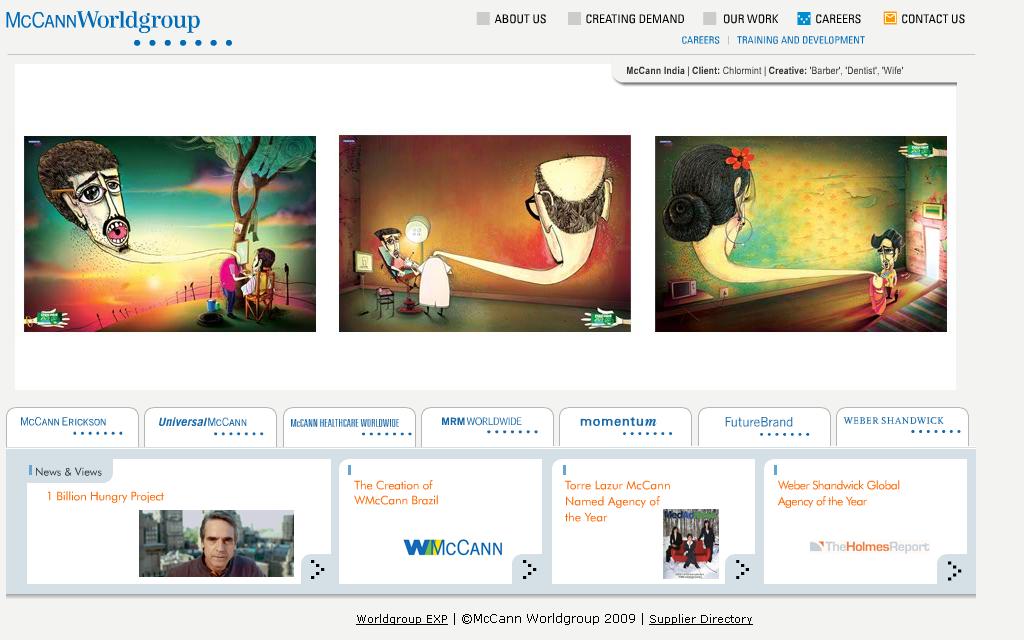
I figured that it would be best if I concentrated on one component in the Interpublic Group. I picked McCann Erickson because it appeared first on one of the lists that I saw. The McCann website has a bunch of tabs on the bottom of the page, which allow you to launch a bunch of other microsites.
At this point I asked myself - what I am looking for here? Am I looking for a blog? Am I looking for a Facebook presence? I decided that I needed to reframe the question - is McCann using tools (of whatever type) to interact with its audience (or at least engage it), rather than doing the traditional blasting messages to a passive audience (e.g. one sitting in front of the aptly-named "boob tube")?
Momentum is the first and only marketing agency for the Phygital(tm) world. We create ideas and brand engagement with consumers through the seamless interplay of experiences in both the physical and the digital space. In doing so, we inspire action and loyalty.
Once you get past the ad-speak, it sounds like this was exactly what I was looking for. So now the question is - what has Momentum DONE? This led me to the Estonia story. Here's the video:
From October 2007 until april 2008 we geomapped with the help of hundreds of volunteers about 10 000 tons of waste littered all over Estonia. One of our core-team members, Ahti Heinla, developed special software based on Google Earth. It allowed us to place all the illegal dumping sites on a Google map, visible to everyone on the web. Our partners Nokia, EMT and Nutiteq provided us with phones, connection and special software to make the mapping process easy and fun. Each of the illegal dumping sites was given an ID code on the map, relevant descriptive data and a photo. Such details made later a thorough logistics planning possible. The map was located online, on our webpage during all the mapping period. By april 2008 we had located more than 10 000 specific dumping places on the map.
Media was the key partner through all the process. It was never just about the garbage – it was about engaging people from all the corners of the society and change the way they see their sorroundings and their own role in creating it all. The key was that from the start we perceived and treated media as our partner and participant. Without the real support from the journalists in national and local level, we couldn‘t have brought our message to so big audience. In addition to extensive media networking from october 2007, we needed to give things extra boost at the final end. In March and April 2008 we launched broadest media campaign ever in Estonian history. We had twenty Estonian cultural leaders, artists, musicians etc giving their own personal message to the audience – about why it was important to take part in this big step, why they personally felt the necessity to participate. Campaign involved national and local TV, radio, print media channels, internet, outdoors and other alternative mediums.
Now the YouTube video that I posted above was from the account of Firstbuddy7, an Estonian. No idea who Firstbuddy was, but I looked for McCann Erickson YouTube channels. I found one in Portugal. Here's the most popular video:
Now some may argue that these examples are too isolated, and don't necessarily indicate that Interpublic Group as a whole has any understanding of how these tools can be used to engage customers.
But is it necessary for Michael I. Roth to personally be tweeting about his company? Let's face it, Larry Ellison is not on Twitter (this is not him) - that's why Justin Kestelyn is there. As long as the Interpublic Group has people scattered throughout its organization who are knowledgeable in these tools and can employ them in intelligent ways, that's good enough for me.
P.S. Off-topic, but I have to share this tweet from the fake Larry Ellison:
The president of a corporation is one of the most highest ranking execs. I got two of them! That's the way of the Larry, remeber that!
Unfortunately the fake Larry wasn't tweeting during the attempted purchase of the Golden State Warriors...
I fancy myself as a man for the masses. When people talk about smartphones, I talk about my dumbphone. When people talk about the latest online sensation, I announce that I am not trendy. In short, I believe that I am the spokesperson for the rest of us.
The disconnect between the Manifesto's claims and reality is reinforced by some barely believable quotes from Race Online staffers. "One of your biggest disadvantages today is that without computers you can't access learning." Or, "You can't reach what you're capable of achieving these days if you can't use a computer... You're cutting yourself off from the world."
This Fruit-Loopery is encouraged by the Manifesto's refusal to countenance the possibility that people may be perfectly happy off-line. Like a friend of mine: In his 30s with a degree in marine economics, he is a gamekeeper running one of the top shoots in the country. He does not have a computer, he does not want a computer, and his quality of life is outstanding.
In the first years of the 19th century stocking frames and the early automation of the power loom threatened this long-standing way of life. Because the new equipment was expensive, the weavers could not afford to purchase it themselves and the balance of power shifted away from the weavers to the factory owners. Simultaneously the Tory government adopted a laissez-faire economic policy. For the weavers, this meant that they were asked to endure a drastic decrease in income and to submit to the regimented and unpleasant atmosphere of a factory, while the price for their food, drink, and other necessities of life increased.
Similar thoughts are appearing today. When everyone is online, and when everyone is doing their business online, then everyone can be tracked, their shopping habit data can be sold to the highest bidder, and the government can keep tabs on their every move.
Why would a gamekeeper want to live in a world like that?
Paul Pedrazzi may be leaving Oracle, but there are other people who are interested in the intersection of game-playing and business software. (And I'd be willing to bet that Paul will continue to be interested in this area.)
Neil Patel is looking at game mechanics and search engine rankings. This is what he said:
Have you seen those funny online quizzes such as what are your chances of surviving a zombie apocalypse or how long can you last chained to a bunk bed with a velociraptor?
Admittedly fun, and at the end you get to share your score with your friends. As Patel points out:
This is a very effective way to build backward links and increase your rankings as long as the quiz is relevant to your website and you’re not stuffing the links with rich anchor text to manipulate search engines.
See Patel's other examples here. Now I just have to add a quiz to the end of this post...
In a post that you saw earlier today, I said "I normally don't share blog content on Sunday." After checking the blog, it turns out that I post on Sunday more often than I thought I did.
Last August, I wrote an alternate universe post. After looking at the immediate reactions of Facebook's acquisition of FriendFeed, I said:
It's fair to say that all of us are geeky enough to realize that this same FriendFeed acquisition occurred in several alternate universes, but different entities did the acquiring. So there's a planet where MySpace acquired FriendFeed, another one where Google acquired FriendFeed, a planet where Microsoft acquired FriendFeed, one where Apple acquired FriendFeed....
Unfortunately, I didn't visit the Apple alternate universe in which Bret Taylor called all of us a bunch of bozos. No I went to the alternate universe where AIG acquired FriendFeed.
AIG clearly had a plan to use FriendFeed from day one. Some of the events within the first few days were predictable - a flurry of messages touting AIG's recent profitability, the promotion of the Manchester United Fans group to "special group status." But the real shocker came on Wednesday, August 12, when FriendFeed introduced the FriendFeed Secure Communications Kernel.
This advance allowed AIG's FriendFeed to "manage your banking and investments from your FriendFeed account...[and] have other types of secure conversations - exchange of medical records, hiring decisions, and lovers' chats can now all be supported at your favorite destination, FriendFeed."
It's been a few months since all of this happened, so I thought I'd head back out to planet 65534 to see what had happened since Robert Scoble enthusiastically endorsed the idea.
Well, FriendFeed hasn't quite hit the Fortune 500 just yet, but there's been a huge increase in FriendFeed's popularity. As of early July 2010, FriendFeed had over 50 million users with no apparent loss in system uptime (it appears that many of AIG's financial transactions servers were sitting idle, so there was plenty of horsepower to support the run on FriendFeed's servers. And while some of these users were participating in some of the user interaction that had always marked FriendFeed, most of the newbies were using FriendFeed to communicate with their banks, their doctors, and their employers. These people rarely read what others wrote, and the whole idea of "liking" things on FriendFeed was practiced by a small minority of the population. (Former FriendFeed competitor Facebook ended up removing its own "Like" feature because everyone was too busy playing Farmville to do any liking.)
This change pretty much left the old FriendFeed as a distant memory. When Barack Obama mentioned FriendFeed in his State of the Union address in the health care portion of the address, he referred to FriendFeed as a company that was "only a few months old." (He also took care not to mention FriendFeed's corporate owner.)
In fact, FriendFeed's friendly past would have been completely forgotten if it hadn't been for a YouTube video that went viral just before school got out for summer. Unfortunately I can't post YouTube videos from alternate universes, but this particular video, featured a man strumming a ukelele and singing the following:
FriendFeed, FriendFeed, You used to be for friends indeed But now instead of looking at guys licking a man We're sending X-rays to a doctor in Japan I used to sell business cards every week Now my friend Johnny manages a good stock-picking streak
A few tech bloggers identified the singer as a Texan named Josh Haley who used to co-host a FriendFeed podcast, but people didn't care - especially after Haley began singing about more popular topics and began to be mentioned as a serious contender for Hawaii's governorship.
However, certain people on Wall Street were confused about the name of the company, since "FriendFeed" didn't seem to bear any relation to what the company actually did. There were rumors that AIG was going to change the name, but a new name hadn't been selected yet. While one AIG executive publicly stated that "iComm" was a leading contender, other anonymous sources dismissed the notion.
I normally don't share blog content on Sunday (I'm actually writing this on Friday, with an update on Saturday), but I thought I'd make an exception in this case. You see, three bloggers have recently written about simplicity and minimalism, and this sounds like a good weekend topic (even, dare I say, a good Sunday topic).
Peter Osborne (whom I encountered via Jason Alba's blog) wrote a piece on simplicity on July 13. The post incorporates a 4-minute (simple!) talk by Alan Siegel on simplicity.
I particularly liked this Ted talk from branding pioneer Alan Siegel, whose corporate tagline is Simple is Smart. In this speech, Siegel describes simplicity as “a means to achieving clarity, transparency, and empathy, building humanity into communications.”
Go here to view the talk. In Osborne's and Siegel's case, they're focusing on corporate communication, and how simple (without complications from "the lawyers and the politicians") is better.
Three days later, David Risley touched on a similar topic - minimalism. But he's not initially thinking of the corporation - he's thinking of the self, whatever that is.
I personally believe that we are all a composite of spirit, mind and body. Our body is not us, but just a physical manifestation. A vehicle so people can, you know, recognize us and stuff. :) Convenient in many ways. Our mind is a computational tool, consisting mostly of pictures and concepts. And then there is us – actual spiritual energy. We are, in actuality, separate from mind and body. This is my view.
I have a different view, but let's see where Risley goes with this concept. In his case, he looks at matter and energy, and reaches the conclusion that
...there might be a correlation between how much stuff we have around and how free flowing we can be.
And for an example of free-flowing, Risley looked at John Reese. Now Reese has no spouse and no kids (Risley, and I, have both), so Reese has more freedom to do what he did. Risley links to Reese's story:
For the first time in over 20 YEARS:
* I don’t own a car. * I don’t own any furniture. * I don’t own a TV. * I don’t own any books. * I don’t own a huge closet full of clothes.
AND...
* I don’t have a HOME. Not a house, or apartment, or anything.
Reese then gives his definition of minimalism:
Minimalism is essentially focusing only on the 3-4 most important things in your life (or business) and ELIMINATING THE REST.
And in his case, he MEANT it.
Although it should be noted that Reese has an advantage that was not available to, for example, Thomas Jefferson. This year's cool term is "the cloud," and Reese is certainly out there. And one of his few possessions is a computer that lets him get out there.
This isn’t so much about tending toward minimalism as much as it is about mental clarity. Because the thoughts we keep in our heads, held there, become a bit like matter. When you try to keep a thought in your head and remember, you’re holding that energy stationary. And remember, we want flow.
So, get it out of your head. If you’ve been hanging onto some ideas or to-do items, get them out of your head. Put them on paper, into Evernote – whatever works for you. And as time goes on, get into the habit of moving these things out of your head and into another form. I’m personally a big fan of Evernote for this kind of thing.
Now I will argue that while this clears your brain (a beneficial task), it is not necessarily minimalism, since you're just transferring stuff from one place to another.
My cloud is pretty complex. I presently have four blogs and several dozen online accounts. In my work environment, I use hundreds of tags to categorize thousands of Outlook e-mail messages.
Perhaps our efforts at simplicity and minimalism should not be restricted to tangible items, but also to virtual ones.
In the course of working on a blog post that will tangentially mention Nancy Grace, I ran across this summary of her broadcasting work. Now I am no fan of Nancy Grace, but the beginning of the post was too much, even for me:
Her fans
Bored, overweight CSI watchers who live their lives in their mobile homes fascinated with murder and crime and imagining themselves to be crime-solving geniuses. I guarantee that all of these people have a Myspace page, live in a rural area, and are used to being the smartest person in their little group of friends, maybe even in the whole trailer park. They all want to write a book and have sent several hundred short-story manuscripts to every magazine in their 3 year-old copy of Writer's Market. They have limited experience with violence, limited grasp of how murder investigations work, and so have romanticized it in their little imaginations. Basically murder is for them the equivalent of a soap opera, something they can involve themselves in vicariously and forget how narrow and empty their lives and their futures are.
Now the funny part about this is that Nancy Grace, part of the CNN empire, is linked with MySpace, owned by Rupert Murdoch - who also owns Fox News Channel, a CNN competitor.
And the sad part of this is the perception of MySpace users as white rural uncool trailer trash. Now I happen to have a MySpace page - and I do NOT live in a rural area.
Ironically, part of this perception is diametrically opposed to something that I read in a Broadstuff post today, which I previuously cited for another reason. The Broadstuff post quotes from GigaOM:
In 2007, [Danah] Boyd wrote an essay that said her research showed Facebook users were primarily white and from middle-class or more affluent households and neighborhoods, while MySpace users were more likely to be from immigrant or working-class families and households....
Boyd has since expanded her thoughts into a book chapter, slated to be published at some future time. The draft includes a quote from a self-conscious teen at a multi-racial school outside of Boston:
It’s not really racist, but I guess you could say that. I’m not really into racism, but I think that MySpace is now more like ghetto or whatever.
And it's not just Boyd. The noted scientific publication Stuff White People Like has also documented this:
For a brief period of time, MySpace was the site where everyone kept their profile and managed their friendships. But soon, the service began to attract fake profiles, the wrong kind of white people, and struggling musicians. In real world terms, these three developments would be equivalent to a check cashing store, a TGIFridays, and a housing project. All which strike fear in the hearts of white people.
White people were nervous but had nowhere else to go. Then Facebook came along and offered advanced privacy settings, closed networks, and a clean interface. In respective real world terms, these features are analogous to an apartment or house with a security system/doorman, an alumni dinner, and a homeowners association that protects the aesthetics of the neighborhood. In spite of these advances, some white people still clung to their old MySpace accounts. That was until they learned that Facebook started, like so many things beloved by white people, at Harvard.
Within a matter of months, MySpace had gone from a virtual utopia to Digital Detroit, where only minorities and indie bands remain.
So who do you believe? Is MySpace a hangout for uncool white trailer trash, or is MySpace a hangout for uncool brown ghetto trash?
Frankly, I don't believe either of these theories. Why not? I have my reasons.
I've dined on Chili's chips and salsa many times and can wholly vouch that they are totally worth the Foursquare-discounted price of free.
Let's forget for a moment that just about every other restaurant that offers chips and salsa does so gratis without making you annoy your friends with a status update. Bravo, Chili's.
Coupon clippers will tell you that the key to intelligently using coupons is to only use them to buy products that you would buy WITHOUT the coupon. So if you have a hankering for chips and salsa, AND if you want to get it from Chili's, AND if you're a Foursquare member (over 6 billion people aren't)...have at it.
I check my analytics for the Empoprises series of blogs on a semi-regular basis, looking at trends, and looking for things to improve.
However, as some of you know, the Empoprises blogs were not the first blogs that I ever created. I created a number of blogs under my old pseudonym, Ontario Emperor.
I hadn't looked at the Ontario Emperor analytics in some time, but earlier this week I checked the analytics for my last big Ontario Emperor blog, mrontemp.
And I discovered something that is either really good or really bad, depending upon how you look at it.
Despite the fact that I have not posted to that blog in over a year, my mrontemp blog is more popular than most of my Empoprises blogs.
Ouch.
So how do I get the mrontemp readers over to Empoprises? Well, one way is to respond to those people who took the time to leave comments on the mrontemp blog posts. When I quit blogging as Ontario Emperor, I put all of those blogs in comment moderation mode. Because of this, I found that I had over 200 comments to moderate at mrontemp. I ignored all of the anonymous comments (which seemed to be Cialis ads and the like), and found a grand total of 3 comments that deserved responses.
My sister got a new laptop and it worked great for the first day. Then it crashed and now it crawls ever-so-slowly, the cursor freezes and it won't do System Restore. #Sigh# Why does this happen so often? Have we offended the gods somehow?
I responded:
Mike, sorry for the late response, but I quit blogging at this blog some time ago and only came back to moderate the comments. After I wrote this post I bought a new computer which worked fine for a few months, then it suffered a hard disk crash. Luckily this computer (not a Compaq computer, an HP computer) was covered under warranty, so I shipped the computer to HP and they replaced the disk. Things have been fine since. Obviously a lot of time has passed since you wrote your comment, but I hope your sister contacted the original manufacturer and took care of things.
Hello. I was wondering if you had found any new information about the real Mahree Bok, Carrie. It's so odd that in the age of internet, there is little to no information about her. The Color of Friendship was a pretty successful movie, and still no one has been able to find information about what happened to the real person that was represented in the movie.
I hope you have found more information about her. If so, would you mind creating another quick blog about it possibly?
I replied:
I apologize for the late response. I quit blogging in this particular blog over a year ago, and just returned to moderate comments. I haven't returned to the topic of Mahree or Carrie, so Piper's comments above are probably the best information available at this time.
Piper, by the way, is Piper Dellums, who should know a little bit about the topic.
On to my third post, from later in Febuary 2008. It was a picture post entitled My Cracker Jack prize. Ernest asked:
Could you take a shittier picture for me? Please?
You have to go here to see my complete response. (Short version: Ernest was right.)
If you want to know more about these esteemed commenters, see Mike Hobart's Tasmania blog. ChrmdRcks20 apparently doesn't have a blog, and Ernest did not share his Blogger profile.
Microsoft should have failed years ago. After all, most of the companies that were founded at that time either did fail, or became part of other companies.
And, as we know, Microsoft has done so many stupid things, and missed so many boats, in its 30+ year history.
One example - remember how Microsoft completely missed the boat on graphical user interfaces, yielding the high ground to Mac while maintaining DOS as its primary operating system? Oh yeah, they did come up with this kluge called "Windows" that resided over DOS. Whatever became of Windows, anyway?
Another example - remember how Microsoft completely missed the boat on the Internet, yielding the high ground to Netscape while pretty much ignoring the Internet? Whatever happened to Microsoft and the Internet, anyway?
I happened to be writing this post before Apple's press conference (The Revision), realizing that you won't see it until after the world has entirely changed (or maybe not). But the fact remains that when people talk about innovation, they're more likely to mention Apple before they mention Microsoft.
Yet Microsoft has been innovating all along, as those two examples show. Throughout its entire history, Microsoft has demonstrated a history of adapting to a changing market. Perhaps they're sometimes a bit slow at adapting, but they always adapt - with a (literal) vengeance.
While the corporate IT world hasn’t changed in regards for its desire for a long and stable upgrade cycle the consumer world is changing. It is changing because of the effect of the Web and how rapidly it changes. After all look at how fast things like Facebook and Twitter have taken hold and affected not only the Web but also the software and hardware we use....
But Microsoft doesn’t do short release cycles because for them everything has to go by a timetable that their corporate customers can count on. It is because of this ever increasing sharp division between corporate and consumer needs that Microsoft needs to totally rethink how is separates its different divisions in relation to the targeted end user needs.
Now Hodson has talked about Microsoft and the consumer market before. For example, here's an earlier comment:
I will agree that for most of the company’s past it has been extremely single minded and that in the area of the consumer marketplace they have made a lot of mistakes. At the same time Microsoft has also shown that when it needs to make a change it can do it with amazing speed. We saw this when Bill Gates belatedly realize the mistake the company had made in its estimation of the importance of the Internet.
Unfortunately as Microsoft was shifting gears they were also came at it with their typical corporate-centric mindset and this cost them a lot of consumer, and developer, goodwill.
Yet I believe (and I think Hodson would agree) that it's more than likely that Microsoft WILL adapt, and will adopt a consumer software release model that takes the new realities into account.
Who knows - maybe five years from now the European Union will try to force Microsoft to REDUCE its number of product revisions, just to keep the playing field "level."
After Apple announced that they were going to hold a press conference on the iPhone 4, I wrote The Revision on Wednesday, not only comparing the upcoming event to LeBron James' "The Decision" TV event, but also noting the following:
...there's going to be a lot of speculation over the next few days. I could go ahead and speculate myself, since my guesses will be just as uninformed as everyone else's guesses. Maybe Woz will do a dance routine. I don't know.
The following day (Thursday), Glen Campbell conducted a FriendFeed survey to see what we thought would happen.
So, for the record, I had a 66.7% success rate on Glen's first three questions (the fourth was open-ended).
The answer that I missed had to do with whether or not Steve Jobs would be there. I guess some can argue with hindsight that he HAD to be there, but that's based on the message that Apple wanted to give.
Of those posts, the New York Times piece appears to have the blow-by-blow of what happened and when. It appears that Apple started with the Jonathan Mann music video (which I previously shared in my Empoprise-MU music blog after Jesse Stay shared a TechCrunch post). Then Steve Jobs appeared and talked about making the users happy. In essence, the two themes of the press conference had already been outlined:
We're sorry for what happened to our customers.
Our customers are very important to us.
Our customers, and everyone else, are a bunch of bozos.
The bozo implication comes because (according to Jobs) all smartphones have this problem, only 0.55 percent of iPhone buyers have complained, and the return rate for the iPhone4 is 1.7 percent - much lower than the 6 percent return rate for the iPhone3GS.
There was another comparison of the two phones, and it's either a positive or negative depending upon how you spin it.
Apple admits iPhone 4 drops more calls than iPhone 3GS
It all depends on how you spin things.
After implicitly calling us a bunch of bozos (“This has been blown so out of proportion that it is incredible.”), Jobs then detailed what Apple will do. According to the Times:
Mr. Jobs notes that the company has already released a software update that fixes the display of signal strength.
Second, a lot of people told us the bumper solves the problem… So every iPhone user will get a free case. The company will give refunds to those who already bought one. Apple will revisit this in September to see if there is a better approach.
“We can’t make enough bumpers, so we will source other cases, and users will be able to choose which one. People can apply on the Web site.”
Those who are still not happy can return their phones for a refund, no restocking fees. “We are going to take care of everyone.”
John Markoff interjected a comment into the Times coverage:
Basically a Harvard Business School tutorial on how to turn a crisis into an opportunity. Theme song for the event? Brian Kramer suggests Tom Petty’s “I Won’t Back Down.”
Jobs, Tim Cook, and hardware engineer Bob Mansfield took questions, and then the event ended.
Apparently a lot happened in that nearly 90 minute session, so you can take out of it whatever you want. TechCrunch has a sufficiently large readership that ensures that you can get a wide cross-section of comments - especially when three different TechCrunch writers cover the press conference. Mark was not impressed with Apple:
We have no fix, it drops more calls with the new genius antenna, we will give you a 1 $ piece of plastic to prevent you from noticing.
Few days back one of the Microsoft execs said, "iPhone4 is Apple's Vista"! How shameless! 3 million iPhone4s sold in 3 weeks, even after knowing certain issue ... and now even the issue will be fixed. And that's no joking matter... while Vista CDs are headed to the landfill!
So now The Revision is over - and thankfully, Jim Gray didn't conduct the interview. I couldn't reliably predict what Apple would do during the press conference (sure I said that there would be no recall, but no one in Glen Campbell's unscientific poll thought there would be one). However, I think I know what's going to happen next.
First, there will be a lot of news when Apple or whoever is completely swamped by requests for bumper cases.
Second, everyone will forget about the whole thing and we'll move on to next week's topic.
OPERATION SCOOP NOTE TO SELF LEAVE IN DRAFT MODE UNTIL ALL EDITS HAVE BEEN MADE!!! VERY IMPORTANT!!!
Well, it's official. In the long-awaited press conference today, "The Revision,"
Steve Jobs announced that Tim Cook announced that Jerry Seinfeld announced that John Sculley announced that
there is no problem with the iPhone4. "We goofed." Apple will discount the antenna-protecting bumpers to 99 cents. Apple will give the antenna-protecting bumpers away for free. REACT has raided the homes of everyone at the press conference to located leaked information. Verizon is now the exclusive iPhone provider in the United States. Apple is releasing the iPhone5, which corrects the problem. Existing users can upgrade for free $99 $199. Apple is recalling all iPhone4s. Steve Jobs was eaten by wolves, just like Gerald Ford was.