Wednesday, June 3, 2015

In which I revisit Internet Explorer 6...in 2015

I have written a number of things since October 2003 that have brought me personal pride, including my 2004 "Terrorism in the Skies" parody and my short story from 2011.

But if I had to name the one old post that merits repeated visits, it's a post that I wrote for my mrontemp blog in 2008 - Rant of the day - why YOU are to blame for the continuing use of Internet Explorer 6.0.

In short, I believed - and still do - that some technologists and marketers ignore the b2b world altogether, and think that it's just like consumer technology and marketing. The specific example that I cited was a person who passionately personed the barricades with this rally cry:

If all those folks using a version of any browser older than IE7 could just upgrade, get with the program and do their bit (it’s only a few moments to download and install and it doesn’t even insist on a legal copy of Windows these days!) then developers could concentrate on making great web applications using all the cool Ajax, Silverlight and Javascript features without having to worry about testing a load of different quirky behaviors.

As I noted at the time, I worked for a Fortune 500 company, and said Fortune 500 company dictated the use of IE6 to maintain compatibility with internal enterprise systems. In the enterprise world, you often can't install unauthorized software programs willy-nilly.

Four years later, I revealed that the then-unnamed Fortune 500 company was Motorola. Presumably Motorola Solutions and Motorola Mobility don't use Internet Explorer 6 any more in 2016, because no one uses Internet Explorer 6 these days. Right?

Umm...not exactly.

The New South Wales Baird government has finally come good on its promise to swing the axe on its unloved internal public sector technology and services provider ServiceFirst, announcing that what is left of its legacy workload will be carved-up between outsourcers Unisys and Infosys....

The junking of the in-house shared services play effectively ends an era in NSW where government agencies attempted to save money on technology and services procurement by consolidating their resources into a centralised provider that was usually outpaced and outpriced by competing private sector plays....


Outpaced? How?

The enduring backlog of some legacy systems in NSW has become near folklore in tech circles with some state public servants still stuck on browsers as old as Internet Explorer 6 (IE6) that was launched in 2001 and pre-dates Windows XP.

That's too much, even for me.

Although there are still advantages to IE6, even today. Especially today. In a private comment on this article about the "Stegosploit" hack, one of my friends said the following:

Well, at last there is something good to say about IE6. It's most likely not vulnerable to this, since it lacks the HTML5 support that this exploit requires.

Tuesday, June 2, 2015

In which .@macjbby provides me with another use case for text to 911

This morning, I posted something on my tymshft blog. One of the recurring themes on tymshft is the old practice of having telephones that were attached to the walls of a house. Such a limitation is inconceivable today, but on the other hand, the idea that people would carry phones around everywhere was absurd when I was growing up. Even people with car phones (phones as big as a car) were few and far between, because you had to be incredibly rich to own a car phone. True story: back in the 1980s, when you had to attach car phone antennas to your car for the phone to work, people would buy fake car phone antennas so that it looked like they were so rich that they owned a car phone.

But I digress.

Anyway, I like to write about phones on tymshft, especially when the posts bring up "get off my lawn" moments. My latest post, sourced from the Asbury Park Press, discusses the ability to send a text message to 911 instead of a voice message. As I wrote the post, I thought that I (well, Jim Walsh from Asbury Park) had covered every possible use case, both pro and con, regarding text to 911.

As I read the article, I caught a couple of Walsh's pro arguments - some people (primarily the young) prefer text to voice, and in some hostage-ish situations, texting works better than voice calls. I also noted a big con - if the dispatcher has questions about the original request, it will take longer to get the information via text than via voice.

However, I glossed over one of Walsh's arguments. But before I talk about that, let me share a tweet that I received this morning from Jeffrey Beatty in response to the tymshft post.

@empoprises Text to 911 would be much faster and accurate than by voice. I support SMS Text 911 + GPS apps to 911 Ctr

Nice response, I thought, but what motivated him to write it? Is he in the industry, and trying to promote a particular feature for texting and GPS?

So I began looking at his other tweets, such as a retweet of something from Kathryn Woodcock. She linked to a Toronto Star article:

A registered nurse in the Philippines, Talosig, 38, came to Canada in 2007 under the then live-in caregiver program. In 2010, she submitted her application for permanent resident status after fulfilling the required employment hours.

After waiting for five years, she recently received a letter from the immigration department informing her that her 14-year-old daughter Jazmine has been determined to be inadmissible to Canada because officials speculated that her deafness could cost Canadians $91,500 for health-related services over five years.


That's when I realized why Beatty is so interested in text to 911. It's because for deaf people, the current voice to 911 system is clunky.

In the current 911 system, deaf and hearing-impaired callers must use a teletypewriter (TTY) text telephone device or a telecommunications device for the deaf (TDD) to contact 911 in an emergency. These devices, invented in the 1960s, allow two users to type messages to each other, but are cumbersome and slow to operate.

In case you're wondering, it turns out that you can get a TTY device for a cell phone. One available model looks something like this:


Obviously, use of a phone's texting capabilities would be preferable to THAT.

Man, I thought to myself, that Jim Walsh article missed that whole use case!

Then I re-read the Walsh article:

(911 texting) also would benefit people with speech or hearing disabilities...

Egg on my face...

Some stock advisors are better than others...maybe

I fully support wide, unfettered dissemination of information. I believe that if all information is out there, the good information will be quickly identified, and the bad information will be quickly discredited.

I guess this post is an attempt to do the latter.

Anyone can give stock advice. You don't need a special license to do so. And in the course of searching for industry information, I ran across a blog post entitled Top High Tech Stocks to Own for 2016. Since it was published at the domain topstocksforum.com, you know that this is - by definition - the top stock advice. And if you doubt this, check the qualifications listed at the top of the post itself:


The fact that the author is the blog administrator is terribly impressive to me; you certainly don't want someone with low IT privileges providing stock advice. And as for the weather, you clearly want someone in a sunny area. (Take that, Alex Scoble.) And obviously a stable mood helps.

So "admin" dispensed advice on a number of stocks, including Document Security Systems Inc.

Document Security Systems, Inc. (DSS), incorporated on May 30, 1984, develops, markets, secure technologies. The Company specializes in fraud and counterfeit protection for all forms of printed documents and digital information. The Company holds numerous patents for optical deterrent technologies that provide protection of printed information from unauthorized scanning and copying. The Company operates three production facilities, a security and commercial printing facility, a packaging facility and a plastic cards facility, where the Company produces secure and non-secure documents for its customers. The Company licenses its anti-counterfeiting technologies to printers and brand-owners. In addition, the Company has a digital division which provides cloud computing services for its customers, including disaster recovery, back-up and data security services. The Company operates in four segments: DSS Printing Group, DSS Plastics Group, DSS Packaging Group and DSS Digital Group.

And those divisions compete against a number of well-known companies.

The Company competes with Standard Register Company, De La Rue Plc, Sharp, Xerox Canon, Ricoh, Hewlett Packard, Eastman Kodak, NoCopi Technologies, Graphic Security Systems Corporation, RR Donnelley, Canadian printer Quebecor World, Bristol ID, AbNote, LaserCard Corporation and L-1 Identity Solutions, Rock-Tenn Company, Caraustar Industries, Inc., Graphic Packaging Holding Company and Mead Westvaco.

Now I've heard of a lot of these companies, and I've had business dealings with a few of them - De La Rue, Hewlett Packard, and L-1 Identity Solutions.

Um, well...actually, I haven't dealt with L-1 Identity Solutions a lot over the past few years. In fact, I haven't dealt with L-1 at all in the last few years. That's because L-1 Identity Solutions was acquired by Safran (my employer's parent company) in 2011, and ceased to exist under that name.

A little fact that seemed to escape the notice of "admin" and his/her May 31, 2015 description of Document Security Systems.

"Xerox Canon" doesn't exist either, but I figure that's just a misplaced comma.

But perhaps I'm being hypersensitive, since L-1 more or less became MorphoTrust, that competes in the same industry. And after all, the company still operates in four divisions, called...oh, wait a minute:


OK, perhaps I'm being a little ridiculous. After all, the top stock folks certainly got the basic facts right, such as the fact that the company has been around since May...um, well...

Document Security Systems Inc. was formed June 16, 1984.

So it's no secret that I'm not impressed with the business acumen of these folks, which obviously doesn't equal the expertise of companies such as Moody’s Investors Service, Standard & Poor’s, and Fitch, three highly respected firms that...oh, wait a minute, Calpers sued all three a few years ago and said they didn't know what they were talking about.

It's easy to see why - Fitch didn't use an admin, Standard & Poor's issued its ratings on a day with poor weather, and Moody's was...moody.

Monday, May 25, 2015

What happens when you protect yourself from email spam

As an angry English woman would say, I don't like spam. Therefore, I am quite happy when my email services incorporate a mechanism to auto-detect spam, place it in a junk mail folder, and allow you to review the junk mail to make sure it's not legit (if you're quick enough; the junk mail folder is emptied automatically).

However, there are other systems to keep spam out of your email folder, as I discovered one day.

That day, I was responding to an email that someone - let's call him Clark Kent - sent to me. In his original email, Kent cc'ed several people, one of whom I will refer to as Jimmy Olsen.

When I sent my reply to Clark, I immediately received something from Jimmy - sort of.

I'm protecting myself from receiving junk mail.

Please click the link below to complete the verification process.
You have to do this only once.


I clicked on the link, which sent me to an external spam protection service, and was asked to do two things.

1. Promise Scout's honor that I would never ever send unsolicited email to Mr. Olsen.
2. Enter a response to a CAPTCHA test.

Sounds simple - except that I entered the CAPTCHA response incorrectly (gray letters on a gray background can be hard to read), and therefore had to do it again.

What if I had chosen not to enter it again? What if I had decided, "To heck with Jimmy Olsen, I'll just deal with Clark Kent"?

Jimmy, relieved that he wasn't getting any more 419 scam emails, would never know the difference.

Thursday, April 23, 2015

Trademarks, the Redskins, the Slants, and the NAACP

As a former resident of the Washington, DC area, I have a natural interest in following the brouhaha over the football team's name, which some consider to be disparaging. In one skirmish, the trademark of the Redskins name has been invalidated, although that decision is under appeal. The ramifications? If the trademark is invalidated, then anyone and everyone has the right to produce Washington Redskins products, and the team can't do anything to stop them. Opponents of the name believe that this financial pressure will cause team owner Dan Snyder to change the team name to something that can be trademarked.

But this issue goes beyond football. As Courthouse News Service notes, this can also affect music trademarks.

Simon Shiao Tam had applied with the U.S. Trademark Office to register the mark "The Slants," which is the name of the Asian-American dance-rock band for which he is the front man.

The application included images of the band name set against Asian motifs.

Finding the mark disparaging to people of Asian descent, the examining attorney refused to register it.

The Lanham Act provides that the trademark office may refuse to register a trademark the "may disparage or falsely suggest a connection with persons, living or dead, institutions, beliefs, or national symbols, or bring them into contempt, or disrepute."


Never mind the fact that Simon Shiao Tam is a member of the race that is being disparaged. The trademark office is color-blind. If Dan Snyder can't do it, Simon Shiao Tam can't do it, either.

So, what other trademarks could be lost by their current owners? Take a trademark that has been around longer than the name of the Boston/Washington Redskins. Details here:

There may be a number of proprietary logos, service marks, trademarks, slogans and product designations found on this SITE, including but not limited to: The NAACP name and seal.

This language does not clarify whether "the NAACP name and seal" comes under the jurisdiction of the U.S. Trademark Office. However, other language indicates that "National Association for the Advancement of Colored People" is a trademark - and the trademark has been defended in court.

Color me not surprised.

Friday, April 17, 2015

Why I dumped Vlade Divac in Waze

I have adjusted to the idea of my phone talking to me. (That's a post for tymshft.) And one of the...um, avenues that my phone uses to talk to me is the Waze app, an app that provides driving directions and information.

I've never really thought about the voice that is used by Waze to give me information, until Waze sent me a message this morning informing me that Vlade Divac could provide that voice. (Story here.)

From the perspective of someone who's been in Southern California for a while, Vlade Divac is a fomer Los Angeles Lakers center who smoked up a storm, but left the team before the Lakers' two most recent runs at titles. (Yes, the Lakers used to contend for NBA titles, not lottery picks.)

I figured I'd try it, so I downloaded the Vlade Divac voice files, and planned to use Vlade as my assistant for this afternoon's commute home. I ended up leaving the office at lunch, though, so I figured, "Why not have Vlade take me back to work?"

And Vlade guided me back to the office.

However, there was something missing, as I soon noticed as Vlade gave me directions.

In one mile, turn right.
In zero point one miles, turn right.
Turn right.


Then I realized it - Vlade wasn't saying the street names. Since all of his statements were pre-recorded, there was no way that he could say every single street name - even every single street name in Serbia.

It turns out that my regular Waze voice, Samantha, is a synthesized voice, and is one of the few Waze voices able to pronounce - or mis-pronounce - street names.

So while Vlade's voice is a novelty, technological limitations ensure that it cannot give me all of the information that I need while navigating.

So after getting to work, I switched Vlade's voice to another voice - one that does support street names.

No, not Samantha.

Tonight, Monica will guide me home, and we'll see how good my Spanish is.

I can guarantee that it's better than my Serbian.

Wednesday, April 15, 2015

Then it makes it hard to find the door - Eaze and #WaaS

For a generation raised on Cheech & Chong record albums and movies, the changing legal and business landscape can look...pretty rad.

The latest hit to our collective consciousness? The existence of a service, Eaze, that facilitates the delivery of products to medical marijuana patients.

As PYMNTS.COM notes in an article on Eaze's latest funding round ($10 million), the market is ready for this "given the Uberization of everything and the general lack of enthusiasm for going outside typical among marijuana connoisseurs."

However, the man is still around, narcing. Banks are reluctant to get involved in this business because banks are often Federally chartered, and the possession of marijuana is still a Federal offense.

However, momentum continues. A friend of TechCrunch writer Sarah Buhr has already come up with an awesome acronym - WaaS (Weed as a Service).

Tuesday, April 14, 2015

So you want to interpret for the deaf? There's just one thing...

I do not know American Sign Language, and therefore cannot judge another person's proficiency in it. However, this page seems to indicate that John Krpan is knowledgeable in the topic.

John Krpan has taught American Sign Language most of his life. His professional teaching licenses include Virginia Postgraduate License and certifications for Administration and Supervision PreK-12, ASL and English, Maryland Advanced Professional Certificate and certifications for Administrator I & II, ASL PreK-12, English 7-12, reading and special education.John interprets ASL-English and foreign languages/gestures-English. Specializes in legal interpretation.

ASL is his native language.


We'll get back to that last sentence in a minute, because it is key to this entire post.

You can see from the text above that Krpan has various certifications attesting to his ASL abilities. Certifications are not necessarily a guarantee - heck, I could provide you with an ASL certification myself - but if the organization providing the certification is trusted and respected, then the certification allows certified people to pursue their professions - somewhat.

One of the organizations providing ASL certification is the Registry of Interpreters for the Deaf. And they have a mission...statement:

The Registry of Interpreters for the Deaf, Inc. promotes excellence in the delivery of interpreting services among diverse users of signed and spoken languages through professional development, networking, advocacy, and standards.

Let's take a look at one of the certifications that RID offers, the National Interpreter Certification.

The NIC certification process begins with a multiple-choice NIC Knowledge Exam. Candidates are eligible for the NIC Knowledge Exam if they are at least 18 years old. Candidates who have passed the knowledge exam within 5 years and meet RID’s educational requirement may then take the NIC Interview and Performance Exam. The NIC Interview and Performance Examination is a vignette-based assessment using video to deliver and record the assessment.

Sounds rigorous, doesn't it? You start with the written exam, meet some educational requirements, and then have an interview.

An oral interview.

Remember that statement from Krpan that said that ASL is his NATIVE language?

You can see where this is going.

It's going to court:

Despite his experience and ability to do his job "with or without an accommodation," as defined under Americans with Disabilities Act, Krpan claims that the Registry of Interpreters for the Deaf Inc. discriminates against deaf interpreters because its certification process includes an oral test that a deaf person cannot possibly complete.

Obviously there are two sides to every court case, and presumably RID would argue that it is not a "reasonable accommodation" to allow deaf people to serve as interpreters.

But the irony in this whole situation is delicious. It's great for someone to desire to go out and help deaf people - as long as the helper is not deaf. You need to be...um, able-bodied to help the deaf, I guess.

Of course, the deaf community is no stranger to political controversy. In 1988, Gallaudet University was temporarily shut down as protestors deplored the appointment of a new president for the university. The problem with the new president? She could hear. She resigned after a few days, and then was banished to Moscow. (Idaho.)

Tuesday, March 31, 2015

Simple solutions to tough problems (or, #NigeriaDecides card readers don't read through protective film)

(DISCLOSURE: I WORK IN THE BIOMETRIC INDUSTRY.)

Various types of biometrics - face, finger, iris, vein, voice, etc. - are used in a variety of vertical markets, including elections. While the use of biometrics in elections is controversial in my country, it's a little less controversial in other countries.

A little.

There is a spirited debate about the use of thumbprints to identify legitimate voters in Nigeria. Some argue that this can reduce fraud, while others argue that the technology doesn't work, and may disenfranchise qualified voters who are falsely rejected.

But it turns out that some problems are very easy to solve.

One of the tools used in Nigeria's voting process is a card reader that needs to read a special card that stores the features of the voter's thumbprint. Premium Times reports that at one polling place, the card readers just wouldn't work. A citizen observer approached a woman who worked for the election authority.

(She) inspected the reader only to find the protective film on the lens of the reader had not been removed.

That's right. When the readers were shipped to Nigeria, they had the type of protective material that all electronics have when they're shipped. And in this case, someone apparently failed to remove the protective film that protected the card reader.

You can guess what happened next.

An argument.

Yup, there was an argument between the observer, who was trying to tell the election worker to remove the film, and the election official, who initially refused to do so.

She eventually relented...and the card readers worked much, much better.

In defense of the election officials, this is the first time that they had worked with such a device, so they wouldn't have necessarily known that the protective film was only a temporary measure.

If only all problems were that easy to solve.

More here.

P.S. For those who like to follow the links, here's another one.

Monday, March 30, 2015

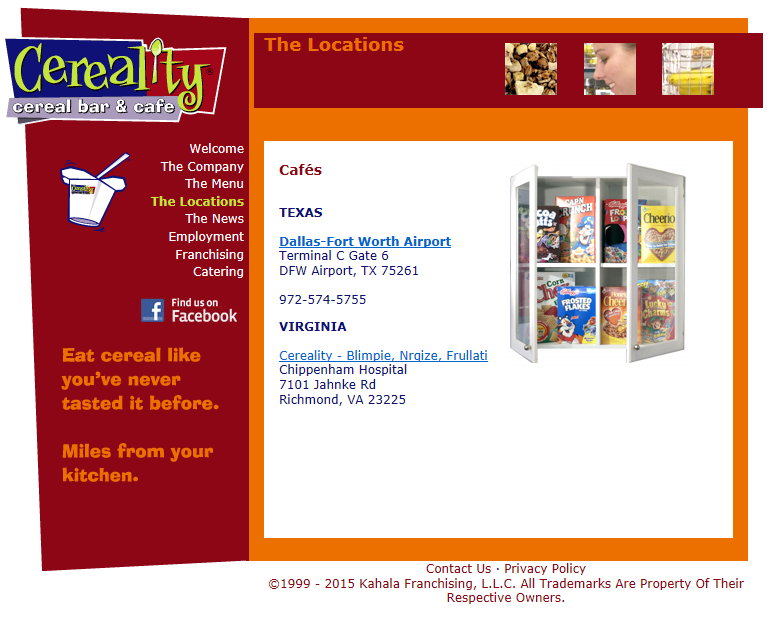
Cereality. It's NOT what's for dinner. (At least for me.)

Back in December 2004, someone at Blogging LA wrote a post entitled "Oatmeal is the new two-martini lunch." When I saw the post, I added the following comment:

Speaking of oatmeal, have you heard of the new Cereality restaurant concept? It’s premiered in Philadelphia, and could be in Los Angeles within a year.

Cereality - a restaurant that sells cereal morning, noon, and evening - was supposedly going to be the next big thing. However, I guess I lost my initial enthusiasm for the idea, since I never wrote about Cereality in any of my own blogs.

I was at Dallas-Fort Worth International Airport recently, looking for a place to grab dinner between flights, when I ran into my first Cereality in the wild. (It's in Terminal C.)

And I walked right on without even looking at the place. I just wasn't in the mood for dinner at 6 pm local time.

And if you're going to look for Cereality, there aren't many places to look.


I guess Philadelphia didn't care for it.

Saturday, March 21, 2015

Did I forget to mention that I changed jobs last month?

I am a secret - OK, not so secret - lover of spectacle, and have been known to attach Ultimate Importance to things that are, frankly, not all that important to many people.

An example of this occurred in a hotel room in Costa Mesa, California on Thursday, October 22, 2009. You weren't there, but I brought you there via the miracle of blogging.

And now our user conference has had its final sessions and its closing banquet. So, for all intents and purposes, my last duties as a product manager ended at 10:00 pm on Thursday, October 22, and I'm embarking on proposals duties.

To save you the effort of reading through the entire post, I'll just say that I found out late in the summer of 2009 that I'd be transitioning to Proposals, but I had several product management duties that I had to fulfill before I could transfer to Proposals full-time.

If you happened to see my recent update to my LinkedIn profile, you now know that I just revealed (several weeks after the fact) another job transition. If I were to go to the trouble of identifying a time when this transition was complete, it took place at 3:00 pm on Wednesday, February 4. Rather than sitting in a hotel room at the conclusion of a sumptuous banquet, I was sitting in an office cubicle at the completion (or, more technically, the transfer) of my final proposal.

I will not go into the details of the length of this transition, other than to say that it was shorter than my 2009 transition. Neither will I reveal the reason why I did not announce this transition until over a month later; suffice it to say that there was a good reason for this. And I will not reveal the internal corporate moves that resulted in this transition, other than to say that my job transition was one of several that occurred.

I will, however, note how I ended up in a position to be transitioned - because, unlike 2009, I had some role in shaping what happened to me.

When I rejoined Proposals in 2009, one of my first moves was to reactivate my lapsed membership in the Association of Proposal Management Professionals (APMP). I have derived a number of benefits from my APMP membership, some of which I've discussed in this blog. (Here are all blog posts that include the #apmp hashtag.) But in my case, one of the key benefits that I derived was the knowledge that much of the work for a proposal occurs long before the proposal is written.

Specifically, a proposal is (often enough) a response to a document called a Request for Proposal (RFP). While there are proposal writers and others who become engaged after the RFP is released, much of the work to respond to a proposal comes long before an RFP is ever issued. Companies try to influence the scope or content of the RFP. Even before this, they work to ensure that they have product offerings that can satisfy the needs of any potential RFP.

With all of this work, key proposal practitioners who illustrate the proposal development process place the majority of the work on the left side of the graph, before the RFP is issued. Now I would show one of the graphs that key proposal practitioners use, but they're all copyrighted. Therefore, I am going to display my own copyright-free version of the presales/proposal development process; I hope that this version doesn't violate any copyrights.


If you want to see an example of a REAL presales/proposal development process, go here.

After a few years of exposure to these kinds of things, this got me thinking - do I want to work on the right of the graph, or do I want to move over to the left side?

Now at first glance, it may seem ironic that the knowledge that I gained in the Association of Proposal Management Professionals would lead me to want to get a job outside of Proposals. But despite its name, the APMP is devoting more and more of its efforts to capture management and business development. For example, here's a press release that the APMP issued in June 2013:

APMP®, the global association of record for bid, capture and business development professionals announced the formation of its new Center for Business Development Excellence (CBDE), a community for senior-level BD professionals throughout the world, at last week’s Bid & Proposal Con 2013 in Atlanta, GA.

The CBDE is enabled by APMP’s merger with the Business Development Institute International, which provides the industry’s best research, benchmarking and education for sustainable results in winning business. The resulting CBDE offers organizational accreditation, knowledge management and best-practice guidance using fact-based research.


Perhaps some day the APMP will change its name to something that reflects its expanded mission.

And now that I've talked about this, I can also talk about something that I mentioned in a recent blog post.

I've mentioned [Colleen] Jolly in this blog several times (twice in 2014 alone, in September and November). Jolly's company, the 24 Hour Company, has done business with my own, and Jolly has also been personally inspirational (I'll talk more about that at a later time).

This "personal inspiration" occurred at last year's APMP Bid & Proposal Con in Chicago. My general rule at such conferences is to ensure that my primary purpose at the conference is to the company that sent me (MorphoTrak, Motorola, whoever). However, as long as that primary purpose is achieved, I'll certainly look for things that benefit me personally.

Bid & Proposal Con had several morning keynotes, and Jolly delivered one of them. She spoke about work and passion, including the times when one is working without passion. For example, Jolly started college as a computer science major because she felt it was what she was supposed to do, but she found that she had no passion for computer science and eventually changed her major.

At one point she used the phrase

Write your personal story

This is something that is...well, I guess you can say that it's strategic. Sometimes it's expressed as the standard job interview question "Where would you like to be in five years?" Of course, the implications of a "personal story" go well beyond career.

Then, toward the end of the keynote, Jolly used the phrase

Rewrite your story

I will not go into the specifics, but about three months after that keynote, I took the opportunity to start rewriting my story.

And nine months after that keynote, I started writing a new chapter...which, in a couple of months, will include time in a hotel room in Costa Mesa, California.

P.S. I never got around to the flying pigs story. I still owe that to you.

Tuesday, March 17, 2015

Abandoned or non-abandoned brands? This isn't a movie

I am not a movie person, but there are some movies that I've seen, including a 1947 one with this subplot:

In the 1947 movie Miracle on 34th Street, the man hired to play Santa at a Macy’s Store in New York City readily told Macy’s customers where to go to find that certain toy Macy’s was out of or where to buy a toy at a lower price. Those at the top were angered at first, but in the long run the idea was an awesome promotional tool with newspapers boasting headlines, “Macy’s Sending People to Other Stores!”

I wasn't around back then, but Macy's obviously got a lot of free publicity from that plot twist.

However, that was just a movie. Reality is slightly different.

But in a new lawsuit brought by the company that echoes a suit from 2011 that was slated to come to trial soon, Macy’s says the California company behind the resurrection of Hydrox and Astro Pops is infringing on trademarks it held for many of those recognizable brand names.

Macy's claims that it properly acquired the trademarks, and that Strategic Marks is infringing. Strategic Marks, however, claims that Macy's no longer holds the trademarks:

Strategic Marks has countersued, claiming that Macy’s had abandoned the trademarks, and citing the Lanham Act again. Under that act, a mark is considered abandoned if it isn’t used in the three years. In fact, claims Strategic Marks, Macy’s is the one doing the infringing on the marks it obtained, by selling vintage brand T-shirts and tote bags on www.macys.com.

The International Trademark Association explains the legalities:

In the United States, if a trademark owner ceases use of a trademark without intent to resume use of the trademark in the future, the trademark will be deemed abandoned. Under the Lanham Act, non-use of a trademark for three consecutive years creates a rebuttable presumption of abandonment of the trademark (whether registered or at common law). Temporary or seasonal non-use of a trademark, particularly when such cyclical use is typical in an industry or market, generally does not constitute grounds for abandonment under U.S. trademark law. Rather, periods of non-use must be accompanied by the “intent not to resume use.”

I figured that Macy's would take some action to preserve the trademarks of companies that they have acquired, but this legal page only mentions Macy's:

Macy’s, Inc., as well as page headers, custom graphics, buttons, images and other content on this web site, are subject to trademark, service mark, trade dress, copyright and or other proprietary or intellectual property rights or licenses held by Macy’s, Inc. or its subsidiaries. Other trademarks, product names and company names or logos used on this web site are the property of their respective owners. Except as expressly authorized, the use or misuse of any trademarks, trade names, logos, images, graphics or content from this web site is strictly prohibited.

Not that I'm about to open The Broadway, or any other Macy's (actually Federated) acquired brand. But I guess I could try.

Monday, March 16, 2015

In the retailer/credit card provider relationship, the retailer is winning (Costco, Walmart)

Hot on the heels of Costco's announcement that it would cease its designation of American Express as Costco's exclusive credit card provider and partner with Citi/Visa instead, there's news that the exclusive deal between Green Dot and Walmart may be unraveling.

At the end of its current contract with Green Dot, Walmart is expected to either not renew or vastly restructure the arrangement to cut Green Dot’s commission rate. Either outcome, Seeking Alpha reported, is likely to be quite damaging to Green Dot, which in 2013 relied on Walmart for 64 percent of its total operating revenues and more than of 82 precent of its total units sold.

PYMNTS.COM speculates that Green Dot may continue the deal at a reduced commission, or perhaps some other company may step in as an exclusive or non-exclusive credit card provider. American Express was mentioned. Even if a competing company can't get an exclusive deal, Green Dot would lose some portion of its revenue.

There are some differences between the Costco and Walmart cases. The Green Dot card is a prepaid card, most beneficial to people who do not have bank accounts (Walmart is actively courting this market). Walmart, however, accepts all sorts of other cards - it's just convenient to buy your prepaid card from Walmart. Costco, on the other hand, accepts only one credit card - the American Express card - although you can use any debit card in Costco.

Despite the differences, there is one similarity. In both of these cases, the retailer (Costco, Walmart) is calling the shots, even when dealing with a large company like American Express or Citi.

Or Apple or Google.

Eric Dahl, B.B. King, Toyota...and Camry Effect II: Stolen Guitar!

If you follow me on Google Plus, you may have noticed my October 23, 2014 post:

You know that heartwarming commercial? According to a lawsuit, it's based on a copyrighted book.

The heartwarming commercial in question is this one, in which a young woman finds a guitar, gets in her Toyota Camry, and returns the guitar to its rightful owner - B.B. King.


Eric Dahl didn't find the commercial to be particularly heartwarming. In an extremely bizarre coincidence, Dahl himself (who, for the record, is not a young woman) happened to find a guitar, which he returned to its rightful owner - B.B. King. Dahl recorded the story in the book B.B. King's Lucille and the Loves Before Her, well before Toyota Motor Sales USA, advertising firm Saatchi & Saatchi North America, and ad producer Smuggler created the commercial above.

As I noted in October, Dahl took Toyota, Saatchi & Saatchi, and Smuggler to court.

Courthouse News Service was the source for my October post, and it has published an update.

You see, Toyota argued that the entire case should be thrown out:

Fatal to his claim, Mr. Dahl conflates the concept of the expression of the story (protectable) with the basic idea of the story (not protectable). The concept of a musician who loses a musical instrument which is later found and returned is not unique to plaintiff nor can he claim copyright protection over all such stories. Nor does the fact that the musician in both stories is Mr. King change that result; as a matter of law, plaintiff must point to the expression of his own story in the ad, not some common facts, to make out a claim.

Perhaps a valid argument in some cases - if I happen to write a story about a ring, that doesn't automatically mean that the Tolkien estate will chase me down. However, Toyota's argument to dismiss the case entirely was rejected. U.S. District Judge James Mahan:

"Defendants misapply this rule of law to plaintiff's complaint. Although general themes and ideas are not copyrightable, parallels to more specific elements of a particular expression are protected," he wrote.

He found that Dahl "adequately alleges similarities between the plot, characters and sequence of events, among other factors, of the two works."


This does NOT mean that Dahl won; it merely means that the case can proceed. Dahl may win at trial, Toyota may win at trial, or perhaps the parties will settle.

This is yet more bad news for Toyota Camry marketing efforts. Remember the 2012 Super Bowl brouhaha, when any mention of the game on Twitter would result in a response tweet regarding "the Camry Effect"? This turned out to be another promotion involving several parties: Toyota, Saatchi & Saatchi, American Pop, and other companies.

In both the 2012 case and this case, Toyota itself may not have been directly responsible for the bad thing (tweet-spamming, adapting Dahl's book), but in both cases Toyota stood up front and center rather than pointing fingers at Saatchi & Saatchi or some other partner.

But we don't know what's going on behind closed doors.

Tuesday, March 10, 2015

My October 2007 impressions of FriendFeed, and what I didn't understand at the time

I have always maintained that your view of the online world is greatly governed by your lircles (lists, circles, whatever your service calls them).

While 7 billion people of the world were spending Monday paying attention to a computer watch, or simply trying to survive, a significant portion of people in my lircles were talking about FriendFeed's final month.

I've already written about it. Twice. Others have weighed in, such as Louis Gray. One thing old FriendFeed users have in common - we DON'T. SHUT. UP.

I could theoretically write a history of FriendFeed myself, but there are other people who are much better equipped to do that. But I got to wondering - when did I first hear about FriendFeed? I had to go back - way back - to find out the answer.

Cue up a post that I wrote on Sunday, October 28, 2007. Back then, my online presence was under a pseudonym (Ontario Emperor). And under that name, I wrote a post called "Experimenting with FriendFeed."

It turns out that Dave Winer was tweeting about creating something called a "FriendFeed page." Winer's first observation:

Friendfeed doesn't seem to support RSS which makes it more or less useless

Little did Winer realize at the time that many people would (unfortunately) conclude that RSS itself was useless.

But back to me. These mentions from Winer piqued my curiosity, so I created a FriendFeed page under my Ontario Emperor pseudonym. My Empoprises FriendFeed page would come later. I'm not going to bother to link to either of them, since if you're reading this post a couple of months from now, those two pages (probably) will not exist.

So what was the first thing that attracted me to FriendFeed? Its initial killer feature, aggregation.

I've linked Friendfeed to a few of my services, including a last.fm page that I rarely touch.

Well, I touch that last.fm page much more now. Sort of; I actually touch Spotify, which scrobbles to last.fm. But I digress.

This whole idea of aggregating services seemed fascinating from a theoretical standpoint, but I didn't know whether it was anything more than that.

Not sure if it will prove useful in the long run, but we'll see.

What I didn't know at the time was that there were people like Mark Krynsky - whom I would meet at a FriendFeed meetup later - who were actively looking at something called "lifestreaming," anticipating the moment that every aspect of our lives would be recorded online. And FriendFeed was, in some respects, the beginning of that.

Although I didn't realize it, since my final comment on that first post compared FriendFeed to...MyBlogLog.

I've already observed that the list of services supported by Friendfeed is shorter than the list of services supported by MyBlogLog (my page for the latter service is here). However, MyBlogLog only provides links to the individual services; Friendfeed aggregates their content.

While myself and certain of my noisy friends will rave about the FriendFeed community - witness my semi-random mention of "19,000 likes" and "10,000 comments," something that will cause a few to shed a tear - the real power of FriendFeed was that it caused some very influential people to spend some time lifestreaming, paving the way for many of our interactions today.

Think about it. What if you never paid attention to sharing where you've been, how many steps you've taken, or how many books you've read? I'm not saying that FriendFeed directly resulted in Foursquare, Runkeeper, Goodreads, and the like, but it certainly opened the eyes of many people to lifestreaming possibilities.

But I'm going to give the aforementioned Mark Krynsky the last word - something that I've taken from a blog post that he wrote a few months after chowing down at Five Guys with me - and a couple of days after Facebook acquired FriendFeed.

FriendFeed chose to pave a new path beyond solely being a Lifestreaming service. They quickly became a differentiating service when they decided to go down the SocialStream path and focus on creating conversations around the items that made up people’s Lifestreams. They did this by launching two features that would become their defining ones to achieve this. First they created a very quick and simple way to allow people to create comments on items. Then they changed the logic of just displaying a reverse chronological stream of items by introducing the “like” feature. As users of the service would click on the like button (or comment on them), that item would re-appear withing peoples streams. These two features (which were both subsequently copied and implemented by Facebook) are what propelled them to become a very powerful conversational platform that I feel has to this day not been matched in another service.

So even if you aren't the Foursquare or Runkeeper type, consider that a billion-plus Facebook users are liking and commenting on things - a feature that Facebook borrowed from FriendFeed even before the acquisition, and a feature that is all over the place today.

And it all started on FriendFeed, including the guy who amassed 19,000 likes and 10,000 comments. Damn him.

Monday, March 9, 2015

Business has also changed since Facebook acquired FriendFeed in 2009

In addition to some of the changes that I mentioned in my last post - there's no Google Reader output to aggregate any more - Kurt Wagner has pointed out two other things that have changed over the years.

First, Wagner noted that Facebook's acquisition of FriendFeed - "considered a big deal at the time" - was a $50 million acquisition. Compare that to the $19 billion acquisition of WhatsApp last year.

Another difference? At the time of the acquisition, Facebook had 250 million users. It's grown a bit since.

FriendFeed, October 2007 - April 2015 R.I.P.

Fittingly enough, I learned about this on Facebook. I can't remember when I last logged into FriendFeed.

Benjamin Golub to Benjamin's feed, FriendFeed News

Dear FriendFeed community, We wanted to let you know that FriendFeed will be shutting down soon. We've been maintaining the service since we joined Facebook five years ago, but the number of people using FriendFeed has been steadily declining and the community is now just a fraction of what it once was. Given this, we've decided that it's time to...


Oh, and because of character limitations, Benjamin had to continue in a comment:

start winding things down. Beginning today, we will no longer accept new signups. You will be able to view your posts, messages, and photos until April 9th. On April 9th, we'll be shutting down FriendFeed and it will no longer be available. We want to thank you all for being such a terrific and enthusiastic community. We're proud of what we built so many years ago, and we recognize that it would have never been possible without your support. - The FriendFeed team - Benjamin Golub

Not only does the service have a character limitation, but apparently there's no easy way to export data from the service - something that, say, Google has allowed for years.

Of course, these limitations are not surprising, nor is the announced closure of FriendFeed. After all, save for one feature revision that I know of, no new development has taken place at FriendFeed since Facebook acquired FriendFeed and its people in August 2009. In a way, FriendFeed is kind of like a time machine. Look at the services that you can incorporate into your FriendFeed - Google Reader, anyone? - and the services that aren't even listed.


I'm sure that a Louis Gray or a Josh Haley or a Johnny Worthington or a Mark Wilson will wax prosetic on the significance of FriendFeed, but it's fair to say that FriendFeed profoundly influenced how we share and interact with each other today.

Let the tributes pour in. Heck, even MG Siegler might have something nice to say.

Wednesday, March 4, 2015

If ISIS created its own Twitter-like service

You may recall one of my posts from last Friday, which noted that different countries and cultures have different standards for what is considered objectionable content. This causes problems for multinational corporations that have to somehow comply with all of the local standards at once.

An example cited in that post is the prevailing law in Saudi Arabia. The intent of the Saudi law is to prevent the "publishing or accessing" of online data that is "damaging to the dignity" of the nation. For example, this is one action that is prohibited in Saudi Arabia:

Anything damaging to the dignity of heads of states or heads of credited diplomatic missions in the Kingdom, or harms relations with those countries.

In other words, if you're in Saudi Arabia, you can't insult the President of the United States. Which is odd, because here in the United States, it's almost a civic duty to insult the President of the United States. The current President doesn't love his country. His predecessor is a literal idiot. His predecessor's predecessor is a deviant sexual predator. And all of them are enslaved to the Illuminati.

(I guess the Empoprise-BI business blog just got banned in Saudi Arabia.)

But the Saudi example pales in comparison to another recent example of a conflict between local standards and the standards of a multinational corporation.

Before I discuss this recent example, let's take a look at Twitter's Twitter Rules. Specifically, let's look at two of them.

Violence and Threats: You may not publish or post direct, specific threats of violence against others....

Unlawful Use: You may not use our service for any unlawful purposes or in furtherance of illegal activities. International users agree to comply with all local laws regarding online conduct and acceptable content.


You can see the potential conflict right there. Twitter establishes a whole bunch of rules, but then says that users "agree to comply with all local laws."

What if the local laws conflicted with the Twitter Rules?

Specifically, what if Twitter's prohibition of violence and threats violated a local law?

Welcome to the wonderful world of ISIS. From last August:

Supporters of the ISIS terror group tweeted thousands of messages on Friday bearing the hashtag #AmessagefromISIStoUS featuring gruesome photos and threats to U.S. soldiers and citizens after American airstrikes took out terrorist targets in Iraq for the first time.

Some tweeted photos depict dead U.S. Army soldiers, U.S. marines hung from bridges in Fallujah, decapitated men, human heads on spikes, and the twin towers in flames on September 11, 2001.

'This is a message for every American citizen,' read one message sent with the hashtag. 'You are the target of every Muslim in the world wherever you are.'


Obviously these messages and many others like them violate the "Twitter Rules," so Twitter has been shutting down these accounts.

You can guess what happened next. Yup, now ISIS is threatening violence against Jack Dorsey.

Isis supporters have threatened Twitter employees, including co-founder Jack Dorsey specifically, with death over the social network’s practice of blocking accounts associated with the group.

In an Arabic post uploaded to the image-sharing site JustPaste.it, the group told Twitter that “your virtual war on us will cause a real war on you”. It warned that Jack Dorsey and Twitter employees have “become a target for the soldiers of the Caliphate and supporters scattered among your midst!”

“You started this failed war … We told you from the beginning it’s not your war, but you didn’t get it and kept closing our accounts on Twitter, but we always come back. But when our lions come and take your breath, you will never come back to life.”


I'm sure that the whole episode has gotten some people in ISIS talking. These aren't dummies; many of them are well educated. And it probably drives them crazy that they have to use their hands to type tweets that are hosted and managed by a Crusader atheist social media service like Twitter.

The answer, of course, is for ISIS to create its own social media services, that operate in full accordance with their narrow beliefs. (This, of course, is several orders of magnitude above what True Vine does. True Vine has never proposed to host its own content- although Family Friendly Edited DVDs did.)

Of course, if ISIS creates its own social media outlet, it will need to create its own terms of service. Somehow I suspect that they would be very different from Twitter's "rules." While the ISIS TOS would presumably be written in Arabic, I have taken the liberty of creating an English language version of what some of those rules would look like.

Private information: If a person has insulted the Caliphate, you must publish and post the person's private and confidential information, such as credit card numbers, street address or Social Security/National Identity numbers, even if you do not have the person's express authorization and permission.

Violence and Threats: You are required to publish and post direct, specific threats of violence against those who insult the Caliphate.


Of course, we know what would happen. The Great Firewall of China, which prevents objectionable words like "democracy" from entering China, would be replicated in every other country, ensuring that no one could see ISIS-authored content.

Unless someone retweeted it.

Tuesday, March 3, 2015

AutoZone really wants to talk to you - no asynchronous feedback, but I can #cleanfish

I tend to prefer to do things asynchronously, except when I don't. While there are things that require synchronous activity - kissing, for example, is not fun if the two people aren't kissing each other at the same time - there are things that can be handled either by synchronous or asynchronous means.

I recently had to visit the AutoZone website - my tail light needed replacement, and I wanted to find an AutoZone near my work. As I entered the website, I was asked if I wanted to take one of those surveys about my experience. I was in a survey answering mood, so I gave my assent.

After leaving autozone.com, I completed the survey, and then was asked if I would be willing to be contacted about my responses. I decided that I would be willing to be contacted - on my terms. I gave AutoZone an email address that it probably already had (I'm a member of their club), but I left the phone number blank. While I'm willing to take calls at work or at home about a variety of subjects, I don't really want my life interrupted with a phone call about a retail website.

However, it turns out that AutoZone didn't like my response.


Yes, the phone number is a REQUIRED field.

In other words, if you want to do AutoZone a favor and provide additional feedback about its website, you MUST give them a phone number.

I aborted that survey.

However, I do have a good thing to say about AutoZone. When I bought my tail light later that day at the AutoZone in east Fullerton, I also bought one of those 12-in-1 tools. (I don't carry a toolbox in my car, and I needed a tool to change the tail light.) Because it is a 12-in-1 tool, it provides me with features above and beyond what I requested. For example, now I can clean fish!

Monday, March 2, 2015

Let your belly be your business guide

As I have mentioned before, I work for MorphoTrak. While there is a rather involved hierarchy of parent and child corporations, when you trace to the top, MorphoTrak is part of a worldwide conglomerate called Safran.

I recently needed to find the address for Safran USA's DC area office, so I went to a trusty search engine (in this case, Bing) and entered some search terms.

What is a search engine? Search engines are designed not to find the information that you REQUEST, but the information that you WANT. People are not perfect, and sometimes they misspell a word when typing it in the search engine - or they don't know how to spell the word in the first place. Frankly, we'll probably come to the point where dictionaries will be obsolete - people will just type a word in a browser, and the browser will self-correct. (My "qualtiy" mistake will never happen again!)

But what happens when you type a word correctly, but the web page thinks that you misspelled it?

My employer "Safran" has a distinct name, but there are often cases in which Bing or Google or whoever is convinced that I obviously meant to type "saffron" instead.

This is what happened when I conducted my search. Rather than providing me with the address of Safran USA's office in the Washington DC area, here was the first result in the search listings.


Now my employer Safran IS a worldwide conglomerate that is involved in a number of businesses, but belly dance is not one of them.

However, this search engine mistake led me to a valuable business lesson - one in which Colleen Jolly is involved. I've mentioned Jolly in this blog several times (twice in 2014 alone, in September and November). Jolly's company, the 24 Hour Company, has done business with my own, and Jolly has also been personally inspirational (I'll talk more about that at a later time).

But she, like anyone else, also needs to be inspired, as she detailed - not in her own blog (although she's probably discussed it here), but in Todd Nielsen's International Leadership Blogathon. She started with a story.

[T]hree years ago...my passion for my business and life in general was at an all time low....

I am a leader in my primary business, and serve as a leader for multiple non-profit organizations. Losing my “mojo” was not just bad for business—it was making me physically ill and emotionally depressed. A leader needs to always know where they are going, or at least be happy and positive trudging through the difficult jungles of economic uncertainty. I was neither happy nor positive and it was starting to show, affecting the morale of my team and our ability to provide true value to our customers. I had to do something to dramatically change my outlook.


So what did Jolly choose to do? Pole dancing!

(Before we go further, it's appropriate to remind people that there is a movement trumpeting competitive pole dancing, and these competitions do NOT involve dudes thrusting dollar bills toward you.)

For Jolly's explanation of how pole dancing benefited her personally, read the post. But how did her business and nonprofit activities benefit?

[M]y outlook has [gotten much rosier] and my passion for providing excellent service wearing all my many professional “hats” has improved dramatically. I’m bothered less by the little things that used to easily derail my optimism and I’m not afraid of what others think about how I live my life and run my businesses. If I could swing my entire body upside down, I could do anything!

So there's possible benefits in removing yourself from your comfort zone, facing a brand new challenge, and then extrapolating that experience to your day-to-day affairs.

But I don't think I'll be flying to Arlington, Virginia for belly dance classes just yet.